Commercial storefront glass must do more than create a clear view into a business. It may need to protect customers, meet safety-glazing rules, reduce heat transfer, control solar gain, resist forced entry, and maintain comfortable indoor temperatures. Choosing glass only by appearance can create performance problems later.
The difficulty is that tempered, laminated, insulated, and Low-E glass do not describe the same type of feature. Some terms describe how glass breaks, while others describe how a glazing assembly controls heat. Treating them as interchangeable can lead to the wrong specification, higher HVAC loads, or unnecessary project costs.
The right choice depends on the storefront location, climate, security requirement, building code, frame system, and energy target. In many commercial projects, the answer is not one glass type. A storefront may combine tempered or laminated safety glass with an insulated glass unit and a Low-E coating.
Tempered vs Laminated vs Insulated vs Low-E: Quick Comparison
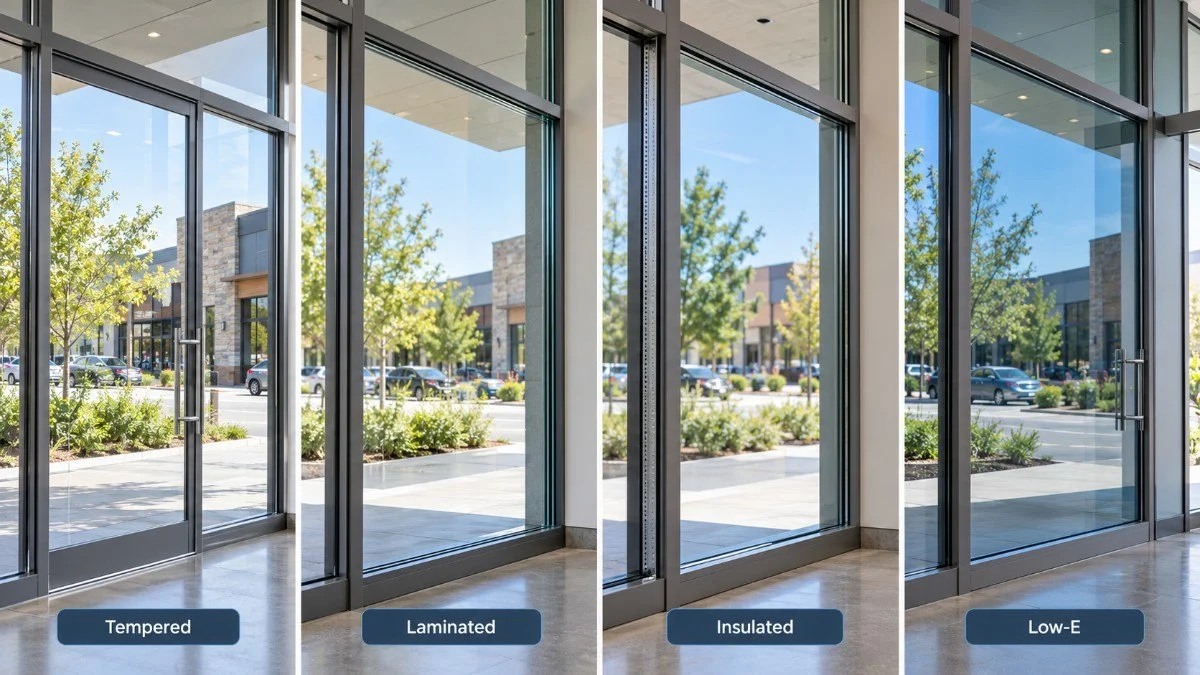
One important distinction simplifies commercial glass selection: tempered and laminated describe safety or breakage performance, IGU describes an assembly, and Low-E describes a coating.
That means these options can often be combined rather than selected as four mutually exclusive products. This is especially important when specifying complete commercial storefront systems instead of purchasing glass separately from the frame.
| Glass option | What it actually is | Main purpose | Typical storefront use | Break behavior |
| Tempered glass | Heat-treated safety glass | Safety and strength | Doors, sidelites, entrance glazing | Breaks into small fragments |
| Laminated glass | Two or more glass plies bonded by an interlayer | Safety, retention, security, acoustics | Security-sensitive glazing, overhead or retention applications | Cracked pieces remain bonded |
| Insulated glass unit (IGU) | Two or more panes separated by a sealed cavity | Thermal insulation | Conditioned commercial storefronts | Depends on the glass used in each lite |
| Low-E glass | Glass with a low-emissivity coating | Solar and thermal control | Energy-efficient exterior glazing | Depends on the base glass |
Tempered glass is approximately four times stronger than annealed glass of the same thickness and configuration. When broken, it forms relatively small pieces rather than large sharp shards. Guardian Glass
What Is Tempered Storefront Glass?

Tempered glass is produced by heating prepared glass and rapidly cooling it. This creates compressive stress at the surfaces, increasing resistance to mechanical and thermal loads. Cutting, drilling, holes, notches, and most edge processing therefore need to be completed before tempering.
Its main advantage is safety after breakage. Instead of producing large sharp pieces like ordinary annealed glass, fully tempered glazing breaks into many smaller fragments. This makes tempered glass widely used around commercial entrances and other areas where people may contact the glazing.
Where Is Tempered Glass Commonly Used?
Tempered glass is particularly relevant for storefront doors, entrance panels, sidelites, and glazing classified as a hazardous location by applicable building codes. U.S. safety-glazing requirements include requirements for glazing used in doors, while building codes also identify several door-adjacent locations as hazardous.
Tempering does not, however, turn a single pane into energy-efficient glazing. A monolithic tempered lite can satisfy a safety requirement while still transferring considerably more heat than a properly designed Low-E insulating glass unit.
What Is Laminated Storefront Glass?

Laminated glass consists of two or more glass plies bonded with an interlayer. PVB is a common interlayer material, although different systems are available according to security, structural, acoustic, impact, and other project requirements.
When laminated glass breaks, fragments tend to remain attached to the interlayer instead of immediately leaving the opening. This retention characteristic makes laminated glazing useful where maintaining a barrier after initial breakage is important.
Is Laminated Glass Better for Storefront Security?
Laminated glass can provide greater post-breakage retention than monolithic tempered glass. However, laminated does not automatically mean forced-entry, hurricane, blast, or bullet resistant.
Those performance levels depend on the complete tested makeup, including glass thickness, interlayer type and thickness, framing, anchorage, and applicable test standard. ASTM C1172 covers laminated architectural flat glass used for applications that can include safety, security, hurricane resistance, sound reduction, and other functions.
| Requirement | Tempered | Laminated |
| Safety glazing | Commonly suitable when properly certified | Can qualify when properly tested |
| Holds together after breakage | No | Yes |
| Forced-entry potential | Limited by itself | Configurable for higher resistance |
| Acoustic improvement | Limited | Can be improved with suitable interlayers |
| Post-breakage opening retention | Low | Higher |
| Can form part of an IGU | Yes | Yes |
This explains why laminated and tempered glass should not always be treated as competing choices. A project can use heat-treated glass within a laminated assembly when the required design and certification support that configuration.
What Is Insulated Storefront Glass?

An insulated glass unit, or IGU, usually consists of two or more glass lites separated by a spacer and sealed around the perimeter. The cavity may contain air or an insulating gas such as argon.
Oridow’s commercial storefront specification presents double- or triple-glazed IGUs with argon filling, together with Low-E coatings and safety-glass options. Its diagram also identifies the glass, air space, spacer, desiccant, and perimeter seal that form the insulating unit. screencapture-oridow-commercial…
The sealed cavity reduces heat transfer compared with basic single glazing. IGUs are therefore important when storefronts enclose air-conditioned or heated retail, restaurant, hotel, office, and other occupied spaces.
Does an IGU Automatically Provide Safety Glass?
No. IGU describes construction, not safety classification.
For example, an insulating unit might contain tempered outer and inner lites, laminated glass on one side, or another approved combination. The required makeup depends on the location, load, safety requirement, security objective, and local building code.
For higher-performance projects, the glass should be evaluated together with the energy-efficient storefront system rather than specifying the IGU independently from its aluminum frame.
What Is Low-E Storefront Glass?
Low-E means low emissivity. A microscopically thin coating is applied to the glass to control radiant heat transfer while maintaining useful visible light.
Modern Low-E coatings can reflect selected infrared energy while allowing significant daylight through the glazing. Depending on the coating, they can reduce heat loss, solar heat gain, or both.
Low-E is therefore not a substitute for tempered, laminated, or insulated glass. A common commercial specification may be a tempered Low-E IGU, while another project could require a laminated Low-E IGU.
Single-, Double-, and Triple-Silver Low-E Coatings
Commercial architectural glass is available with different Low-E coating technologies and performance levels. Oridow’s storefront system lists single-, double-, and triple-silver Low-E options as part of its energy-efficient glazing choices. screencapture-oridow-commercial…
Coating selection should be based on project-specific U-factor, solar heat gain coefficient, visible transmittance, climate, orientation, appearance, and energy-code requirements rather than simply choosing the coating with the strongest solar control.
Key Performance Numbers to Check
An effective storefront specification should define measurable performance instead of relying only on terms such as “energy-efficient glass.”
NFRC identifies U-factor, solar heat gain coefficient, and visible transmittance among the major values used to evaluate fenestration energy performance. Lower U-factor indicates lower heat transfer, while lower SHGC indicates greater resistance to solar heat gain.
| Metric | What it tells you | Storefront design question |
| U-factor | Rate of heat transfer | How well does the complete assembly limit heat flow? |
| SHGC | Solar heat entering through glazing | How much solar heat should the facade admit? |
| Visible Transmittance (VT) | Amount of visible daylight transmitted | How much daylight and merchandise visibility are needed? |
| STC | Sound transmission performance | Is traffic or exterior noise a major concern? |
Values should be reviewed for the actual glass makeup and storefront assembly. Center-of-glass performance alone does not describe the thermal performance of the entire window or storefront.
Why the Aluminum Frame Matters as Much as the Glass
A high-performance Low-E IGU installed in a highly conductive frame can still lose heat through the surrounding aluminum. Storefront performance therefore depends on glazing, spacers, seals, frame profiles, thermal barriers, installation, and perimeter connections working together.
Oridow’s storefront design uses a PA66 polyamide thermal break to separate interior and exterior portions of the aluminum profile. The system is intended to reduce thermal bridging and interior condensation risk. screencapture-oridow-commercial…
This assembly-level approach should also extend into production. Dimensional tolerances, seals, corner joints, glazing engagement, hardware preparation, and finish consistency can be managed through a documented window quality checklist.
Which Storefront Glass Type Should You Choose?
The correct specification begins with the required function instead of a product name.
| Project priority | Typical direction to evaluate |
| Customer safety at doors and entrances | Tempered or approved laminated safety glazing |
| Better retention after breakage | Laminated glass |
| Heating and cooling efficiency | IGU, commonly with Low-E |
| Strong solar exposure | Solar-control Low-E IGU |
| Security plus energy performance | Laminated IGU with an appropriate Low-E coating |
| Noise control | Laminated or acoustic laminated glass within a suitable assembly |
These are starting points, not universal specifications. Glass thickness, panel dimensions, design wind pressure, edge support, frame capacity, local codes, and required certifications can change the final construction.
Can Tempered, Laminated, Insulated, and Low-E Be Combined?
Yes. In many modern storefronts, combining these technologies provides better performance than selecting only one.
For example, a commercial facade could use an exterior heat-treated Low-E lite, a sealed insulating cavity, and a laminated interior lite. The exact makeup must be engineered around safety, energy, wind, security, acoustic, fabrication, and certification requirements.
This ability to combine glass technologies is one reason custom storefront production can be valuable. Architects and contractors can specify the required dimensions, glass makeup, aluminum profiles, finishes, entrances, hardware, and performance targets as one coordinated system.
Why Source Custom Commercial Storefront Systems from Oridow?
Oridow combines custom fabrication, commercial storefront manufacturing, quality control, and international project support for architects, builders, contractors, developers, and wholesalers.
- Manufacturing experience since 2008: Production capabilities support custom residential and commercial glazing projects.
- Custom storefront configurations: Specify dimensions, finishes, Low-E glazing, IGUs, safety glass, entrances, and hardware around project drawings.
- Production quality control: Glass, aluminum profiles, fabrication details, seals, hardware, and finished units can be checked before shipment.
- International delivery support: Export projects can include drawings, production coordination, protective international window packaging, and project-specific shipping arrangements.
Ready to Specify Custom Commercial Storefront Glass?

Oridow helps architects, contractors, builders, developers, and wholesalers source custom aluminum storefront systems with tempered, laminated, insulated, and Low-E glazing options.
Whether your project requires safety glazing, laminated security glass, double- or triple-glazed IGUs, solar-control Low-E coatings, thermally broken aluminum frames, custom finishes, shop drawings, or international delivery, Oridow can manufacture the storefront around your project specifications.
Request a free quote to oridow support team and send your drawings, glass performance requirements, dimensions, finishes, quantities, destination, and project schedule to the Oridow team for a project-specific storefront solution.
Frequently Asked Questions About Commercial Storefront Glass
Can storefront glass be cut after it has been tempered?
No. Major cutting, drilling, notching, and edge fabrication must be completed before the tempering process. ASTM C1048 specifically addresses fabrication before heat treatment. Final hardware locations and glass dimensions should therefore be confirmed before production.
Does thicker storefront glass always provide better energy efficiency?
No. Thickness can affect strength and acoustics, but thermal performance depends heavily on the full glazing makeup. An appropriately designed IGU with Low-E coating can provide much better thermal performance than simply increasing the thickness of one monolithic pane.
Can Low-E glass look clear rather than highly reflective?
Yes. Modern Low-E coatings are available with different levels of visible light transmission, exterior reflectance, color, and solar control. Architects should review glass samples or mockups when visual appearance and merchandise color are important.
Can commercial storefront glazing be combined with operable service windows?
Yes. Restaurants, kiosks, hospitality projects, and service counters may combine fixed storefront glazing with separate operable systems. When an opening function is required, comparing gas-strut and bifold designs can help define the most suitable operating style.
Can Low-E IGUs also be used in operable aluminum windows beside a storefront?
Yes. A mixed facade can use fixed storefront glazing alongside operable aluminum windows, provided each unit meets its own structural, water, air, thermal, and safety requirements. The same energy principles also apply to aluminum casement windows.
Are double-pane and double-casement windows the same thing?
No. Double-pane describes a glazing construction with two glass lites, while double casement describes an operating window configuration. A double casement window can itself contain double- or triple-glazed IGUs.
Should storefront glass be selected before the aluminum framing system?
Usually, they should be specified together. Glass thickness and weight affect glazing pockets, setting blocks, frame dimensions, hardware, structural capacity, and installation details. Thermal targets also depend on how the glass, spacer, frame, and thermal break perform as a complete assembly.