Custom windows often travel thousands of miles before reaching a project site. During that journey, they may pass through factories, warehouses, ports, shipping containers, and delivery trucks. Without the right protection, even a well-made window can arrive with scratched frames, chipped glass, damaged corners, or missing hardware.
These problems can quickly affect the entire project. A damaged window may delay installation, leave an opening unfinished, increase replacement costs, and interrupt other construction work. For builders, contractors, architects, developers, and wholesalers, reliable packaging is therefore not an optional extra. It is an important part of product quality.
Professional window packaging for international shipping uses several protective layers, including surface film, foam cushioning, glass supports, moisture barriers, reinforced crates, secure loading, and clear labels.
When each step is planned correctly, custom windows are more likely to arrive safely, remain easy to identify, and be ready for smooth unloading and installation.
What International Window Packaging Must Protect

A custom window is not one simple item. It contains finished frames, glass units, seals, hardware, drainage paths, screens, and project-specific accessories. Each part reacts differently to pressure, vibration, moisture, and handling.
| Shipping risk | Possible damage | Packaging response |
| Repeated vibration | Finish abrasion or loose hardware | Foam separation and firm restraint |
| Forklift or crane impact | Bent frames and crushed corners | Reinforced bases and corner guards |
| Glass movement | Edge chips and cracks | Setting blocks and cushioned separators |
| Container moisture | Corrosion, staining, or wet cartons | Barrier wrapping and desiccants |
| Poor identification | Wrong-room delivery and delays | Package IDs linked to the window schedule |
| Load shifting | Tipping or frame distortion | Blocking, bracing, and rated lashings |
The packaging plan should be agreed before production ends. A complete window schedule quotation checklist gives the factory the sizes, opening types, quantities, glass specifications, room references, and delivery sequence needed to design each package correctly.
Packaging Starts with the Window Specification
Standard-size cartons rarely suit made-to-measure products. Packaging must reflect the frame depth, glass weight, opening style, finish, center of gravity, lifting points, and shipping route. Large fixed units need different support from operable windows with projecting handles or hinges.
This is especially important for wholesale aluminum frame customization, where one container may include many sizes, colors, glazing types, and opening systems. Packaging by item code keeps similar-looking products from being mixed during unloading.
The factory should review unusual shapes, oversized panels, curved frames, coupled units, and doors before confirming the packing method. Buyers comparing aluminium window pricing factors should check whether reinforced crates, pallets, delivery insurance, and unloading support are included or priced separately.
The Six Protective Layers Used for Export Windows

A strong system does not rely on one thick outer box. It uses several layers that control different hazards. Oridow states that its international orders use six-layer safety packaging and can be prepared for sea or air freight.
| Layer | Typical material | Main purpose |
| 1. Surface film | Low-tack protective film | Protects powder coating, anodizing, and uPVC surfaces |
| 2. Soft wrap | EPE foam or similar cushioning | Stops frame-to-frame rubbing |
| 3. Edge protection | Corner guards and rigid edge strips | Spreads local impact forces |
| 4. Glass restraint | Setting blocks, spacers, and padding | Keeps glazing supported and separated |
| 5. Moisture barrier | Plastic wrap, liners, and desiccants | Limits water, dust, and condensation exposure |
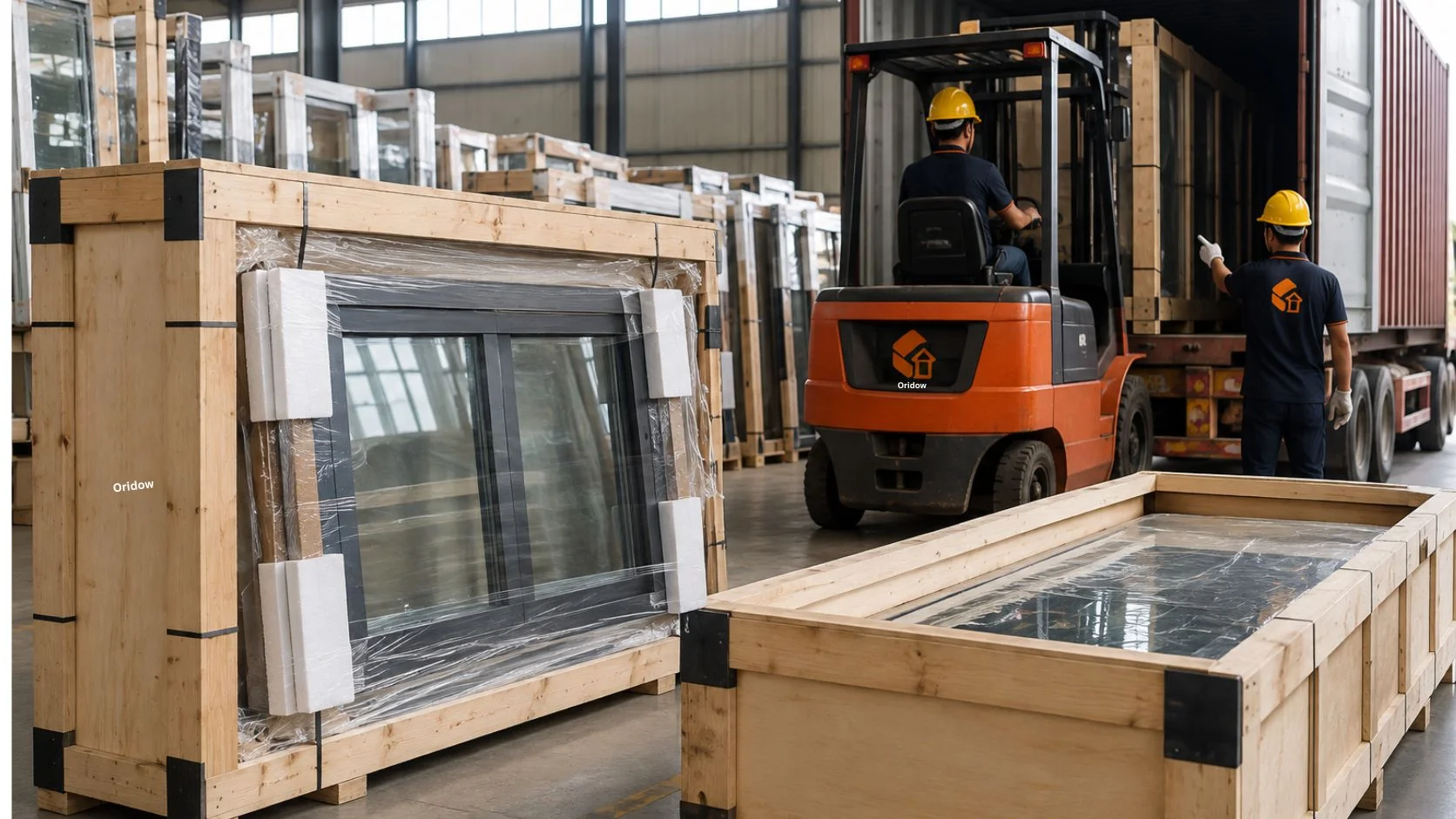
| 6. Outer structure | Plywood crate, rack, skid, or pallet | Carries handling and stacking loads |
Surface and Finish Protection
Protective film should cover visible frame faces without trapping grit beneath it. Soft foam is then placed between adjacent products. This matters for dark powder-coated finishes, anodized aluminum, wood-grain surfaces, and decorative uPVC foils, where light abrasion is easy to notice.
Corners, Edges, and Hardware
Corners receive high impact during lifting and container loading. Rigid guards spread the force before it reaches the frame joint or glass edge. Handles, hinges, restrictors, and multipoint locks may be padded, secured in the closed position, or packed separately.
Operating hardware on double-hung windows needs clearance so balances, locks, and sash edges are not compressed. The same principle applies to the concealed mechanisms described in tilt-turn window security features.
Glass Support and Separation
Glass should be supported at designed setting points rather than resting directly on a crate floor. Soft separators prevent glass-to-glass contact, while rigid stops limit movement. The crate should restrain the frame without twisting it or placing concentrated pressure on glazing edges.
Tempered, laminated, Low-E, and insulated glass units may need different handling. Low-E coatings and spacer seals must remain protected from abrasion, moisture, and sharp packing materials. Large glazed units are usually kept upright because flat transport can create damaging bending stress.
Choosing the Right Outer Package

The best package depends on dimensions, weight, product type, shipping mode, and job-site access. Packaging that is too light risks damage. Packaging that is unnecessarily heavy increases freight, handling, and disposal costs.
| Product or order type | Common outer package | Key design need |
| Small window order | Reinforced carton or compact crate | Full cushioning and easy manual handling |
| Mixed project windows | Numbered plywood crates or racks | Sorting by floor, room, or installation phase |
| Oversized glazed units | Engineered A-frame or enclosed crate | Upright support and controlled lifting |
| Long sliding systems | Reinforced skid or crate | Continuous base support |
| Large doors | Individual reinforced crate | Strong base and protected hardware |
| Loose accessories | Sealed, labeled parts box | Traceability to each opening |
Large custom pivot doors require careful center-of-gravity planning because their size and weight can make a package unstable. Lifting points and forklift entry positions should be marked clearly before the shipment leaves the factory.
When solid wood packaging is used internationally, it may fall under ISPM 15 treatment and marking rules. The IPPC standard covers raw-wood crates, pallets, skids, and dunnage, while processed materials such as plywood are generally excluded.
Moisture Control During Ocean Freight
A standard shipping container is not climate-controlled. Temperature and humidity changes can cause condensation, leading to corrosion, staining, weakened cartons, wet labels, or moisture around unsealed metal edges.
Export packages may use sealed wrapping, water-resistant liners, desiccant bags, absorbent materials, and raised bases. The correct combination depends on the route, season, transit time, container condition, and packaging permeability. Moisture protection should not trap wet materials inside the package.
Before loading, the container should be checked for holes, strong odors, floor damage, standing water, and defective door seals. Dry dunnage and clean packaging materials are essential. Photos should record the empty container, protected products, final loading arrangement, and seal number.
Container Loading, Blocking, and Lashing
Even a strong crate can be damaged if it moves inside the container. Sudden braking, vessel movement, lifting, and road vibration can cause crates to slide, tip, or press against nearby cargo.
A safe loading plan should control both weight and movement. Key requirements include:
- Place heavier crates on stable, reinforced bases.
- Keep glass faces away from direct pressure.
- Fill open gaps with secure blocking materials.
- Attach straps to strong crate members.
- Protect frames, handles, and drainage parts from straps.
- Follow the planned unloading order.
Crates should not rely only on friction to remain stable. Blocking, bracing, and rated lashings must hold each package in position throughout the journey.
The loading sequence should also match the project schedule. Information from the window schedule quotation checklist can help organize crates by floor, room, opening number, or installation phase.
Labels, Manifests, and Installation Control
Clear labels help site teams identify, unload, store, and install each window correctly. Every crate should carry information that remains readable throughout handling and transport.
Important label details include:
- Project name and package number
- Window or door item code
- Product dimensions and quantity
- Gross weight and lifting points
- Correct storage orientation
- Floor, room, or installation area
The crate number should match the packing list, shop drawing, bill of quantities, and window schedule. This reduces sorting errors and helps teams confirm that all products have arrived.
A QR code may provide quick access to inspection photos, hardware lists, drawings, and installation instructions. It should support the printed label rather than replace essential package information.
Specialized products need additional handling details. A crate containing fold-up units can reference the fold-up window installation process so installers can confirm the opening direction, sill layout, accessories, and safe unpacking method.
Pre-Shipment Inspection and Evidence

Packaging should be inspected after the product passes functional and visual quality checks. The inspector should confirm dimensions, glass type, finish, hardware operation, drainage, accessories, label accuracy, cushioning, crate closure, and container placement.
Formal package-development programs may use laboratory distribution testing based on expected vibration, compression, shock, and handling hazards. ASTM D4169 provides a structured method for evaluating shipping units against representative distribution cycles.
Buyers can reduce risk by including these six requirements in the purchase agreement:
- Approved packaging specification for each product group
- Crate dimensions, gross weights, and lifting points
- Packing list matched to item and room codes
- Photos before closure and after container loading
- Damage-reporting and replacement procedure
- Agreed CIF or DDP delivery responsibility
These points belong beside the other key supplier questions asked before ordering. They also help buyers avoid common online window mistakes caused by unclear specifications, hidden logistics costs, or weak after-sales terms.
Shipping Terms and Delivery Responsibility
Under CIF, the seller arranges and pays for freight and insurance to the named destination port, although transport risk normally transfers when the goods are loaded at the port of shipment. The buyer generally handles import clearance and delivery beyond the destination port.
DDP places the highest level of delivery responsibility on the seller. The seller normally handles transportation, export and import formalities, duties, and delivery to the named destination, while unloading depends on the agreed contract and carriage terms.
Oridow offers CIF-to-port and DDP door-to-door options for international orders, subject to the destination and agreed quotation. The company also provides shop drawings before production, performs multi-stage quality control during manufacturing, and uses six-layer packaging for sea or air freight.
Buyers sourcing uPVC products should confirm export experience, packaging capability, glazing support, and document control when choosing Chinese uPVC manufacturers. A clear professional uPVC buying process reduces changes after the crates have already been designed.
Why Source Custom Windows and Doors from Oridow?
Manufacturing Experience Since 2008
Before choosing a supplier for international window projects, it is important to understand their production capability, customization depth, and export support.
A reliable manufacturer should combine long-term experience, flexible engineering, and strict quality control to ensure every shipment meets project specifications and arrives safely.
Fully Custom-Made Solutions
Buyers can customize sizes, colors, glazing, hardware, frame systems, finishes, and opening styles. Oridow manufactures custom aluminum windows to project drawings rather than limiting buyers to standard configurations.
Tested and Quality-Controlled Products
Windows and doors undergo production checks and performance testing before delivery. Packaging is then matched to the product type, glass specification, order size, shipping route, and unloading plan.
Factory-Direct Pricing and Global Support
Oridow supports detailed quotations, material selection, shop drawings, production coordination, and worldwide shipping. CIF and door-to-door DDP options can be discussed according to the destination and project requirements.
Ready to Ship Custom Windows Safely?
Oridow helps builders, contractors, architects, developers, and wholesalers source custom aluminum and uPVC windows and doors directly from an experienced manufacturer in China.
Share your drawings, window schedule, glass requirements, finish, delivery address, and site-access details. The Oridow team can prepare a tailored product quotation, packaging plan, shipping option, and project timeline for safe international delivery.
Request a free quote today to discuss your specifications, packing requirements, and CIF or DDP delivery needs.
Frequently Asked Questions
Should international window shipments be insured?
Yes. Cargo insurance should reflect the product value, freight terms, route, and replacement risk. Confirm what events are covered, who files the claim, required evidence, deductibles, and whether local delivery is included.
What equipment may be needed to unload window crates?
The answer depends on crate weight and size. A forklift, pallet jack, crane, glass lifter, or trained handling team may be required. Confirm access, ground conditions, lifting capacity, and delivery-vehicle limits before dispatch.
Can window crates be reused?
Some plywood crates, steel racks, and skids can be reused if they remain dry, straight, and structurally sound. Reuse should never continue after fasteners loosen, members split, or contamination affects export compliance.
How quickly should shipping damage be reported?
Report visible damage immediately during delivery and note it on the receipt. Photograph the container, crate, labels, seals, damaged area, and internal protection before moving or discarding packaging. Follow the insurer’s and supplier’s notice deadlines.
Should protective film stay on until installation?
Keep it in place during normal site handling, but follow the film manufacturer’s exposure limit. Heat and sunlight can make some films difficult to remove. Never leave damaged or wet film trapping debris against the finish.
Can different window and door types share one container?
Yes, when the loading plan controls weight, movement, protection, and unloading order. Mixed loads need clear manifests, separate accessory boxes, stable crate geometry, and enough space for safe removal.
Is air-freight packaging different from sea-freight packaging?
Often, yes. Air freight may involve stricter weight limits and more frequent handling, while sea freight needs stronger moisture control for longer transit. The package should be engineered for the actual route, not simply labeled “export grade.”
What happens if customs opens a crate?
Customs may inspect cargo. Packages should be designed for controlled opening and secure reclosure. Keep labels, packing lists, fastener guidance, and contact details visible so inspectors can restore protection without mixing components.