
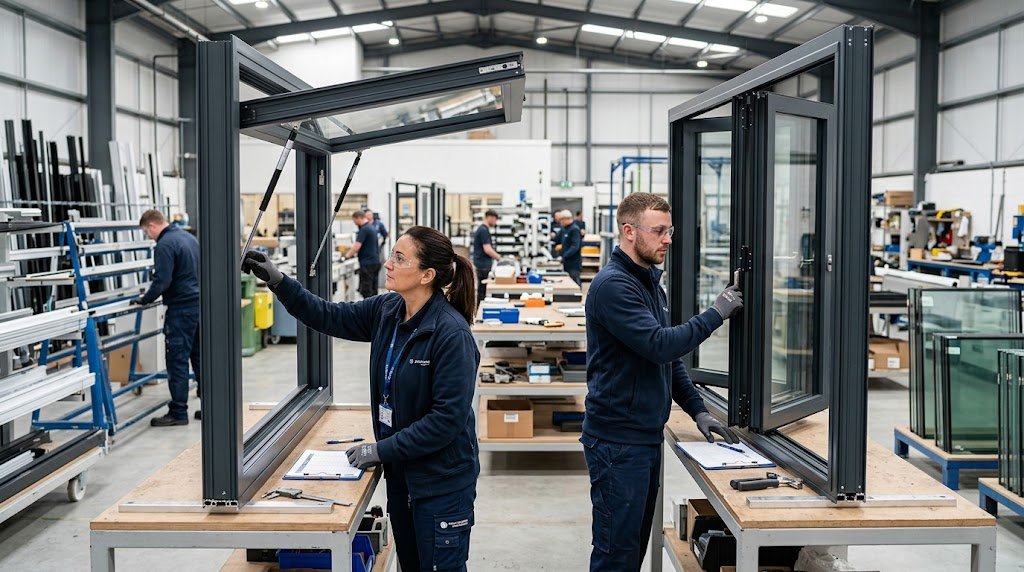
Choosing between a gas strut window and a bifold window can change how well a kitchen, café, patio, or pass-through opening works. Both create a strong indoor-outdoor connection, but they open differently, use different hardware, and place different demands on the surrounding structure.
The problem is that both styles can look equally suitable in product photos. After installation, panel projection, stacking space, wind exposure, sill design, glazing weight, drainage, cleaning, and daily operation affect convenience. Choosing by appearance alone can lead to design compromises or unexpected modification costs.
The better choice depends on opening width, clearance, weather exposure, view, thermal performance, and operating frequency. This guide compares both systems from a practical specification viewpoint so homeowners, builders, architects, developers, and wholesalers can choose the right window for the project.
Gas Strut Window vs Bifold Window: Quick Answer
A gas strut window is usually better for a clean panoramic view and an unobstructed pass-through. A bifold window is usually better for wider openings, staged ventilation, and projects where an outward-lifting sash would conflict with eaves, paths, landscaping, or wind exposure.
| Comparison point | Gas strut window | Bifold window |
| Opening movement | One large sash lifts outward and upward | Multiple hinged panels fold sideways |
| Closed view | Fewer vertical sightlines | More vertical frame lines |
| Open counter | No side stack | Folded panels need parking space |
| Best fit | Medium serveries and pass-throughs | Medium to very wide openings |
| Main hardware | Gas struts, hinges, locks | Rollers, hinges, tracks, locks |
| Main design check | Sash weight, wind, outward clearance | Panel weight, track support, stack location |
For a deeper look at the operating mechanism, learn how gas strut windows work, including gas-assisted lifting, hinge movement, strut support, and how the sash opens and stays in position.
What Is the Main Difference Between Gas Strut and Bifold Windows?
A gas strut window normally uses one glazed sash supported by pressurised gas struts. The sash pivots from the top and rises outward. The struts counterbalance part of the sash weight, helping the user lift the panel and keeping it supported while open.
A bifold window divides the opening into several narrower glazed panels connected by hinges. The panels travel along a track and fold at one or both sides. A detailed guide to how aluminum bifold windows work explains the folding and tracking system.
Which Window Gives a Better View and Pass-Through?
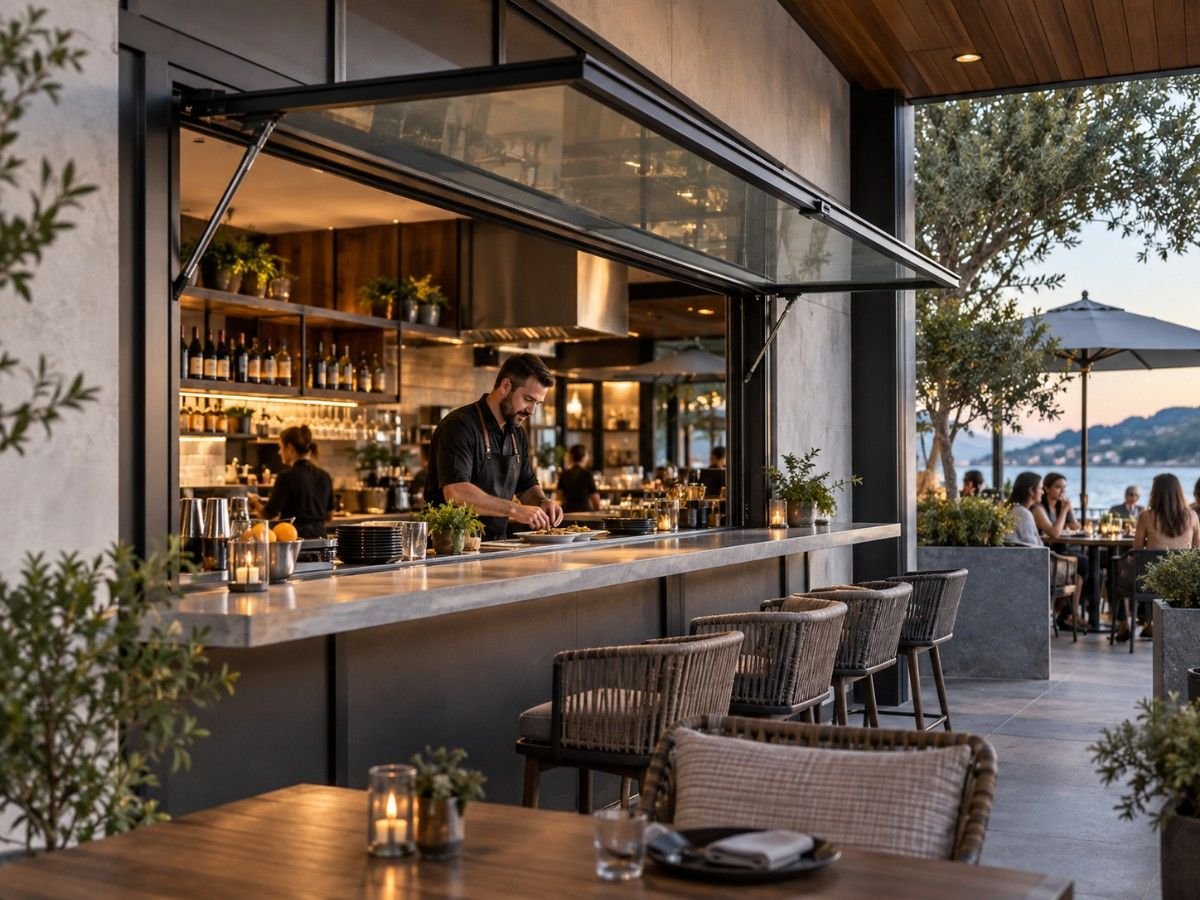
Gas strut windows usually provide a cleaner closed view because one large glazed sash reduces vertical frame lines.
When open, the sash lifts above the serving area. This keeps both sides clear for:
- Plates and drinks
- Countertop service
- Indoor-outdoor communication
- Unobstructed movement
Bifold windows can also create a wide clear opening. However, the folded panels remain stacked at one or both sides.
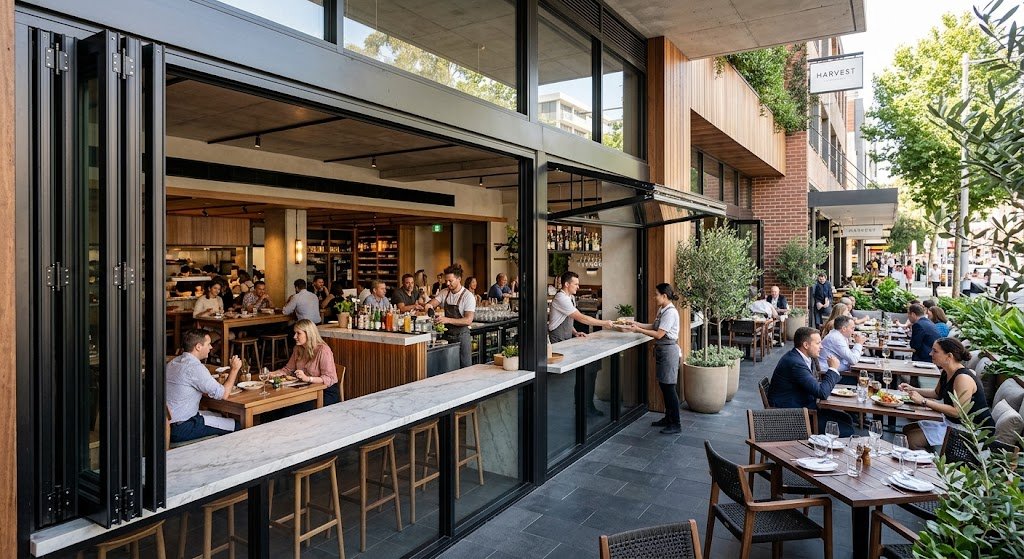
When comparing the two systems, consider:
- How wide the opening needs to be
- Where the panels will sit when open
- Whether side stacking space is available
- Whether the opening will be used for serving or ventilation
Which Is Better for Wide Openings?
Bifold windows generally provide more flexibility for wide openings because the glazed area is divided into multiple leaves. Panel count, folding direction, and stack position can be adjusted around the wall layout and intended use.
Gas strut windows become more sensitive to total sash weight as width, height, frame mass, and glass thickness increase. Larger sashes need correctly selected strut force, strong hinge points, adequate frame rigidity, and controlled closing.
| Project condition | Better starting option | Main reason |
| Panoramic closed view | Gas strut | Fewer vertical divisions |
| Very wide opening | Bifold | Multi-panel configuration |
| Limited side space | Gas strut | Sash parks overhead |
| Low eaves | Bifold | No large overhead-moving sash |
| Exposed wind location | Project-specific | Wind load must be checked |
| Frequent partial ventilation | Bifold | Can often open in stages |
Space, Wind and Structural Support
A gas strut sash needs a clear outward opening arc. Check roof eaves, awnings, gutters, posts, exterior lights, walkways, seating, and landscaping before finalising the size. Wind also matters because a raised sash presents a large surface area to moving air.
Bifold windows avoid the large overhead sash, but tracks and head support must carry repeated moving loads. Wide units may require a suitable structural header. Panel weight, roller capacity, hinge strength, alignment, and frame deflection should be considered before manufacture.
Sill, Drainage and Weather Performance
Gas strut pass-through windows can use a low or no-bottom-track look, which suits continuous stone, timber, or stainless counters. However, a flush appearance should not automatically be treated as equal to a fully weather-rated sill.
Exposed openings need a clear strategy for seals, drainage, flashing, water paths, and wind-driven rain. Bifold windows usually rely more on sill tracks, interlocks, seals, and drainage channels. Match the sill design to site exposure rather than appearance alone.
Energy Efficiency and Glazing
Neither style is automatically more energy efficient. Performance depends on the complete system: aluminum profile, thermal break, glazing, spacer, seals, frame joints, panel alignment, installation quality, and air leakage.
In colder markets such as Germany, the Netherlands, and the UK, thermally broken aluminum and insulated Low-E glazing can be important. Custom aluminum windows can be specified with project-specific frame, glass, finish, and performance options.
Maintenance and Long-Term Operation
Gas strut windows have fewer moving panel joints, but the struts are wear components. Over time, pressure may reduce and replacement can become necessary. Hinges, locks, seals, mounting points, and strut balance should be checked during routine maintenance.
Bifold windows use more rollers, hinges, guides, locks, and panel joints. Clean tracks and correct alignment support smooth operation. For high-use cafés or commercial counters, ask about hardware capacity, replaceable parts, adjustment procedures, and service access.
Cost: Which Window Is More Expensive?
There is no universal price winner. Gas strut window cost changes with sash size, glass weight, strut specification, frame finish, locks, screens, automation, and installation. A gas strut window cost guide explains the main price factors.
Bifold pricing depends on width, panel count, roller and hinge quality, track design, glazing, thermal-break profiles, screens, finishes, and structural requirements. Use the bifold window cost and upgrades guide when comparing essential specifications with optional upgrades.
Which Window Is Better for Different Projects?
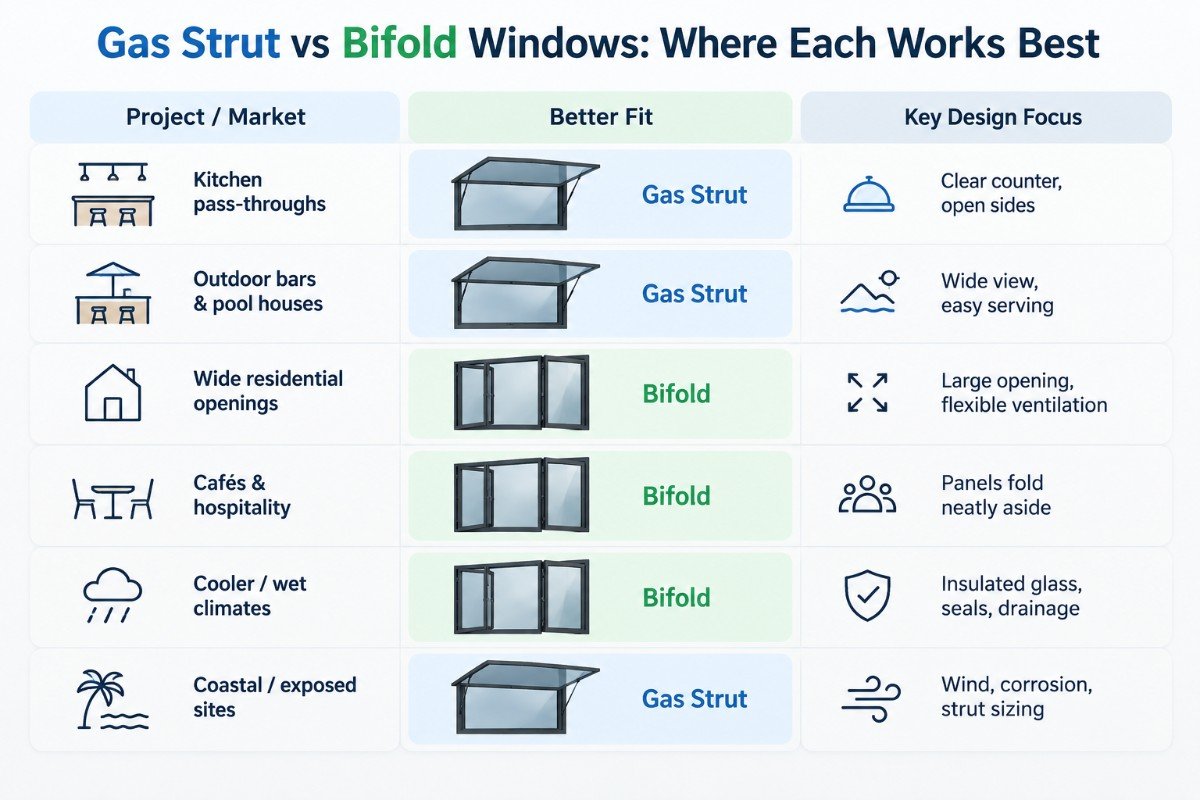
Gas strut windows are often attractive for kitchen pass-throughs, outdoor bars, pool houses, and service counters because the open sash leaves the sides and counter visually clear. They also suit projects where a panoramic closed view is a major design goal.
Bifold windows suit wider openings, staged ventilation, and layouts with limited overhead clearance. They work well in homes, cafés, hospitality spaces, balconies, clubhouses, and commercial service counters where folded panels can park safely at the side.
Bifold windows are particularly popular in the Netherlands, Germany, the UK, and India, while gas strut windows attract strong interest in St Helena, followed by the Netherlands, the UK, the USA, and Australia.
| Market | Specification focus |
| Netherlands | Thermal performance, rain management, corrosion resistance |
| Germany | Insulated glazing and thermal-break framing |
| UK | Weather seals, drainage, insulated glass |
| India | Ventilation, shading, wide opening practicality |
| USA | Pass-through kitchens, outdoor bars, custom sizing |
| Australia / St Helena | Gas-strut suitability, exposure, screens, corrosion protection |
Gas Strut Window vs Bifold Window: Pros and Limitations
Gas Strut Window
A gas strut window is strongest when minimal sightlines, clear side space, and a pass-through counter are priorities. Its main limitations are outward projection, sash weight, wind exposure, strut sizing, and closing reach. Custom gas strut windows can be specified in project-specific sizes, finishes, glazing options, and hardware configurations to suit different design requirements.
Bifold Window
A bifold window is strongest when wide openings, flexible configurations, and partial opening are priorities. Its main limitations are visible frame lines, side stacking, more moving hardware, and track maintenance. Explore bifold window systems for available configurations.
How to Choose Between a Gas Strut and Bifold Window
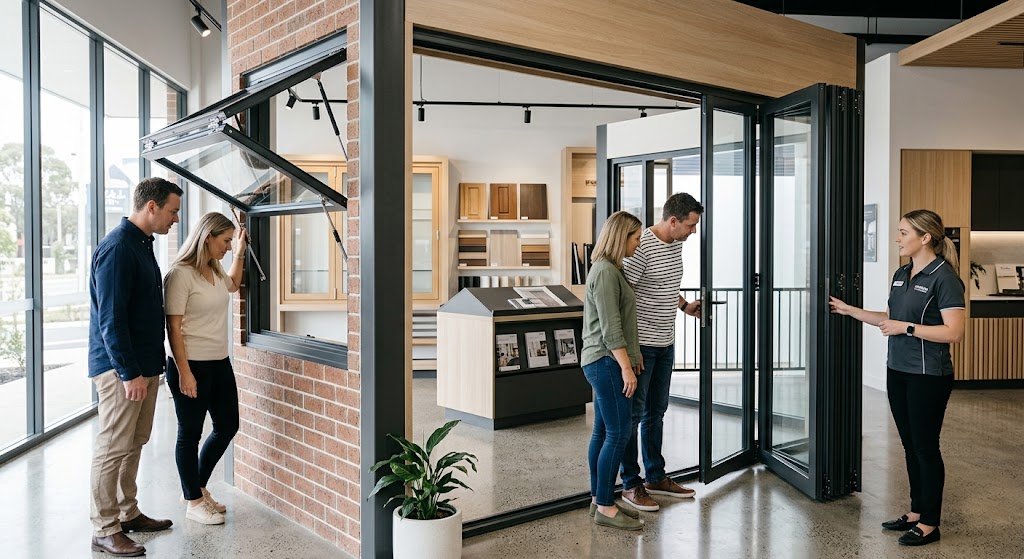
Start with the physical opening. Record width, height, counter depth, wall thickness, eave clearance, exterior projection space, and nearby furniture or equipment. Then define wind exposure, rainfall, glass type, thermal targets, security, insect screening, opening frequency, and local code requirements.
Compare lifecycle value rather than only unit price. Include structural work, installation, maintenance access, replacement parts, shipping, and finishing. For overseas orders, learn more about protecting windows during international shipping, including how frames, glass, hardware, and finishes can be secured in transit.
Final Verdict: Gas Strut Window or Bifold Window?
Choose a gas strut window when the priority is a panoramic view, uncluttered pass-through, minimal side obstruction, and modern lift-up operation. It is especially suitable for kitchen serveries and outdoor entertaining areas with enough outward and overhead clearance.
Choose a bifold window when the opening is wider, partial ventilation is useful, overhead space is restricted, or side-stacked panels fit the layout better. The final decision should be based on sash or panel weight, structural support, sill weather performance, wind exposure, thermal requirements, and daily use.
Why Source Custom Gas Strut and Bifold Windows from Oridow?
Oridow combines experienced manufacturing, custom production, quality control, and international project support for residential, commercial, development, and wholesale orders.
- Manufacturing experience since 2008: Experienced production teams support custom window and door projects for international buyers.
- Fully custom-made solutions: Specify sizes, colors, glazing, hardware, frame systems, opening styles, screens, and project details.
- Quality-controlled production: Products can be checked for dimensions, finish, hardware operation, glazing, sealing, and packing before shipment.
- Factory-direct global support: Buyers can receive shop-drawing assistance, quotations, production coordination, and CIF or door-to-door DDP options where available.
Ready to Source Custom Gas Strut or Bifold Windows?
Oridow helps builders, contractors, architects, developers, homeowners, and wholesalers source custom aluminum gas strut and bifold windows directly from an experienced manufacturer in China.
Whether you need production to drawings, help selecting frames and glazing, custom finishes, screen coordination, shop drawings, factory-direct pricing, or international delivery, Oridow can develop a solution around your opening dimensions, climate, performance requirements, budget, and project schedule.
Request a free quote and send your window schedule, drawings, sizes, opening direction, glass requirements, delivery destination, and expected project timeline to the Oridow team.
Frequently Asked Questions
Can I replace an existing sliding window with a gas strut or bifold window?
Usually yes, but the opening, header, wall construction, counter, and exterior clearance must be checked first. Larger replacement openings may need structural modification, new flashing, or finishing work.
Can a gas strut window be installed above a sink or cooktop?
It may be possible, but handle reach, heat sources, splash zones, ventilation rules, and closing access must be reviewed. The final position should remain safe and practical to operate.
Can bifold windows open only one panel for ventilation?
Many configurations allow a lead panel or selected leaves to operate without opening the full system. The exact function depends on the panel arrangement, hardware, and locking design.
Do I need planning permission or building approval?
Requirements vary by location. Structural changes, façade alterations, heritage rules, safety glazing, and large openings can trigger approvals. Confirm local requirements before ordering.
Can gas strut or bifold windows include insect screens?
Yes. Retractable screens are common because they can cover wide openings without permanently blocking the pass-through. Screen type and mounting position should be coordinated before production.
What measurements should I send for a custom quote?
Send opening width and height, wall thickness, sill or counter detail, photos, opening direction, glass preference, frame color, screen requirement, quantity, and delivery location. Drawings are recommended for complex projects.
Can custom windows be shipped internationally with the glass installed?
Often yes, depending on size, weight, route, and project requirements. Export packaging should protect glass edges, frames, finishes, hardware, and seals with suitable bracing and moisture protection.


