

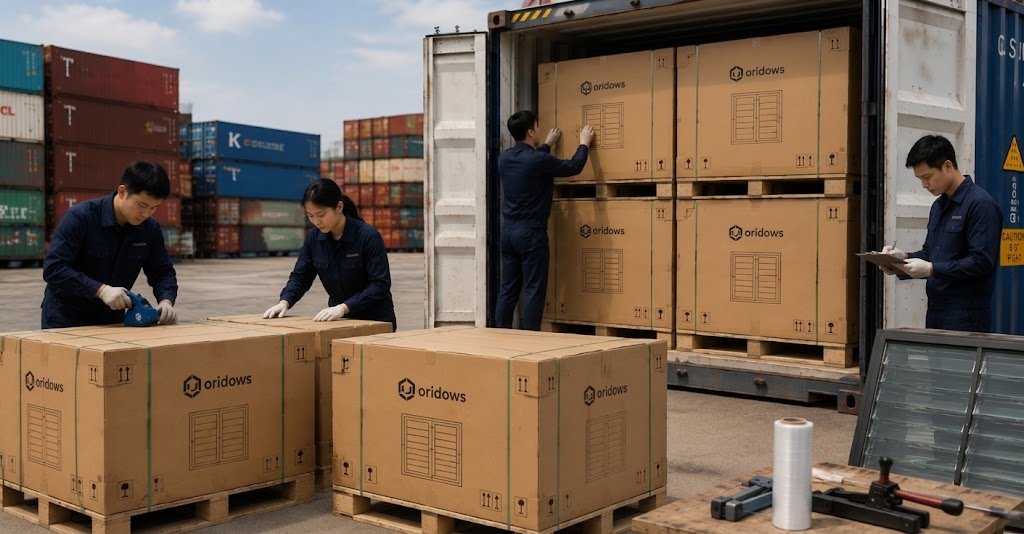
Bulk jalousie window orders face more shipping risk than many standard window types. Each unit includes a frame, multiple glass or aluminum blades, holders, operating hardware, seals, and finished surfaces. Long-distance handling can turn small packing weaknesses into broken slats, scratched frames, or bent mechanisms.
For contractors, developers, wholesalers, and importers, transit damage creates more than a replacement cost. One damaged window can hold up installation, create room-by-room shortages, complicate claims, and force teams to reopen crates just to find the correct item.
A strong jalousie window packaging plan should protect the product, support efficient container loading, and help the site team identify each opening quickly. The best plan is agreed before production, matched to the window schedule, and checked again before the shipment leaves the factory.
What Makes Jalousie Window Packaging Different?
A jalousie window is a moving assembly, not just a glazed frame. The louver blades, clips or holders, operator, linkage, and frame all react differently to vibration and impact. Packaging must control movement without placing pressure on the blades or operating parts.
For a bulk Commercial Jalousie Window order, buyers should confirm how complete units, loose glass slats, screens, and hardware will be packed. The correct method depends on window size, glass type, order quantity, shipping route, and how the units will be unloaded.
| Shipping risk | Jalousie component at risk | Packaging response |
| Repeated vibration | Blades, holders, linkage | Cushioning, separators, firm restraint |
| Corner impact | Aluminum or uPVC frame | Rigid corner and edge protection |
| Glass edge contact | Tempered louver slats | Individual separation and supported packing |
| Moisture and condensation | Hardware, cartons, finishes | Dry packing, barrier protection, desiccant planning |
| Poor handling | Full window assembly | Stable crate base and marked lifting points |
| Wrong-site delivery | Mixed window sizes | Package IDs linked to the project schedule |
Plan the Packaging Before Production Starts
Packaging decisions should begin with the same documents used to manufacture the order. Window dimensions, quantities, glass specification, frame finish, hardware, screens, installation zones, destination, and unloading method all affect the crate design and packing sequence.
A clear window schedule checklist helps the supplier plan both manufacturing and logistics. For large projects, crate numbers can also match floor, unit, room, elevation, or opening references used by the site team.
This schedule-linked approach is a useful improvement over simple “model A/model B” labeling. It reduces unnecessary crate opening, helps installers stage the correct units, and makes shortages easier to trace during receiving.
Choose the Right Packing Format for the Order
There is no single best package for every jalousie shipment. The format should balance protection, container space, labor, and site conditions.
| Packing format | Best suited to | Main consideration |
| Fully assembled units | Projects needing faster installation | Requires strong restraint around glazing and hardware |
| Frames with slats packed separately | Routes with higher glass-handling risk | Adds installation work but improves slat protection |
| Loose louver glass in cartons/crates | Replacement or component orders | Needs separators, edge protection, and clear size labels |
| Mixed project crates | Multi-floor or multi-unit developments | Requires schedule-based identification |
| Reinforced pallet or crate systems | High-volume container shipments | Must support forklift handling and stable container loading |
Buyers should not choose a lighter package only to reduce freight volume. A slightly smaller shipping cost can be lost quickly if glass breaks, frame corners deform, or replacement units delay the project.
Build Protection in Layers
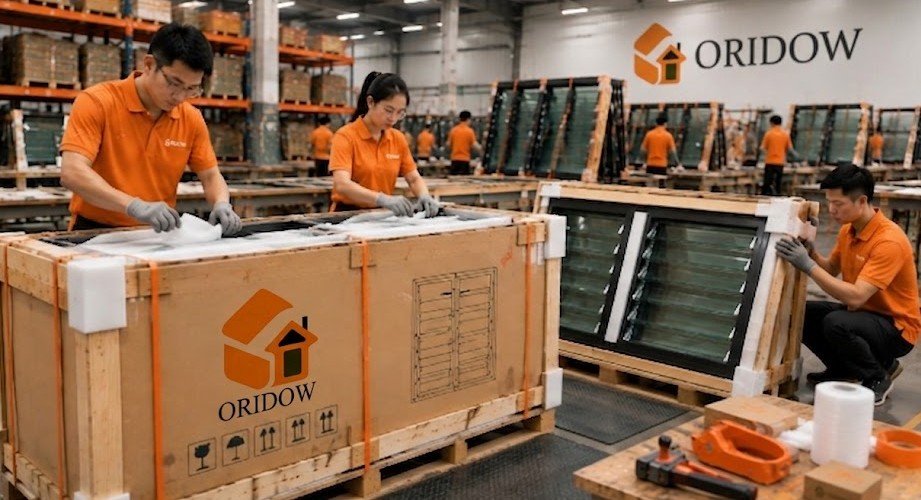
Professional jalousie window packaging works best as a system of protective layers. Oridow uses multi-layer safety packaging for international orders, while the exact combination can be adjusted for the product size, glass configuration, freight method, and destination.
For a broader view of frame, glass, moisture, crate, and loading protection, see this guide on window packaging for international shipping.
Protect Finished Frame Surfaces
Low-tack protective film helps protect powder-coated, anodized, or uPVC surfaces from scratches and rubbing. Foam or other soft material should separate finished faces from rigid crate members and neighboring windows.
Protect Corners and Edges
Window corners take concentrated impact during forklift movement, warehouse transfers, and container loading. Rigid corner guards and continuous edge protection help spread those loads and reduce the chance of dented profiles or distorted joints.
Restrain Operating Hardware
Handles, operators, linkage bars, and projecting hardware should not carry crate pressure. Moving parts should be placed in a safe position and restrained so repeated vibration does not allow them to strike the frame or neighboring components.
Pack Jalousie Glass Slats as a Separate Risk Group
Louver glass needs special attention because each narrow blade has exposed edges. Tempered glass is strong in normal use, but concentrated edge damage can still cause breakage. Loose slats should therefore be separated, cushioned, and kept from striking each other.
For bulk glass-blade packs, practical controls include interleaf material or dividers, foam at contact points, strong cartons or internal boxes, and a reinforced outer plywood package. Labels should show blade size, glass type, quantity, and the window group or opening reference where possible.
When multiple blade lengths are included in one project, separating them by size or installation zone reduces site sorting. It also lowers the risk of installers opening several packages to locate one required group.
Control Moisture During Sea Freight
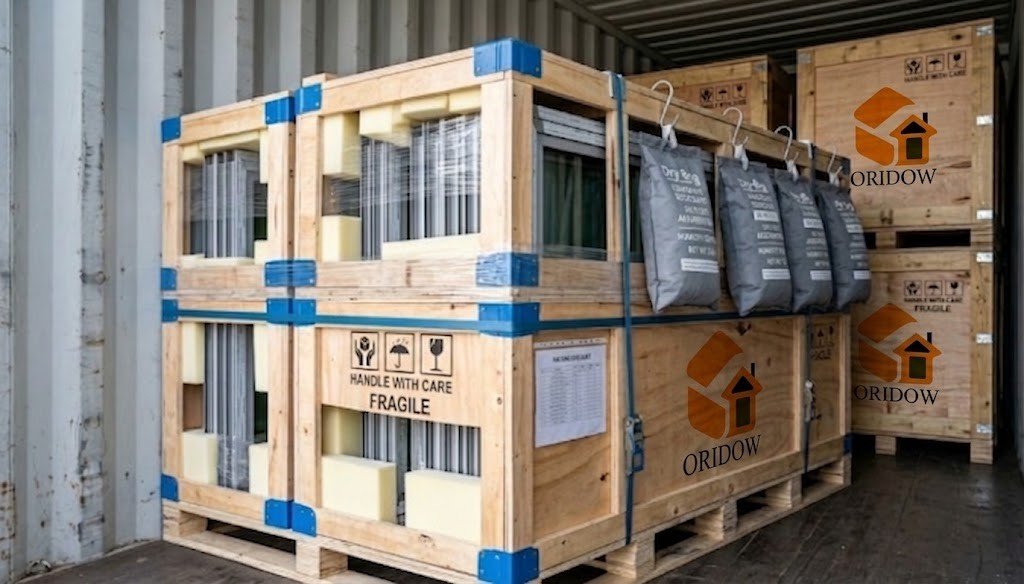
Ocean shipments can face large changes in temperature and humidity. Moisture can soften cartons, stain metal parts, affect labels, and create condensation inside a container. Packaging should begin with dry materials and a clean, dry container.
Barrier wrapping and desiccants can be added according to route, transit time, container size, and moisture risk. The correct quantity should be calculated for the shipment rather than guessed. Wet timber or damp packing material should never be sealed inside the load.
For a broader view of frame, glass, moisture, crate, and loading protection, detailed practices for window packaging for international shipping explain how each layer contributes to safer export handling.
Use Export-Ready Crates and Secure Container Loading
The outer package must carry handling loads, not the window frame. Plywood crates, reinforced pallets, or engineered racks should provide a stable base, controlled support, and suitable forklift access without pressing against vulnerable glass or hardware.
If solid raw wood is used for pallets, crates, blocking, or dunnage, the buyer and supplier should confirm applicable ISPM 15 requirements. Packaging made entirely from processed wood such as plywood is generally outside the standard’s raw-wood treatment scope.
Inside the container, crates must be restrained against shifting, tipping, or repeated impact. The IMO/ILO/UNECE CTU Code provides international guidance for safe packing and securing of cargo transport units across sea and land transport.
For jalousie orders, load planning should also consider crate weight, center of gravity, stacking limits, unloading sequence, and the equipment available at destination. Heavy crates placed in the wrong order can create avoidable site handling and increase the risk of damage during unloading.
Check Quality Before the Crate Is Closed
Packaging cannot correct a production defect. Each jalousie unit should pass final inspection before protective materials hide the frame, glass, hardware, and operating system.
An aluminum window quality control checklist gives buyers a useful reference for production and pre-shipment checks. For jalousie windows, operation testing is especially important because the blades must open, close, and align without binding.
| Pre-shipment check | Evidence to request | Why it matters |
| Frame and finish | Close-up QC photos | Confirms condition before packing |
| Glass/slat count | Packing record | Reduces quantity disputes |
| Operator and linkage | Function test | Confirms movement before transit |
| Package ID | Label photo | Links the crate to the window schedule |
| Crate condition | Finished packing photo | Shows protection before loading |
| Container loading | Loading and seal photos | Creates a clear shipment record |
For high-value or unusually fragile crates, buyers can also discuss optional shock or tilt indicators. These devices do not prevent damage, but they can improve handling visibility and provide useful evidence if a shipment arrives with signs of severe impact.
Make Unloading and Installation Part of the Packaging Plan
A safe package can still fail if the site cannot unload it. Before shipping, confirm key site handling limits to avoid delays or damage.
- Forklift capacity and availability
- Crane access or lifting equipment
- Loading-dock height and restrictions
- Door width and entry clearance
- On-site storage space for crates
- Movement path by floor or building zone
Clear handling information reduces risk during delivery. It also helps teams plan unloading in advance, especially for bulk jalousie window shipments where many similar crates arrive together.
Add simple but clear markings on every crate:
- Lifting points and safe handling marks
- Exact crate weight
- Center-of-gravity indication
- Opening or project reference codes
These details reduce guesswork and help the receiving team move and place crates safely, even in busy construction environments.
After unpacking, installers should always perform a quick inspection before installation:
- Check frame condition for dents or scratches
- Confirm slat seating and alignment
- Test operator and linkage movement
- Verify full blade opening and closing
If blades do not close evenly, refer to a detailed guide on how to adjust and close gaps in jalousie windows, which explains common alignment and sealing correction steps in a simple way.
Once installation is complete, airflow performance should also be reviewed. Understanding how the system works in real use helps improve comfort and ventilation balance.
A practical guide on improving airflow comfort with jalousie windows explains how blade angle, spacing, and opening control affect indoor air movement and overall comfort in daily conditions.
Balance Protection With Freight Cost
Bulk buyers usually pay for both product volume and packaging volume. Overbuilt crates can waste container space, while weak packaging increases damage risk. The goal is not the cheapest crate; it is the lowest delivered risk for the complete order.
Ask the supplier to compare assembled versus partially separated packing, crate dimensions, gross weight, estimated container use, and unloading needs before the order is finalized. This can reveal savings without removing essential glass, frame, or hardware protection.
Shipping terms should also be written clearly in the quotation. Oridow can support international project delivery through options such as CIF or door-to-door DDP, depending on the destination and agreed order terms. Packaging scope, freight responsibility, customs handling, and unloading responsibility should be confirmed separately.
Bulk Buyer Packaging Approval Checklist
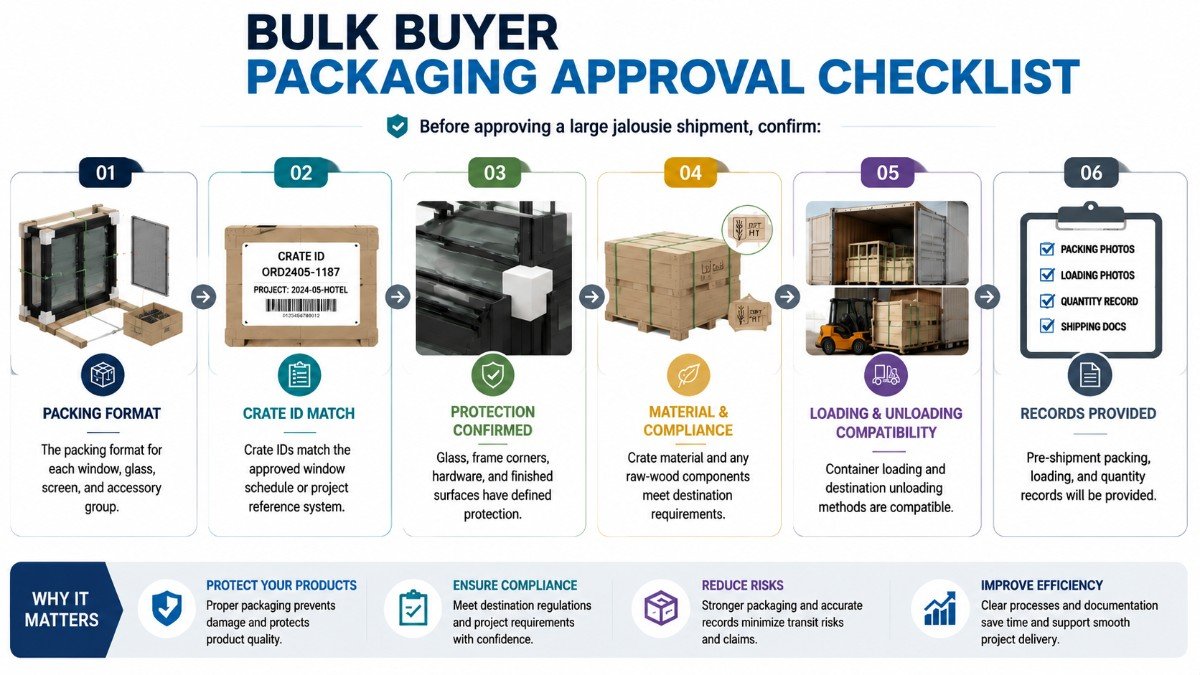
Before approving a large jalousie shipment, confirm:
- The packing format for each window, glass, screen, and accessory group.
- Crate IDs match the approved window schedule or project reference system.
- Glass, frame corners, hardware, and finished surfaces have defined protection.
- Crate material and any raw-wood components meet destination requirements.
- Container loading and destination unloading methods are compatible.
- Pre-shipment packing, loading, and quantity records will be provided.
Why Source Custom Jalousie Windows from Oridow?
Oridow combines custom manufacturing, quality control, export packaging, and international project support for residential, commercial, wholesale, and development orders.
Manufacturing Experience Since 2008: Experienced production teams support custom window projects with factory coordination from drawings through shipment.
Fully Custom-Made Solutions: Buyers can specify sizes, colors, glazing, hardware, frame systems, louver configurations, and other project requirements.
Tested and Quality-Controlled Products: Windows are checked during production and before packing, with attention to frame quality, glass, hardware, finish, and operation.
Factory-Direct Pricing and Global Support: Oridow provides manufacturer-direct quotations, shop-drawing assistance, production coordination, and international shipping support, including CIF or door-to-door DDP options where available.
Ready to Source Jalousie Windows for a Bulk International Project?
Oridow helps builders, contractors, architects, developers, and wholesalers source custom jalousie windows directly from an experienced manufacturer in China.
Send your window schedule, drawings, quantities, glass requirements, finish, destination, and preferred delivery method. The Oridow team can review the specification, recommend a suitable export packaging plan, prepare a detailed quotation, and coordinate production and international delivery.
Request a free quote to discuss your bulk jalousie window order, packaging requirements, project timeline, and shipping destination.
Frequently Asked Questions
Can jalousie window crates be customized for narrow elevators or restricted job sites?
Yes. Share access limits before packaging is approved. The supplier can review crate dimensions, unit grouping, and handling methods so the shipment is easier to move after delivery.
Should I order extra replacement glass slats with a bulk shipment?
For large or remote projects, a small spare quantity can be practical. Confirm the blade size, glass type, tint, and edge finish so any spare slats match the installed windows.
How should unopened jalousie window crates be stored on site?
Keep them in a dry, level, protected area away from standing water, direct construction impact, and unstable stacking. Follow any orientation or stacking marks on the crate.
Can insect screens be packed with jalousie windows?
Yes, but screens need protection from bending and point pressure. Ask whether they will be packed inside the main crate, in a separate frame pack, or in a dedicated accessory package.
What if my project site has no forklift?
Tell the supplier before shipment. Crate size, weight, lifting points, and delivery method may need to be changed to suit manual handling, a pallet jack, crane unloading, or local delivery equipment.
Can private-label or project-specific shipping marks be added?
Usually, yes for bulk orders. Provide the required marks, project codes, logo rules, language, barcode, or destination labels before the packaging artwork and packing list are finalized.
When should protective film be removed from the window frames?
Follow the supplier’s instructions and avoid leaving protective film on longer than necessary after installation. Heat and long exposure can make some films harder to remove or leave adhesive residue.


