

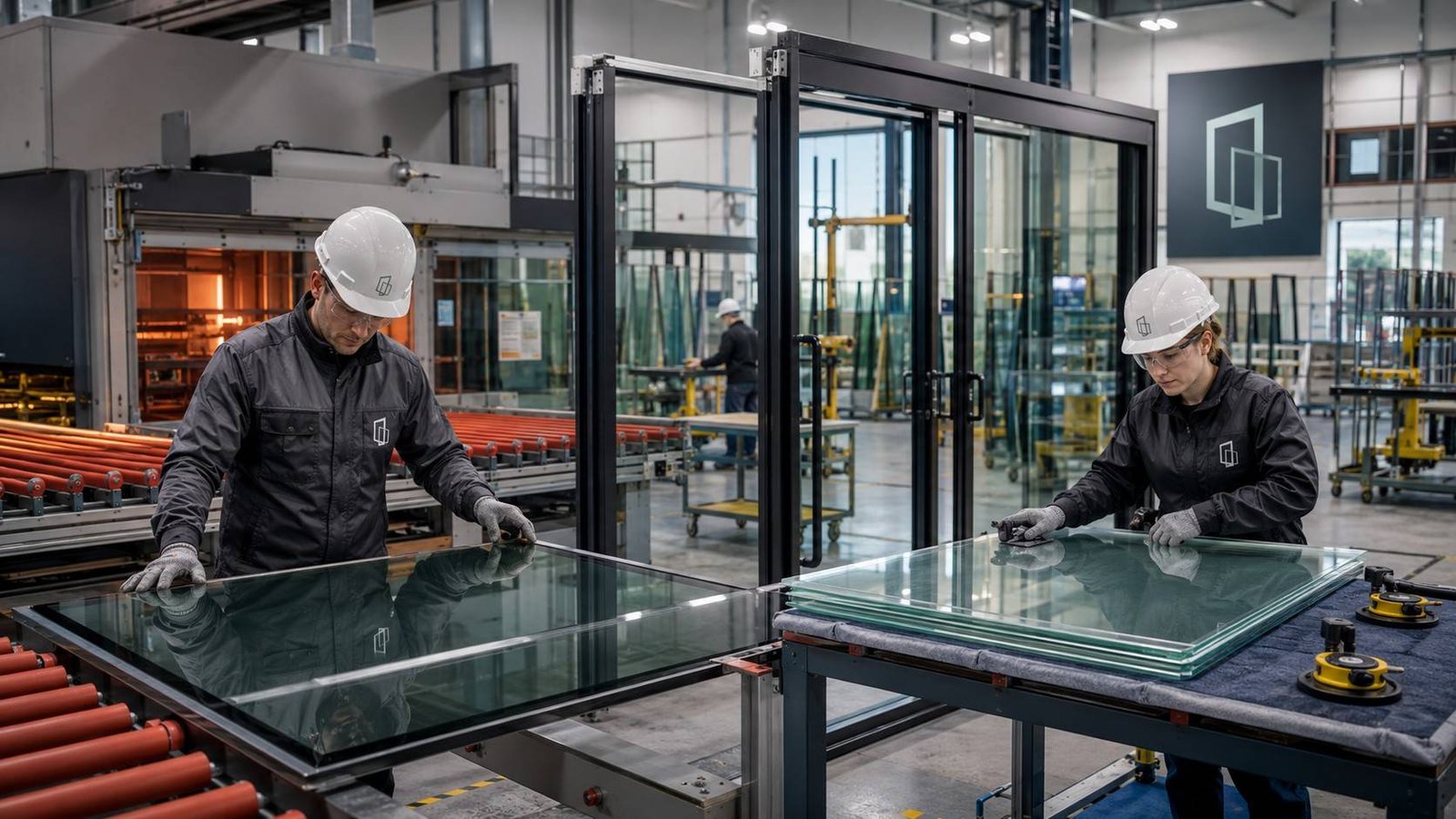
Swing-sliding doors combine a large glazed area with frequent movement, so the glass must do more than look clear. It must handle impact, support safe daily use, work with the selected hardware, and meet the building-code requirements of the destination market.
The wrong glass specification can create hidden problems. A pane may resist impact but leave a large opening after breakage. Another may remain intact after cracking but add more weight, cost, and hardware demand than the door system was designed to support.
The right choice depends on the risk being controlled. Tempered glass provides high strength and safer fragmentation. Laminated glass adds post-breakage retention, security, sound control, and UV protection. For demanding applications, tempered-laminated glass can combine several of these benefits.
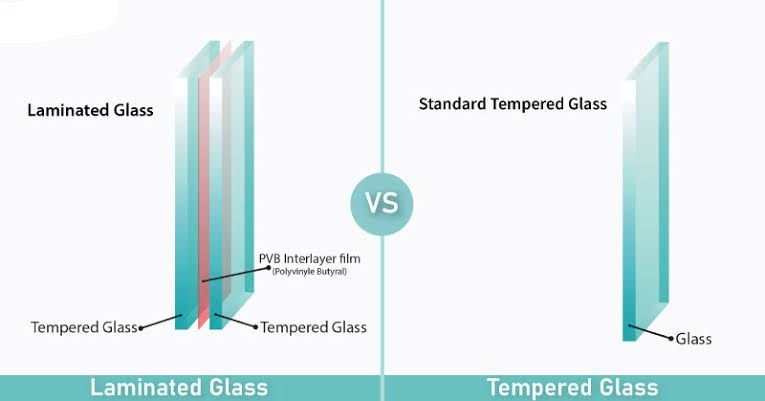
Tempered vs Laminated Glass: Quick Comparison
For many residential and light-commercial projects, tempered safety glass is a practical starting point. Custom swing-sliding door systems can be configured with different glazing make-ups based on panel size, safety requirements, climate, security expectations, and project specifications.
| Factor | Tempered Glass | Laminated Glass |
| Main advantage | Higher strength and safer fragmentation | Holds broken fragments together |
| Break pattern | Small granular pieces | Cracked glass remains bonded |
| Barrier after breakage | Usually lost | Usually retained |
| Security potential | Moderate | Better with suitable make-up |
| Acoustic potential | Standard | Better with suitable interlayer |
| UV protection | Depends on glazing | High with many PVB interlayers |
| Typical cost | Lower | Higher |
| Common use | General safety glazing | Security, noise, retention |
The main difference is simple. Tempered glass is designed to resist breakage and fragment more safely when failure occurs. Laminated glass is designed to keep broken glass attached to an interlayer.
That distinction becomes important in large moving door panels where people, furniture, access routes, and valuable interior spaces are close to the glazing.
How Tempered Glass Works
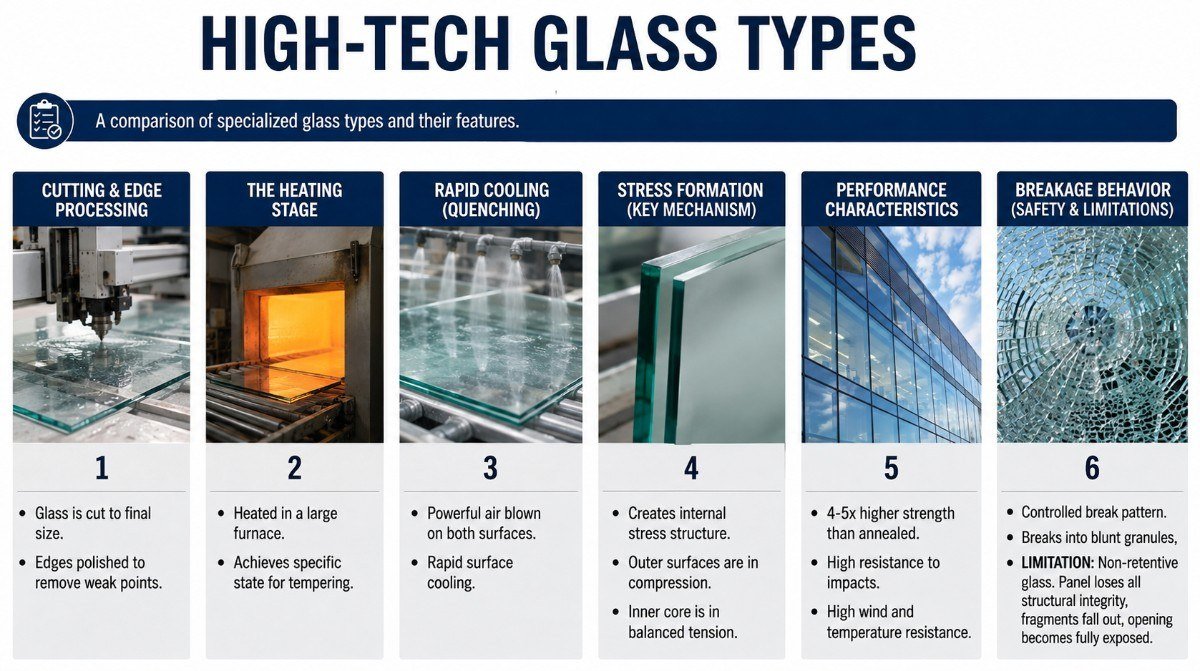
Tempered glass (also called toughened glass) is manufactured through a controlled process that increases strength and improves safety performance. The process can be understood in clear steps:
1. How Tempered Glass Is Made (Step-by-Step Process)
- Cutting & Edge Processing
The glass is first cut to size and edges are polished to remove weak points. - Heating Stage
The glass is heated in a furnace to around 600–650°C, making it soft and flexible. - Rapid Cooling (Quenching)
High-pressure air is blown onto both surfaces to cool the glass quickly. - Stress Formation
- Outer surface becomes compressive stress zone
- Inner core forms a balanced tensile state
This internal stress structure is what gives tempered glass its strength.
2. Performance Characteristics
Because of this treatment, tempered glass offers:
- 4–5× higher strength than annealed glass of the same thickness
- Better resistance to:
- Impact loads
- Wind pressure
- Sudden temperature changes
3. Common Applications
Tempered glass is widely used in high-contact and safety-critical areas such as:
- Entrance and swing-sliding doors
- Interior glass partitions
- Shower enclosures
- Storefront and façade glazing
- Public and commercial access zones
4. Breakage Behavior (Safety Feature)
When failure occurs, tempered glass follows a controlled break pattern:
- The entire pane fractures at once
- It breaks into small, blunt granules
- Sharp, dangerous shards are avoided
This significantly reduces the risk of deep cutting injuries in occupied spaces.
5. Key Limitation to Understand
Despite its strength, tempered glass has one important limitation:
- It is a non-retentive glass system
- After breakage:
- The panel loses structural integrity immediately
- Fragments fall out of the frame
- The opening becomes fully exposed
- Security and enclosure are no longer maintained
This is why tempered glass is ideal for safety, but not always sufficient where post-breakage protection is required.
How Laminated Glass Works
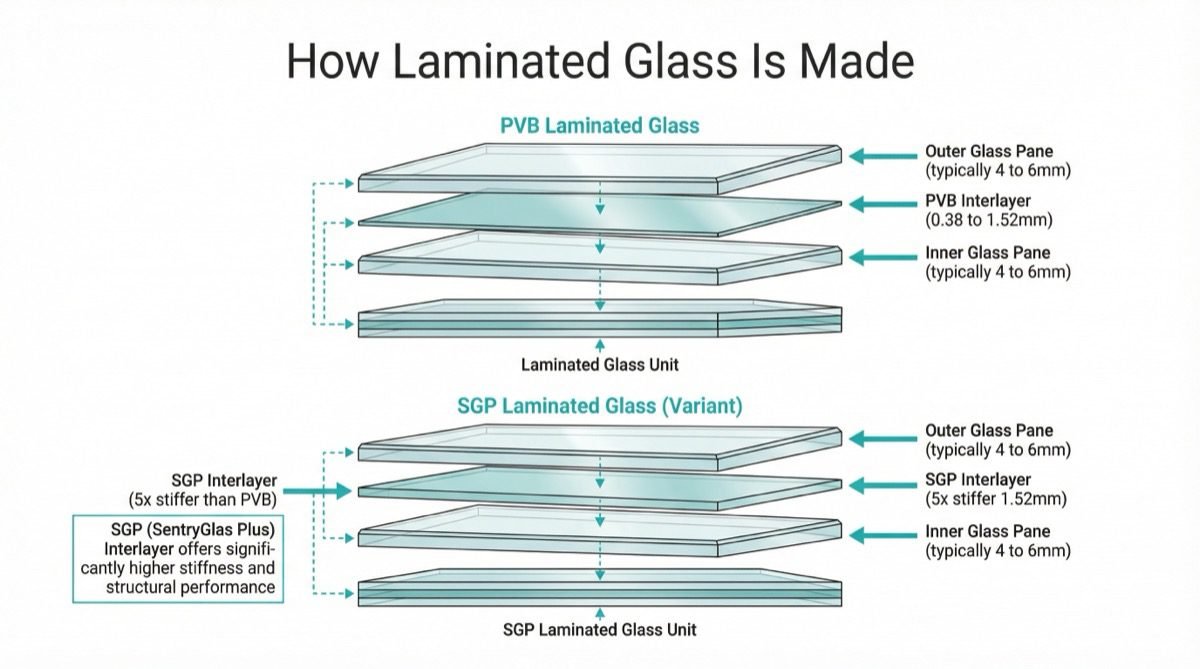
Laminated glass is manufactured through a clear step-by-step layering process:
- Two or more glass plies are selected according to the required thickness, strength, and performance level.
- A polymer interlayer, most commonly polyvinyl butyral (PVB), is placed between the glass sheets.
- The stacked assembly is then heat-pressed and bonded, forming a single unified glass panel.
When the glass is impacted and begins to crack, its behavior changes in a controlled sequence:
- The glass may crack under force, but it does not immediately separate or fall apart.
- The PVB interlayer holds the broken fragments in place, keeping them bonded to the sheet.
- The panel continues to cover the opening, maintaining a temporary protective barrier instead of collapsing into loose shards.
This predictable post-breakage performance is why laminated glass is commonly used in higher-risk applications such as entrance doors, ground-floor glazing, schools, retail storefronts, and public buildings where safety and containment are essential.
Laminated glass also improves acoustic performance through the same layered structure:
- The interlayer absorbs and dampens vibration between the glass plies.
- This reduces the amount of sound energy transmitted through the panel.
- When acoustic-grade PVB is used, noise reduction improves further, especially when combined with a properly designed glazing system.
What Is Tempered-Laminated Glass?
Tempered and laminated glass are not always alternative choices. Tempered glass plies can also be laminated together.
This configuration combines the higher pre-breakage strength of tempered glass with the fragment-retention characteristics of laminated construction.
Tempered-laminated glass may suit high-traffic commercial doors, large exterior panels, exposed locations, luxury residential projects, and openings where both impact strength and post-breakage retention are important.
Its higher weight and more complex fabrication also mean that glass thickness, interlayer selection, framing, rollers, hinges, and track capacity must be coordinated together.
Tempered vs Laminated Glass for Door Safety
Both tempered and laminated products can qualify as safety glazing when manufactured and tested to the standards required by the destination market.
The important issue is not simply whether a supplier calls the glass “safety glass.” The project specification should identify the applicable standard, glass make-up, thickness, certification, marking, and required impact classification.
Swinging, sliding, and folding glazed doors are commonly treated as human-impact locations under modern building codes. However, exact requirements vary between countries, states, regions, and building types.
Project teams should therefore confirm local code requirements before approving production rather than assuming that one glass configuration is suitable for every market.
Which Glass Is Better for Different Project Risks?
| Project Condition | Typical Starting Choice | Main Reason |
| Interior residential door | Tempered | Strong and cost-effective |
| Office partition door | Tempered or laminated | Depends on acoustic needs |
| Ground-floor exterior door | Laminated | Better post-breakage retention |
| High-traffic commercial entry | Tempered-laminated | Strength plus containment |
| Urban noise exposure | Laminated | Better acoustic potential |
| Retail entrance | Laminated security glazing | Better forced-entry delay |
| Large exposed exterior panel | Engineered glass make-up | Requires structural review |
Laminated glass should not automatically be treated as security-rated glazing. Security performance depends on glass thickness, interlayer type, number of layers, framing, edge capture, anchoring, and tested system performance.
Impact Strength: Which Glass Performs Better?
Tempered glass generally provides greater strength than annealed glass of the same thickness before breakage. It can therefore be an efficient choice for door panels exposed to frequent movement, accidental impact, and daily operation.
Laminated glass cannot be evaluated from the word “laminated” alone. Laminates may use annealed, heat-strengthened, tempered, or mixed glass plies.
A laminated unit made from annealed glass can behave very differently from one made with fully tempered plies. Procurement documents should therefore specify the complete glass build-up.
Which Glass Provides Better Security?
Security performance depends heavily on what happens after impact.
Monolithic tempered glass can be difficult to break initially, but once it shatters, the opening may become accessible.
Laminated glass normally retains fragments on the interlayer. This can make penetration slower because a person must break the glass and then work through the remaining interlayer.
For commercial security, high-value retail, schools, or vulnerable ground-floor openings, tested security glazing should be specified rather than relying only on generic laminated glass.
Which Glass Is Better for Noise Control?
Standard tempered glass does not become significantly better at reducing sound simply because it has been tempered.
Laminated glass can provide better acoustic performance because the interlayer helps reduce vibration transmission between the glass plies.
Acoustic laminated glass can perform even better when used with different glass thicknesses, insulated glass construction, suitable air gaps, and dedicated acoustic interlayers.
If noise control is important, the specification should include a target rating such as STC, OITC, or Rw rather than simply requesting “soundproof glass.”
Does Tempered or Laminated Glass Improve Energy Efficiency?
Neither tempering nor lamination alone determines the overall thermal efficiency of a door.
Energy performance depends on the complete glazing system, including Low-E coatings, insulated glass cavities, gas fill, warm-edge spacers, glass thickness, frame construction, seals, and thermal breaks.
A laminated or tempered pane can also form part of an insulated glass unit. This allows safety, acoustic, security, and thermal requirements to be addressed within one coordinated glazing specification.
Three Technical Details Buyers Often Miss
Stronger Glass Does Not Mean Stiffer Glass
Tempering increases glass strength, but it does not significantly change the elastic stiffness of the glass.
This means tempered and annealed glass of the same thickness can still deflect in a similar way under the same load.
For large swing-sliding door panels, deflection should be controlled through:
- Appropriate glass thickness selection
- Proper panel sizing and proportions
- Correct support and framing conditions
- Accurate wind-load calculations
- Well-designed frame stiffness and reinforcement
Heat-Soak Testing Can Reduce NiS Risk
Fully tempered glass carries a small risk of spontaneous breakage caused by nickel sulfide, or NiS, inclusions.
Heat-soak testing is an additional manufacturing process intended to identify many glass panes that contain critical inclusions before installation.
It may be worth specifying for large, expensive, difficult-to-replace, overhead, or high-consequence tempered glass panels where unexpected breakage would create significant cost or safety concerns.
Glass Weight Affects Door Hardware
Laminated, tempered-laminated, and insulated laminated glazing can weigh considerably more than a single monolithic lite.
That additional weight affects rollers, hinges, tracks, fasteners, frame rigidity, operating force, panel dimensions, and long-term alignment.
Including the final glazing details in a window and door quote checklist helps suppliers verify hardware capacity before the shop drawings and production specifications are finalized.
Glass Selection Matrix for Buyers
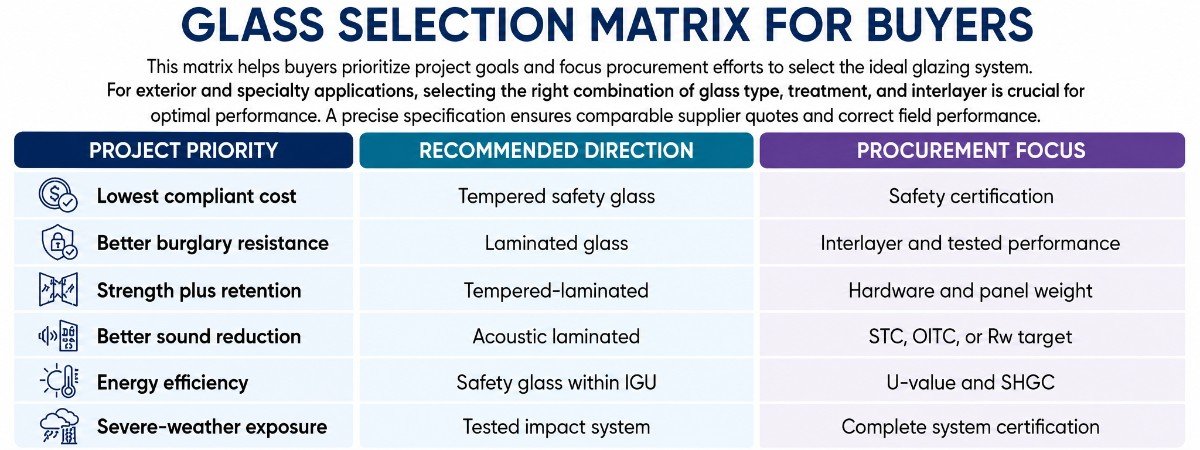
| Project Priority | Recommended Direction | Procurement Focus |
| Lowest compliant cost | Tempered safety glass | Safety certification |
| Better burglary resistance | Laminated glass | Interlayer and tested performance |
| Strength plus retention | Tempered-laminated | Hardware and panel weight |
| Better sound reduction | Acoustic laminated | STC, OITC, or Rw target |
| Energy efficiency | Safety glass within IGU | U-value and SHGC |
| Severe-weather exposure | Tested impact system | Complete system certification |
A detailed quotation should define glass thickness, heat treatment, laminated interlayer, Low-E coating, insulated glass build-up, tint, safety marking, spacer, gas fill, and applicable test requirements.
Clear specifications make supplier quotations easier to compare and reduce the risk of receiving technically different glazing systems under similar product descriptions.
Manufacturing Quality Control Matters
Selecting the right glass type is only part of the process. Production quality must also match the approved specification.
Inspection should verify glass thickness, safety markings, Low-E orientation, edge condition, setting blocks, glazing bite, gaskets, hardware capacity, frame dimensions, panel alignment, and final operating performance.
For larger project packages, an aluminum window quality checklist can support consistent inspection of glazing, profiles, hardware, dimensions, labeling, and production records before shipment.
Packaging Heavy Glazed Doors for Export
Large glazed swing-sliding doors require careful protection during international transportation.
Glass edges, frame corners, hardware, exposed surfaces, and moving panels can be damaged by vibration, poor blocking, moisture, impact, or movement inside the crate.
A properly planned international window packaging guide becomes especially relevant when heavier laminated or insulated door panels must travel long distances by container.
Coordinating Doors With Tropical Ventilation
Swing-sliding doors are often only one part of the building ventilation strategy.
In tropical and warm-climate projects, designers may combine large doors with operable window systems to support cross-ventilation and more flexible airflow.
Understanding tropical jalousie window benefits can help project teams coordinate glazed doors with windows that remain highly open to natural ventilation.
For rooms that depend on continuous passive ventilation, effective jalousie airflow comfort strategies can also influence opening placement, orientation, and the relationship between doors and adjacent windows.
Existing louvered windows may develop leakage as seals, clips, or blade alignment change over time. Practical jalousie window gap fixes can help maintain the performance of these adjacent window systems.
Why Source Custom Swing-Sliding Doors from Oridow?
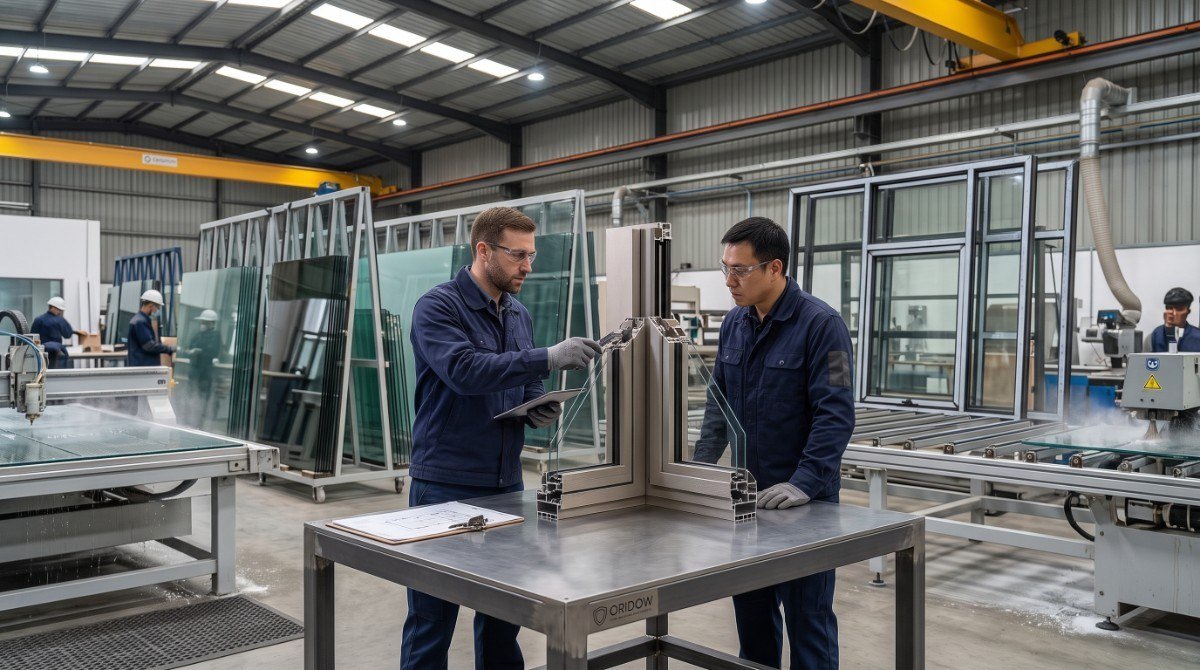
Oridow combines custom manufacturing, project coordination, quality control, and international supply support for contractors, builders, developers, architects, distributors, and wholesalers.
- Manufacturing experience since 2008: Production teams support residential, commercial, development, and wholesale projects.
- Fully customized configurations: Buyers can specify dimensions, profiles, finishes, glass make-ups, hardware, Low-E coatings, and opening arrangements.
- Quality-controlled production: Frames, glazing, hardware, assembly, operation, and packaging can be inspected against approved project requirements.
- Factory-direct project support: Oridow supports quotations, drawings, material coordination, production planning, CIF shipping, and door-to-door delivery where available.
Ready to Specify Glass for Your Swing-Sliding Door Project?
Oridow can help compare tempered, laminated, tempered-laminated, and insulated safety-glass configurations based on panel size, building use, security expectations, climate, acoustic requirements, energy targets, and destination standards.
Send your drawings, opening schedule, required glass performance, quantities, destination, and project timeline to connect with the Oridow support team for a factory-direct quotation and specification review.
Frequently Asked Questions
Can an existing swing-sliding door be upgraded from tempered to laminated glass?
Sometimes. The glazing pocket, beads, rollers, hinges, tracks, frame, and fasteners must accommodate the added thickness and weight. Hardware capacity should be checked before replacement.
Can laminated glass be tinted or frosted?
Yes. Laminated glass can incorporate tinted glass, colored interlayers, decorative finishes, and privacy treatments while still being manufactured as safety glazing.
Does laminated glass need replacement after it cracks?
Usually, yes. The interlayer may temporarily keep the damaged panel together, but its appearance, strength, weather resistance, and security can be reduced after cracking.
How can buyers confirm delivered glass is safety glass?
Check permanent glass markings, product labels, certificates, test documentation, and approved production records against the project specification and applicable destination standard.
Can laminated glass delaminate around the edges?
It can occur when fabrication, sealant compatibility, moisture protection, edge quality, or glazing conditions are poor. Correct processing and compatible glazing materials reduce this risk.
Is laminated glass always thicker than tempered glass?
No. Thickness depends on the required build-up. Laminated glass often becomes thicker because it contains multiple glass plies and an interlayer, but configurations vary by project.
Which glass is easier to replace after breakage?
Monolithic tempered glass is often simpler to clear after shattering. Laminated glass may remain attached to its interlayer and frame, so removal can require more labor.
Should the glass be specified before the door hardware?
They should be selected together. Glass thickness and make-up determine panel weight, which directly affects rollers, hinges, tracks, fasteners, operating force, and allowable door dimensions.


