
Casement window hinges are the part of the system that quietly determines whether the window still operates smoothly a decade in. Specify the wrong hinge for the sash size, and the window sags. Specify a fixed friction setting where you needed an egress restrictor, and the window fails fire-egress compliance. Specify a top-hung hinge on a sash that needed cleaning access, and the homeowner cannot wash the outside of the glass.
This guide walks through the three hinge families used in modern aluminium casement windows, the weight and size limits of each, and how to choose between them for any given application. It is written for window specifiers, fabricators, and serious homeowners who want to know what they are buying before the order goes in.
For the wider casement window range and how the sash style affects the hinge choice, start with our guide to types of casement windows, then come back here for the hinge selection detail.
The Three Casement Hinge Families
Casement windows use three distinct hinge mechanisms. Each one solves a different problem and has different limits.
Friction Stay
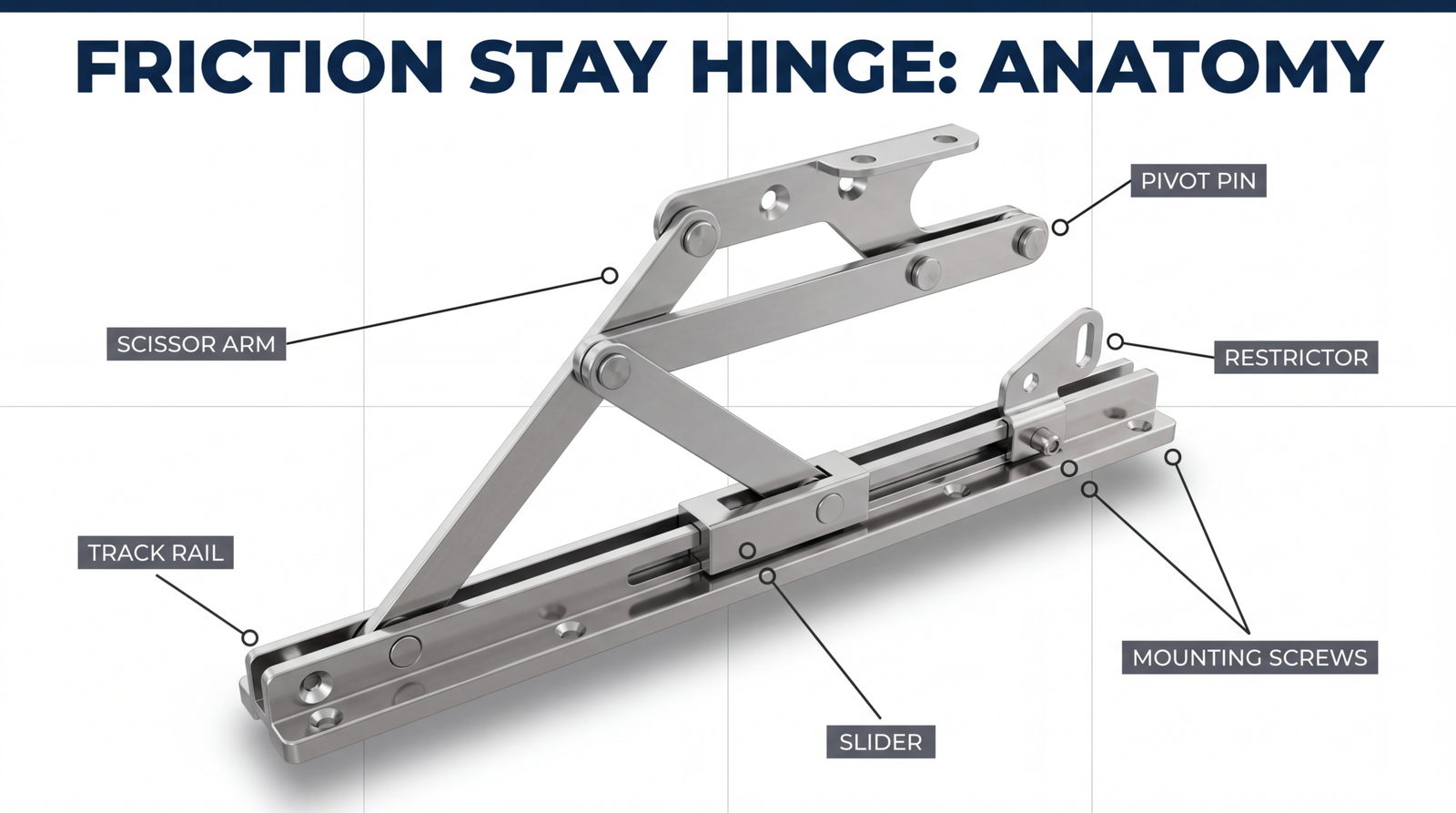
A friction stay is a slider-and-arm assembly that lets the sash open along an arc while the bottom of the sash slides along a track. The friction in the slider holds the sash at any angle without a separate stay arm, which is where the name comes from.
Friction stays are the dominant hinge type in modern aluminium casement windows. They are unobtrusive (the whole assembly hides behind the sash when closed), they offer egress (the sash can be pushed almost flush with the frame for fire escape), and they support cleaning access (a wider opening angle pulls the outside of the glass into reach from inside).
Side-Hung Butt Hinge
A traditional pair of butt hinges fixed to the side jamb, with the sash swinging out (or in) like a hinged door. This is the strongest of the three options. Heavy sashes, oversized sashes, and high-cycle commercial applications often default to side-hung butts because the load path is simple and the components are robust.
The trade-off is cleaning access. A side-hung sash opens to a maximum of about 90 degrees in most installations, and the geometry means the outside face of the glass stays at arm’s length plus the sash width away from the operator. On upper-floor windows, this often forces the homeowner to clean from a ladder or pay for window cleaners.
Top-Hung Hinge
Top-hung hinges fix the sash to the head of the frame, with the sash swinging out at the bottom. This style is most often used for awning windows, top-lights above doors, and high-level ventilation in commercial buildings. The geometry sheds rain naturally because the open sash forms a downward-pointing canopy.
Top-hung windows have two limits worth knowing. They cannot be used for fire egress because the bottom of the sash, which is what an evacuating occupant would push, swings away from the room rather than into the room. And cleaning the outside is impossible from inside because the open sash hangs from the top.
Weight and Size: How Hinges Actually Fail
Hinge failure on a casement window almost always traces back to one specification mistake: choosing a hinge whose weight rating does not match the sash being hung on it.
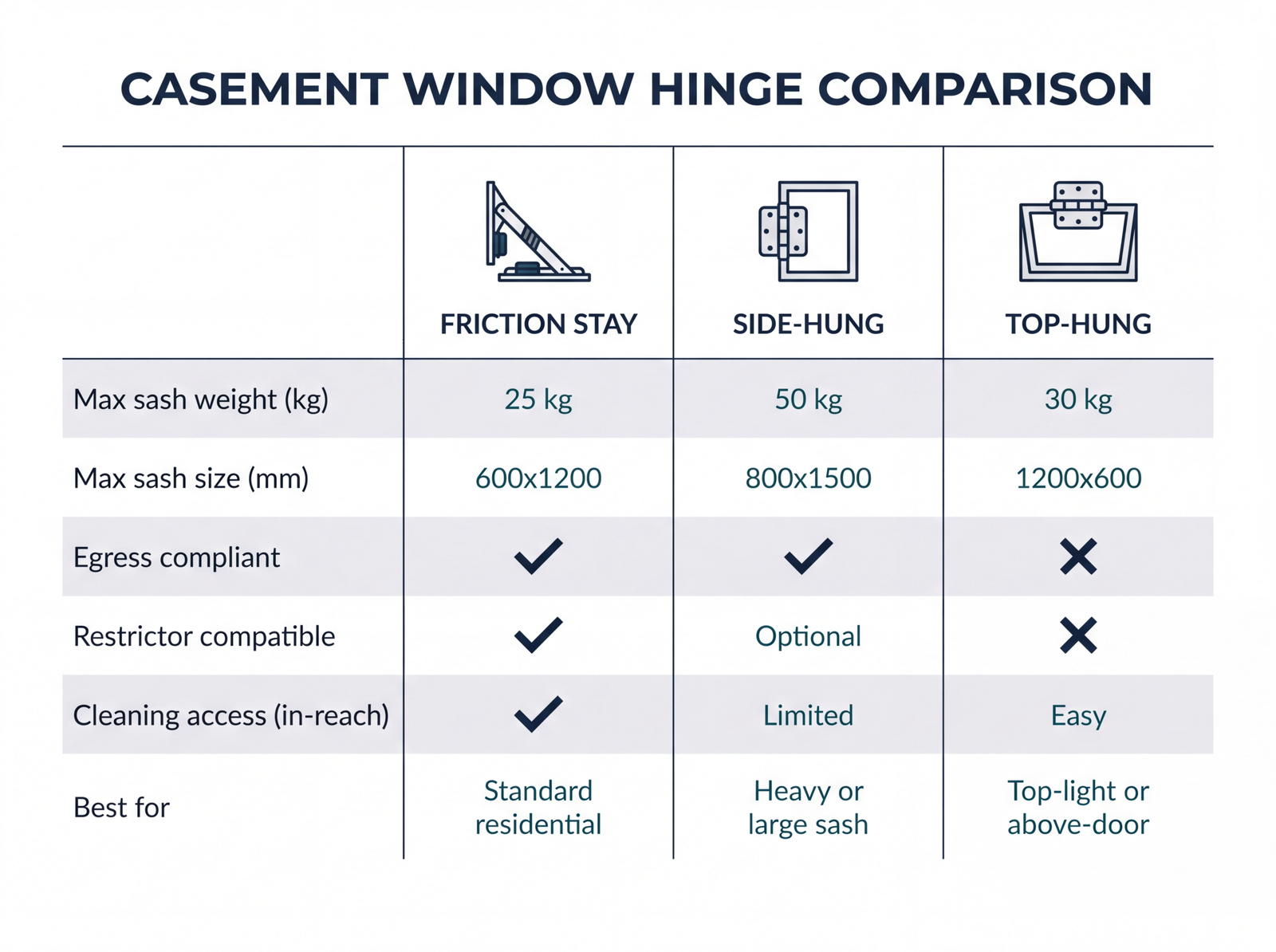
Friction stays are the most weight-sensitive of the three. A standard residential friction stay is rated for sashes up to about 25 kg. Push that to 35 kg or 40 kg and the slider develops play, the sash starts to sag, and within two years the window will not close cleanly without lifting the sash by hand. Heavy-duty friction stays exist (rated to 50 kg and above), but they are visibly bulkier and add cost.
Side-hung butt hinges are the least weight-sensitive. A pair of well-mounted butts can carry 50 kg of sash for the life of the window, and three-hinge configurations stretch that to 80 kg or more. The limit on side-hung is not weight, it is size: a sash wider than about 800 mm starts to put bending moments on the hinges that compromise long-term seal compression.
Top-hung hinges sit between the two on weight tolerance. A standard top-hung supports about 30 kg comfortably. Above that, the hinges and the head of the frame both need reinforcement.
Egress and Restrictor Logic
If the window is part of a habitable room and may be used as a fire escape, the hinge choice carries compliance consequences.
In the UK, building regulations require any escape window in a habitable room to give a minimum clear opening of 0.33 m², with no dimension less than 450 mm, and the bottom of the opening no higher than 1,100 mm above floor level. The window must also open to at least 90 degrees for an evacuating occupant to fit through.
This rules top-hung hinges out for escape windows. It also means friction stays specified for escape windows must be the “egress hinge” variant, which lets the sash track far enough out of the frame to give a true 90-degree clear opening. Standard friction stays open to about 80 degrees, which is fine for ventilation but fails the regulation.
A restrictor is a separate device, usually a stainless steel cable or arm, that limits how far the sash can open. Restrictors are required on windows above ground floor level to stop a child or pet falling out. The two regulations interact: the restrictor must restrict the opening to less than 100 mm, but it must also be releasable (with a key or a pinch-grip) so the occupant can use the window for escape if needed.
In practice, the right hinge choice for a first-floor habitable bedroom is an egress friction stay with a key-released restrictor. Side-hung butts can also work, with a separate restrictor. Top-hung is not eligible.
Cleaning Access: The Specification That Gets Forgotten
Cleaning access is the specification homeowners only think about after the windows are installed and they realise they cannot wash the glass.
Friction stays earn most of their reputation here. A wide-opening friction stay tracks the sash several centimetres out from the frame as it opens, which pulls the outside face of the glass inward toward the operator. On a 600 mm wide sash, this typically brings the entire outside face within arm’s length from the inside.
Side-hung butt hinges do not give this benefit. The sash swings to one side and the outside of the glass remains a sash-width plus an arm-length away.
Top-hung windows, as covered, are not cleanable from inside.
For specifiers working on upper-floor windows where ladder access is impractical, the friction stay is almost always the right answer. For ground-floor windows where outside cleaning is straightforward, the choice can default to whichever hinge family fits the sash size and weight best. Aluminium bifold windows are an alternative to consider for very large openings where no single casement hinge can carry the sash.
How Hinge Choice Maps to Sash Configuration
Different casement window configurations carry different hinge defaults. The configuration determines what is even possible, and the project requirements then narrow the field.
| Sash configuration | Default hinge | Notes |
|---|---|---|
| Single sash, wider than tall | Friction stay | Most common residential casement |
| Single sash, taller than wide | Friction stay or side-hung | Side-hung if heavy or oversized |
| Double sash with central mullion | Friction stay on each | Mirror-image hinge sets |
| Top light (small horizontal sash above a fixed pane) | Top-hung | Awning-style ventilation |
| Above-door fanlight | Top-hung | Manual or motorised |
| Heavy or oversized sash (>40 kg or >800 mm wide) | Side-hung butt | Three-hinge configuration if needed |
| Push-out style | Friction stay (egress variant) | Wide-angle stays |
| Bottom-hung (hopper) | Bottom hinge with restrictor stay | Inward-tilting ventilation |
Hinge Material and Corrosion
Hinges live in the gap between the sash and the frame, where condensation pools and dirt collects. The material specification matters more than most homeowners realise.
Stainless steel is the right material for most aluminium casement windows. Grade 304 is acceptable for sheltered residential. Grade 316 (marine grade) is the right specification for coastal sites, pool environments, and any exposed elevation where chloride exposure is realistic. Plain steel hinges with a zinc coating exist at the budget end and they will rust within five years on any installation that sees real weather.
On Oridow systems, all hinges are stainless steel as standard, with grade 316 available as a specifiable upgrade for marine and coastal applications.
A Working Decision Sequence
For any new specification, the hinge selection runs in this order:
- Sash weight: calculate the sash weight (frame plus glass plus gasket). If above 40 kg, side-hung butts are the safe default. If below 25 kg, friction stays are the default.
- Egress requirement: if the window is in a habitable room above ground floor, an egress hinge is required. This rules out top-hung. Friction stay must be the egress variant.
- Cleaning access: if the window is on an upper floor where ladder access is impractical, friction stay with wide-angle opening is the right default.
- Restrictor: if the window is above ground floor and the cill is below 1,100 mm, a key-released restrictor is required.
- Material: stainless steel 304 for sheltered residential. Stainless 316 for coastal, marine, or exposed elevations.
Going through this sequence at specification stage takes about two minutes per window type and prevents almost all the failure modes covered in this guide.
Related Reading
- Types of casement windows: the casement style overview that determines what hinge choices are available
- Aluminium bifold windows guide: the alternative for openings too large for any single casement hinge
- Jalousie windows: the louvered alternative for ventilation-led applications
- How to choose installation screws: hinge fixings, particularly for aluminium-to-aluminium connections
FAQs
What is the difference between a friction stay and a butt hinge?
A friction stay is a slider-and-arm assembly hidden behind the sash, with friction in the slider holding the sash at any angle without a separate stay arm. A butt hinge is a traditional pair of pivoting plates fixed to the jamb. Friction stays dominate residential aluminium casement windows because they offer egress, cleaning access, and a clean sightline. Butt hinges are stronger and used for heavy or oversized sashes.
Can a top-hung window be used as a fire escape?
No. Top-hung windows hinge from the head of the frame and the bottom of the sash swings outward, away from the room. UK building regulations require an escape window to open to a minimum clear area accessible from inside. Top-hung geometry does not meet that requirement. Use a friction stay or side-hung casement for any escape window.
How heavy a sash can a friction stay carry?
Standard residential friction stays are rated for sashes up to about 25 kg. Heavy-duty friction stays rated to 50 kg and above are available but are visibly bulkier and add cost. For sashes above 40 kg, side-hung butt hinges are usually the better default.
Do all casement windows need restrictors?
No. Restrictors are required on windows above ground floor level where the cill is below 1,100 mm, to stop a child or pet falling out. Ground-floor windows do not require a restrictor. Where a restrictor is required and the window is also an escape window, the restrictor must be releasable with a key or pinch-grip so the occupant can use the window in an emergency.
Should I specify stainless 304 or 316 hinges?
Stainless 304 is acceptable for sheltered residential. Stainless 316 (marine grade) is the right specification for coastal sites within about 5 km of the sea, pool environments, and any exposed elevation where salt or chloride exposure is realistic. The cost difference is small and the lifespan difference in marine conditions is significant.


