
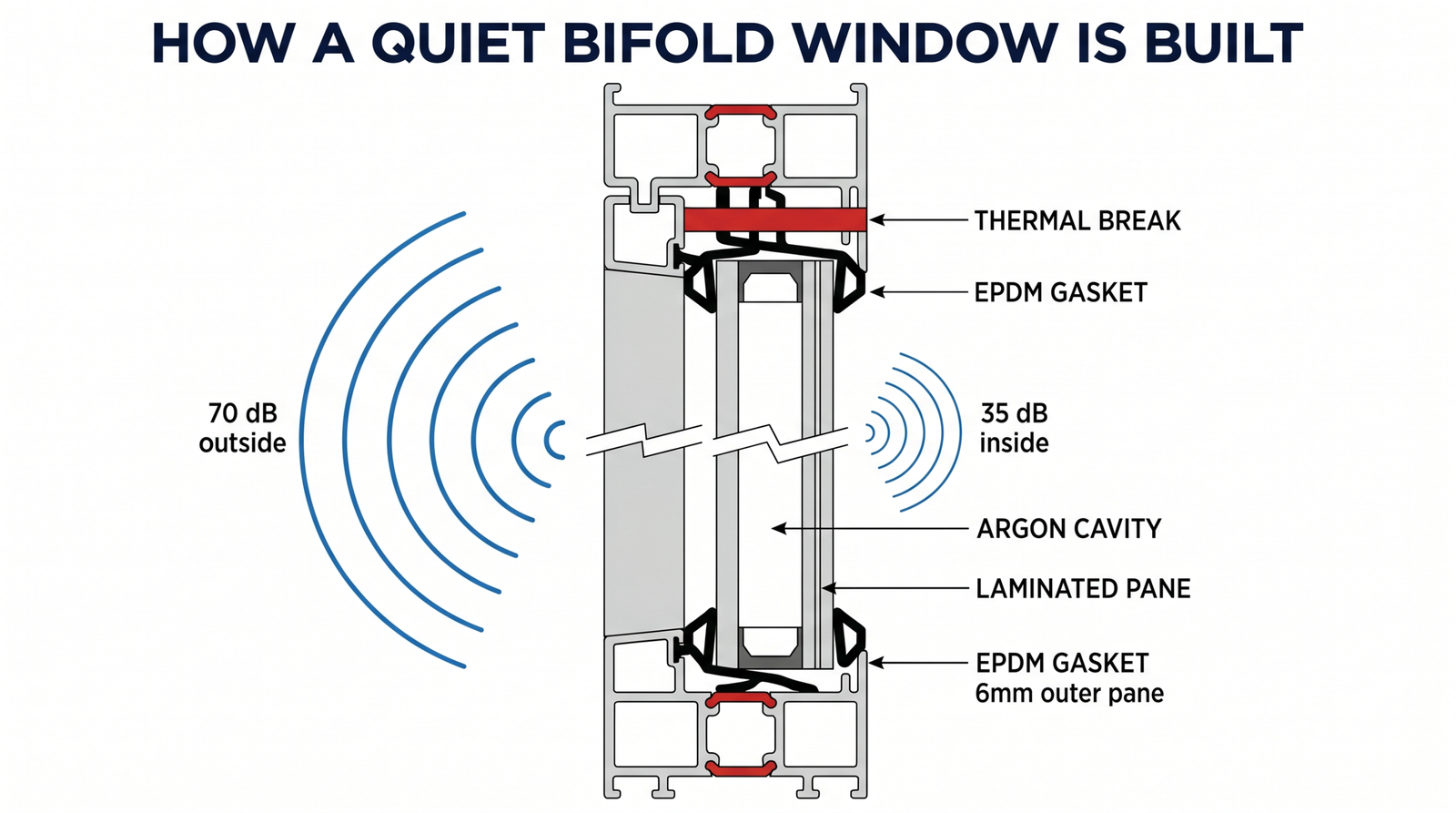
If a bifold window is going on the side of the house facing a busy road, a flight path, a school, or any other steady source of noise, the glass and frame choices stop being aesthetic and start being acoustic. Most aluminium bifold windows are specified for thermal performance and stop there. The acoustic build-up gets bolted on at the end, if at all, and the homeowner discovers post-installation that opening the windows for fresh air also opens the room to the noise.
This guide walks through the engineering of a quiet bifold window. It covers what STC ratings mean and how to read them, the glass build-ups that move the dial, the gasket and seal logic that closes the air-leak path, and the hardware decisions that affect long-term acoustic performance. It is written for premium-residential designers, homeowners on noise-sensitive sites, and specifiers who want a window that delivers the quiet room the brief promised.
For the system-level overview of aluminium bifold windows, start with our aluminium bifold windows guide, then come back here for the acoustic detail.
What STC Ratings Actually Mean
STC stands for Sound Transmission Class. It is a single-number rating, measured in decibels, that summarises how much sound a building element blocks across a range of frequencies. Higher STC means more sound blocked.
The reference points worth committing to memory are these. STC 25 lets normal conversation through clearly. STC 30 lets loud speech through faintly. STC 35 lets only loud music through, and only just. STC 40 produces a room that feels genuinely quiet to most occupants. STC 45 starts to approach studio-grade insulation.
A standard 6 mm single-pane window comes in around STC 27. A standard double-glazed unit with two 4 mm panes and a 6 mm cavity comes in at STC 28, which is barely an improvement. To move into the territory where a bifold window actually changes how a room sounds, the build-up needs work.
The Glass Build-Up Decision
Glass is where most of the acoustic gain comes from. The three variables that matter are pane thickness, cavity depth, and lamination.
Thicker panes block more low-frequency noise. Doubling pane thickness from 4 mm to 8 mm typically gains 2-3 dB at low frequencies (where road noise and aircraft live). The catch is the coincidence dip. Every glass thickness has a frequency range where the panel resonates and lets sound through, and matching pane thicknesses on both sides of a DGU stack their dips, which produces a noticeable weak spot. The fix is asymmetric panes: 4 mm on one side and 6 mm on the other moves the dips apart and smooths the response.
Cavity depth between the two panes also matters, but with diminishing returns. Going from 6 mm to 12 mm adds 2-3 dB. Going from 12 mm to 20 mm adds another 1-2 dB. Cavities deeper than 20 mm add little for windows because the cavity starts coupling acoustically with the surrounding frame.
Lamination is where serious acoustic gain hides. A laminated pane is two pieces of glass bonded with a thin polyvinyl butyral (PVB) interlayer. Standard PVB gives a small acoustic improvement. Acoustic-grade PVB, sometimes called acoustic interlayer, is a different product: it is engineered to dissipate vibrational energy and adds 4-6 dB to the build-up at mid frequencies (the frequencies most relevant to traffic and voice). On a premium quiet-bifold spec, an acoustic-laminated inner pane is the highest-leverage choice you can make.
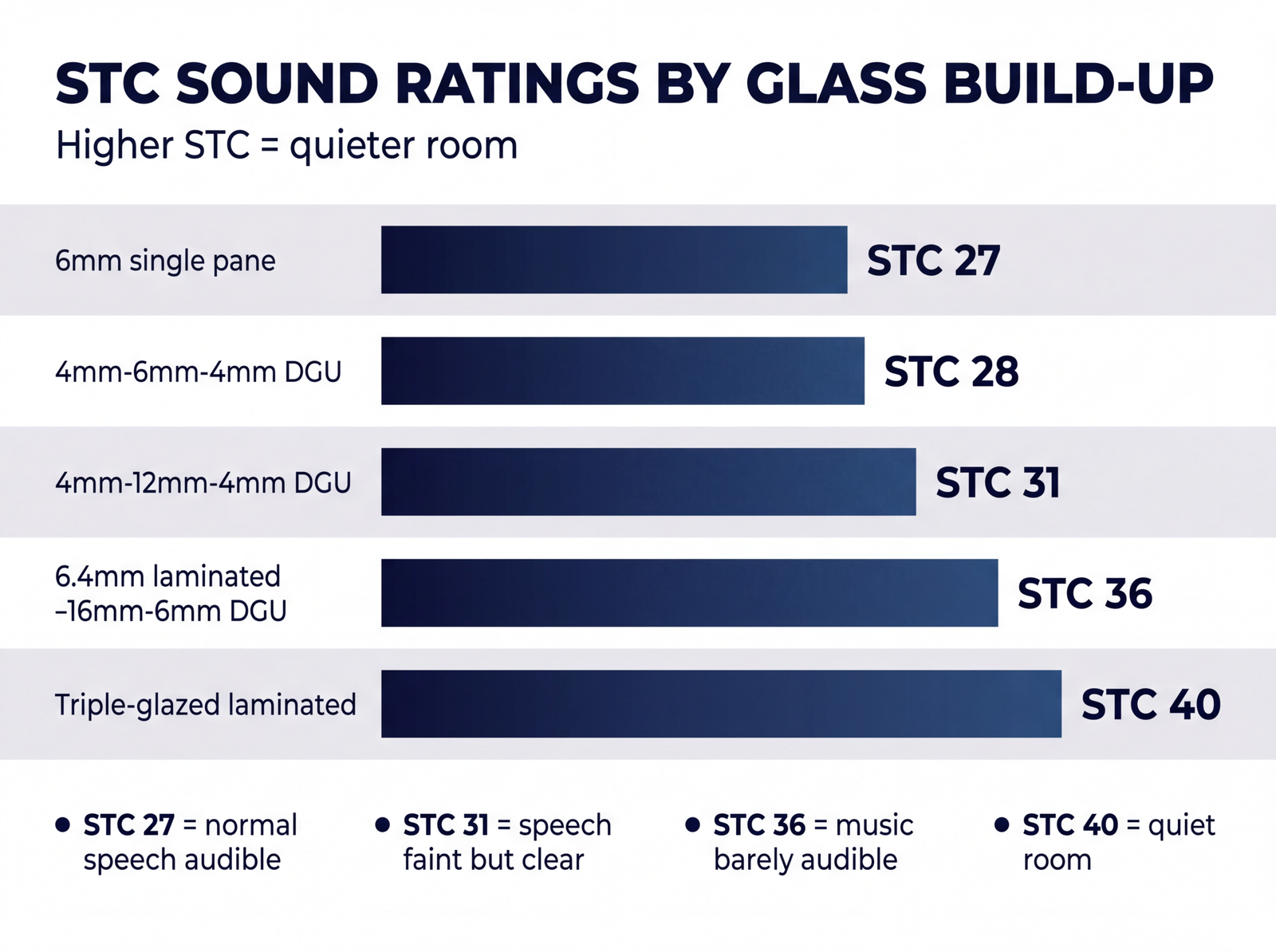
The chart above shows how the choices stack up. A 6.4 mm acoustic-laminated inner pane plus a 6 mm outer pane, with a 16 mm argon cavity between, comes in around STC 36. That is the sweet spot for most premium-residential projects: a meaningful, perceptible quiet room without paying for triple glazing.
Sealing: The Path Sound Actually Takes
Glass blocks sound. Air gaps let it straight through. A bifold window with excellent glass and a 1 mm air gap somewhere along the seal will perform like a much cheaper window. This is true even when the gap is invisible.
Bifold windows have more potential leak paths than fixed windows because the sash moves. Each leaf has gasket compression along all four edges, and the leaves seal against each other in the folded path. Each interface is a chance for a leak.
Three things drive the seal performance:
- Gasket type and compression. EPDM (ethylene propylene diene monomer) is the standard. It compresses to about 30 percent of its uncompressed thickness in service and recovers when the sash opens. Cheaper gasket materials lose recovery within a few years and the seal opens up. Specify EPDM, and ideally dual-gasket profiles (an outer weather seal and an inner air seal).
- Multi-point locking. A single locking point at sash centre creates uneven compression. Multi-point locking (typically three or four points distributed along the sash height) compresses the gasket evenly across the full perimeter. Multi-point locking is acoustic, not just security.
- Threshold seal. Bifold thresholds are the hardest interface to keep airtight because the leaves slide along the track during operation. The track design, the brush seal between leaves, and the bottom gasket together form the threshold path. Specify a threshold profile rated for both water tightness and air tightness, not just one.
On Oridow systems, the gaskets are EPDM with dual-profile sealing as standard, and multi-point locking is included on every multi-leaf configuration.
Frame Material and Thermal Break Acoustic Effect
Aluminium frames are sometimes assumed to be acoustically inferior to UPVC because aluminium is a denser, stiffer material that should transmit more vibration. In practice, the thermal break in a modern aluminium frame disrupts that path. The thermal break is a polyamide strip that separates the inner and outer aluminium profiles, originally introduced for energy efficiency. It also breaks the direct mechanical path for vibration.
A thermally-broken aluminium bifold frame performs comparably to a quality UPVC frame on acoustic tests. The frame is rarely the limiting factor in real-world acoustic specs because the glass area dominates the result. As long as the frame has a proper thermal break, the acoustic difference between aluminium and UPVC is within the margin of measurement variability.
Hardware Choices That Affect Acoustic Performance
Three hardware choices show up in real-world acoustic performance and are easy to overlook at specification stage.
Hinge and roller weight rating
A correctly-rated hinge and roller assembly holds the sash square against its gasket for the life of the window. An undersized assembly lets the sash sag a few millimetres over time, which opens up the gasket compression along the top edge and degrades acoustic performance. Specify the next weight class up from where the sash actually lands. A 30 kg sash on a 35 kg-rated assembly will hold its acoustic performance longer than a 30 kg sash on a 30 kg-rated assembly.
Master door handle and locking
The master door (the swing-only leaf used as a pedestrian door) has its own multi-point locking system separate from the folding leaves. This is the leaf operated most often, so its compression cycles are the highest. Specify a high-cycle multi-point lock with a robust handle gear. Cheaper handles develop play within two years and the master door starts to leak.
Installation fixings
The frame fixings between the bifold and the structural opening are typically not visible in datasheets, but they matter acoustically. A frame that is screwed tight against an unfilled gap to the structure leaks sound around the frame, even if the window itself performs to spec. Choosing the right installation screws and ensuring the structural gap is filled with closed-cell expanding foam (not open-cell) closes that path.
Budget vs. Premium: Where the Money Actually Goes
On a quiet-bifold specification, the biggest single budget impact is the inner pane. Going from a standard 4 mm or 6 mm inner pane to a 6.4 mm or 8.4 mm acoustic-laminated inner pane usually adds 15-25 percent to the glass cost on a typical residential project. That single change moves the build-up from STC 28 to STC 36, which is the difference between a window that does not improve the room and a window that audibly transforms it.
The next biggest impact is the gasket and seal package, where dual-EPDM and multi-point locking together add about 10 percent to the door cost. After that, frame upgrades (deeper sections, heavier thermal break) add another 5-10 percent for marginal acoustic gains.
Triple glazing is rarely the right call on a budget basis. The acoustic gain over a high-spec laminated DGU is small (typically 3-5 dB at most frequencies), and the cost increase is significant. Triple glazing earns its place when thermal performance is the priority and acoustic is a side benefit, not the other way around.
How Casement and Bifold Compare for Acoustic Spec
On any project where a quiet room is the priority, a fixed (non-opening) window will always outperform a bifold of the same glass build-up by 2-4 dB. The reason is the gasket interface count. A fixed window has one perimeter seal. A bifold has multiple sash-to-sash seals plus the threshold.
If the brief allows it, splitting the wall into a quiet fixed picture window plus a separate bifold for ventilation and access can deliver acoustic and amenity targets simultaneously. For full-opening configurations where a fixed pane is not an option, the bifold spec covered in this guide is the right path.
For comparison, a casement window with the same glass build-up will perform similarly to a bifold of equivalent spec, because both have similar gasket-interface counts. See our guide to types of casement windows for the casement options.
A Working Specification: Premium Residential, Road-Facing
For a 4-panel aluminium bifold window facing a moderately busy urban road, the acoustic specification looks like this:
- Glass: 6 mm float outer pane, 16 mm argon cavity with warm-edge spacer, 6.4 mm acoustic-laminated inner pane. Predicted STC: 36.
- Frame: standard thermally-broken aluminium, 70 mm depth class. Frame is not the limiting factor at this spec.
- Gaskets: dual EPDM profiles, outer weather seal plus inner air seal.
- Locking: multi-point locking on each leaf, four-point on the master door.
- Threshold: ramped, with brush seal between leaves and bottom gasket rated for both 200 Pa water tightness and air-class 4.
- Installation: closed-cell expanding foam in the structural gap, perimeter fixings on the manufacturer’s recommended schedule, sealant bead inside and outside.
That specification typically delivers a room where conversation in a moderately-busy urban street outside is faintly audible inside, music outside is inaudible, and the room feels noticeably quieter than the room next door with a standard double-glazed window.
Related Reading
- Aluminium bifold windows guide: the system-level overview
- Types of casement windows: the casement alternative when full bifold opening is not required
- How to choose installation screws: the fixings that close the frame-to-structure acoustic path
FAQs
What STC rating do I actually need for a quiet room?
STC 36 is the practical target for most premium-residential rooms in moderate-noise environments. It is the threshold where most occupants describe the room as noticeably quieter. STC 40 is required for sites near major flight paths, motorways, or rail lines. STC 28 (a standard double-glazed unit) is not enough for any noise-sensitive room.
Does triple glazing make a bifold window quieter?
Marginally. A triple-glazed unit typically adds 3-5 dB over a high-spec laminated DGU, which is a perceptible but not transformative improvement. The cost increase is significant. Triple glazing is the right answer when thermal performance is the priority and acoustic is a secondary benefit. For acoustic-led specifications, a high-quality laminated DGU is usually the better budget allocation.
Can I retrofit acoustic glass into an existing bifold window?
Sometimes. The frame and sash channels need to be deep enough to take the new DGU thickness, which is usually 28-34 mm for an acoustic spec. Many older bifold systems use shallower channels and cannot accept the upgraded glass without replacing the sash. Always check the channel depth and gasket spec on the existing window before pricing a glass-only retrofit.
What is the difference between standard PVB and acoustic PVB?
Standard PVB is the safety interlayer used in laminated glass for impact resistance and shatter containment. It gives a small acoustic improvement. Acoustic PVB is a different product, often described as acoustic interlayer or PVB-A, engineered specifically to dissipate vibrational energy. Acoustic PVB typically adds 4-6 dB at mid frequencies (traffic and voice). Always specify acoustic PVB explicitly. Standard laminated glass without acoustic PVB will not deliver the same acoustic result.
How much does a quiet bifold window cost compared to a standard one?
On a typical 4-panel residential project, a quiet bifold specification (acoustic-laminated DGU plus dual-EPDM gaskets plus multi-point locking) usually adds 20-30 percent to the cost of a standard thermal-only specification. The single biggest line item is the laminated inner pane. Frame upgrades and triple glazing add cost beyond that for diminishing acoustic returns.


