
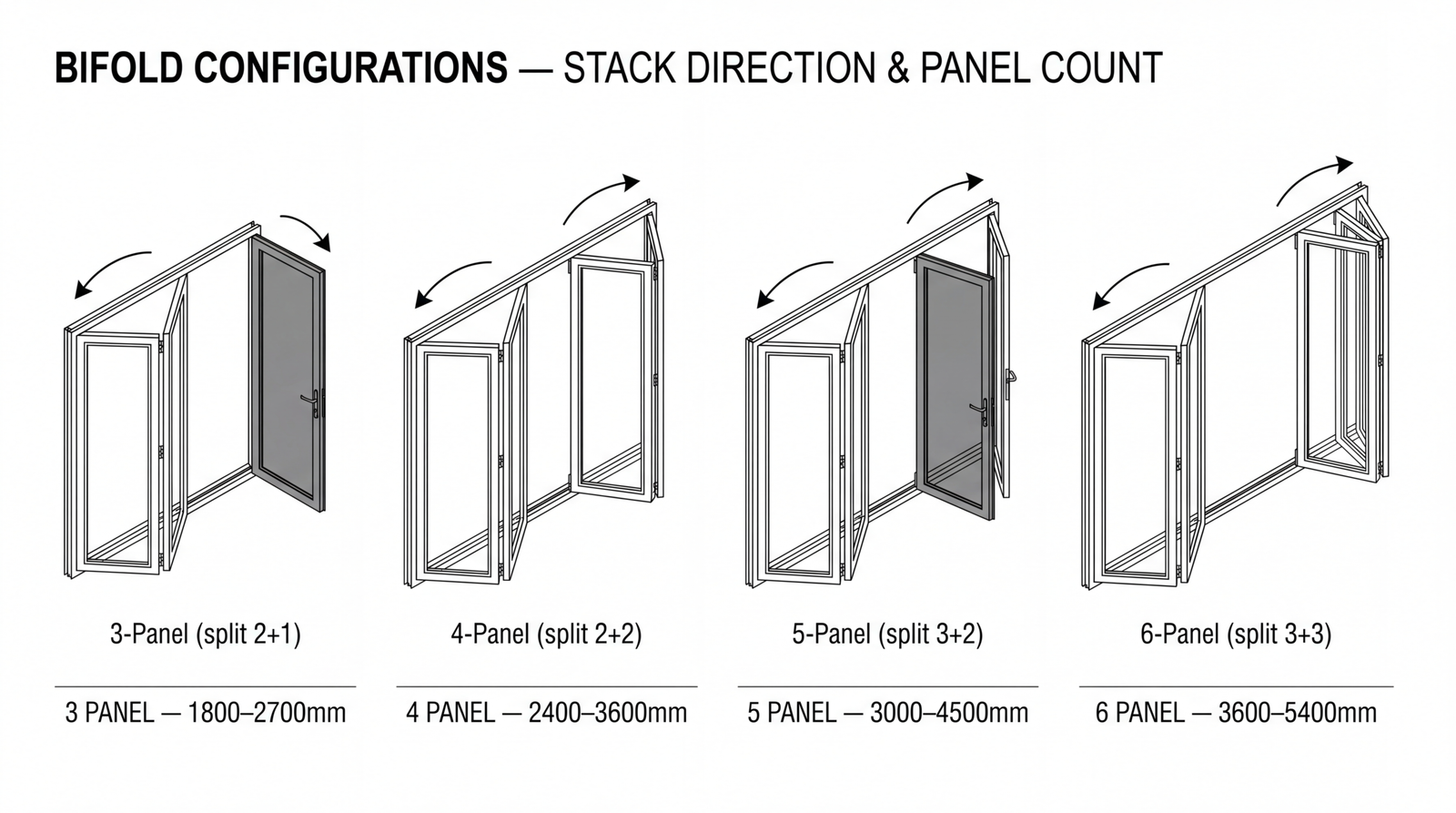
If you have ever specified an aluminium bifold door and felt like the configuration choices were arbitrary, this guide is for you. Panel count, stack direction, master-door placement, and threshold type are not interchangeable. Each one carries weatherability, accessibility, and ergonomic consequences that show up after the door is installed, and they are easier to get right at drawing-board stage than retrofit later.
This guide walks through how the four variables interact, with the dimensions and decision rules a working specifier actually needs.
Looking for the wider picture first? Start with our aluminium bifold doors guide for the door system overview, then come back here for the configuration detail.
How Panel Count Maps to Clear Opening Width
The first decision is panel count, and it is driven by the clear opening you have to fill, not by aesthetics. Each panel has a practical width range. Push narrower than the lower end and the door looks crowded; push wider and the panel weight starts to fight the rollers.
| Panels | Typical opening width (mm) | Practical maximum (mm) | Use case |
|---|---|---|---|
| 2 | 1,200 – 1,800 | 2,000 | En-suite to balcony, narrow utility access |
| 3 | 1,800 – 2,700 | 3,000 | Single-room garden access, kitchen pass-through |
| 4 | 2,400 – 3,600 | 4,000 | Standard living-room-to-patio opening |
| 5 | 3,000 – 4,500 | 5,000 | Open-plan living-to-deck, hospitality |
| 6 | 3,600 – 5,400 | 6,000 | Large entertaining spaces, commercial |
| 7 | 4,200 – 6,300 | 7,000 | Premium residential, pool/garden full openings |
The reason panels do not simply scale linearly is sash weight. A standard double-glazed unit at 28 mm thickness and reasonable height (2,100 mm) puts each leaf at 35 – 50 kg. The track and rollers can handle that all day, but the operational feel, how easily the door folds and how cleanly it stacks, degrades when individual leaves get past about 950 mm wide. Most quality manufacturers, Oridow included, hold panel width between 600 and 950 mm for residential systems.
Stack Direction: Why It Is Not a Free Choice
Stack direction is the side the door folds and parks against when fully open. The default assumption is “wherever the customer wants.” But in practice, three things constrain it:
1. Internal furniture. A door stacking against a sofa or kitchen island simply cannot fully open. The folded stack adds 180 – 250 mm of frame depth to the wall on the stack side; that depth needs clear floor and clear airspace for the leaves to swing.
2. Prevailing wind. On exposed elevations, a door stacking into the wind will catch every gust during operation. Stacking with the wind keeps the leaves controllable when partially open.
3. The master door (traffic door). Every bifold configuration has one panel that swings independently, the master, used as a regular pedestrian door without folding the whole system. The master always sits on the stack-end side, opposite the hinge stile of the next leaf in the stack. So if you stack right, the master is on the right; if you stack left, the master is on the left.
The master door is a specification choice, not an option. Without it, every walk-through requires unfolding the full system. Oridow includes a master door in every multi-panel configuration above two leaves, with the option to specify left- or right-hand operation.
Even vs. Odd Panel Counts: The Split Decision
When the panel count is even (2, 4, 6), the door splits evenly: half stack left, half stack right, or stacks fully to one side. When the panel count is odd (3, 5, 7), one side always carries the extra panel. That extra panel is what creates the master-door asymmetry.
A 4-panel door commonly runs as 2+2 (split open from the centre) or 4+0 (stacks fully to one side). A 5-panel door runs as 3+2 (one side gets the master plus two folding leaves; the other side gets two folding leaves). A 6-panel door runs as 3+3 (symmetric centre-open) or 6+0 (full one-side stack).
For most residential applications, even-panel symmetric configurations look cleaner architecturally. For maximum unobstructed clear opening on one side, odd-panel configurations or one-sided stacks are stronger. The trade-off is sight-lines: a 6+0 stacks 1,200 – 1,500 mm of folded leaves against one jamb, which is a lot of metal against a wall.
Inward vs. Outward Opening
Most bifold doors open outward by default. Outward folding keeps the internal floor clear, which is why almost every garden-facing residential bifold opens out. The exception is when external space is constrained: a tight balcony, a covered porch with a low soffit, where inward folding is the only option.
Inward folding has two consequences worth flagging:
- Clear floor zone: the swing of the leaves needs to be unobstructed by furniture, rugs, or appliances. A 4-panel inward-folding door needs about 700 mm of clear internal floor along the full opening width during operation.
- Threshold drainage: outward-opening systems shed water naturally to the outside. Inward systems need extra attention to drainage and gasket sealing, see the threshold section below.
For tight-space alternatives where neither direction is workable, the PD door is a swing-sliding hybrid worth considering.
Threshold Choice: Where Most Specifications Go Wrong
Threshold type is where bifold doors most often disappoint after installation, and almost always because the wrong threshold was specified for the application.
There are three threshold types in common use, each with a clear best-fit application.
Rebated threshold (recessed)
The aluminium threshold sits in a recess machined into the floor structure, with the door’s bottom seal compressing against an upstand. This is the most weather-resistant of the three, water draining off the exterior face of the door is intercepted by a drainage channel and chased outside before it can reach the internal seal.
- Weatherability: highest (rated for >300 Pa water tightness and beyond)
- Accessibility: poor, the upstand is a 25 – 40 mm trip hazard
- Best for: coastal, exposed, or high-rainfall sites; commercial applications without DDA accessibility requirements
Flush threshold (level)
The aluminium threshold is set level with the internal finished floor, no upstand, no step. Drainage is handled by a sub-threshold channel that catches water passing under the door’s bottom seal.
- Weatherability: moderate (typically rated for 150 – 250 Pa)
- Accessibility: excellent, fully DDA compliant, wheelchair- and mobility-aid-friendly
- Best for: residential extensions, ground-floor living spaces, any project with accessibility requirements
Ramped threshold (sloped exterior)
A hybrid: the internal side of the threshold is flush with the floor, but the external side ramps down at a gentle slope. This gives weather resistance approaching the rebated profile while preserving most of the accessibility of the flush option.
- Weatherability: good (200 – 300 Pa range with a quality ramped profile)
- Accessibility: good, the gentle ramp meets most DDA gradient guidance
- Best for: premium residential, pool-deck transitions, anywhere both weather and accessibility matter
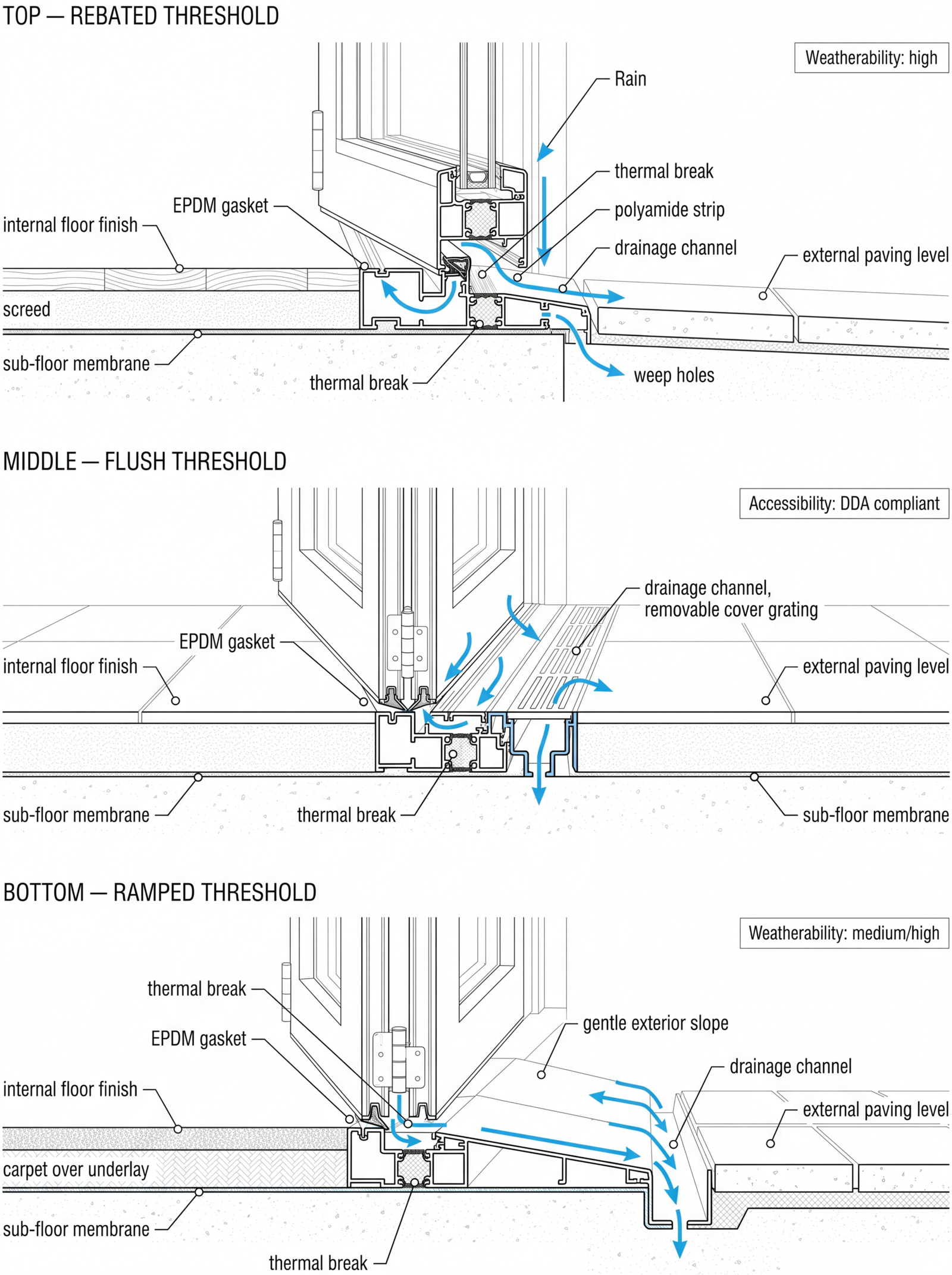
The rule of thumb most specifiers eventually learn: on a UK-style coastal or exposed site, default to ramped or rebated; on a sheltered modern residential extension, default to flush; reach for the rebated profile only when the project actively prioritises weather over accessibility.
Putting It Together: A Worked Example
Consider a 3,200 mm clear opening to a south-facing garden in a sheltered residential rear extension. The decision chain looks like this:
- Panel count: 4 panels (2+2 split). 3,200 mm divided by 4 leaves = 800 mm per leaf, comfortably inside the 600 – 950 mm operating sweet spot.
- Stack direction: centre-split (2+2). Sight-lines stay symmetrical and the kitchen island sits 1,400 mm off the opening on the right, which would have ruled out a 4+0 right-side stack.
- Master door: specify on the right-hand pair, where the family enters from the patio path.
- Opening direction: outward. Internal floor is hardwood and stays clear of leaf swing.
- Threshold: flush. South-facing, sheltered by an overhanging eaves detail; accessibility matters because there is a young child and an older relative who use the door regularly.
That is the full configuration in five decisions. Every one of them is reversible at the design stage and difficult to change after manufacture.
Frame Build Quality Underneath It All
Configuration choices only deliver if the underlying door system is built right. The thermal break in the frame, the gasket compression, the roller weight rating, and the multi-point locking all need to match the configuration you specified. A 6-panel system on a low-grade frame will sag and stick within two years; a 3-panel system on the right frame will run cleanly for fifteen.
Choosing the right installation screws for the head and jamb fixings, particularly on aluminium-to-aluminium connections, is one of the small details that affects whether the door still operates smoothly a decade in.
Related Reading
- The ultimate guide to aluminium bifold doors: system-level overview
- Aluminium folding doors guide: terminology and how folding doors compare
- Aluminium bifold windows guide: same folding mechanism, applied to windows
- PD door: swing-sliding hybrid for tight openings where bifolds will not fit
- Swing sliding door: full PD door product page
FAQs
How wide can a single bifold door panel be?
In aluminium residential systems, the practical operating sweet spot is 600 – 950 mm per leaf. Below 600 mm the configuration looks crowded; above 950 mm the leaf weight degrades the operational feel and shortens roller life.
What is the master door in a bifold configuration?
The master door is the leaf that operates as a standard hinged pedestrian door, without folding the rest of the system. Every multi-panel bifold above two leaves should include a master door, it is what lets you walk through the system day-to-day without unfolding everything.
Should a bifold door open inward or outward?
Outward opening is the default and the right answer for almost all residential applications. Inward opening is only specified when external space is genuinely constrained: a tight balcony, a covered porch. It also requires extra attention to internal floor clearance and threshold drainage.
What is the difference between rebated, flush, and ramped thresholds?
Rebated thresholds have a recessed channel and an upstand, giving the highest weather resistance but creating a trip hazard. Flush thresholds sit level with the floor for full accessibility but tolerate less driving rain. Ramped thresholds split the difference: almost level internally, gently sloped externally, and they are the most popular choice for premium residential.
Can I change panel count after the door is manufactured?
No. Panel count, stack direction, and master-door placement are all fixed at manufacture. This is why the configuration discussion is most valuable at drawing-board stage, every variable in this guide is reversible in design and irreversible in manufacture.


