
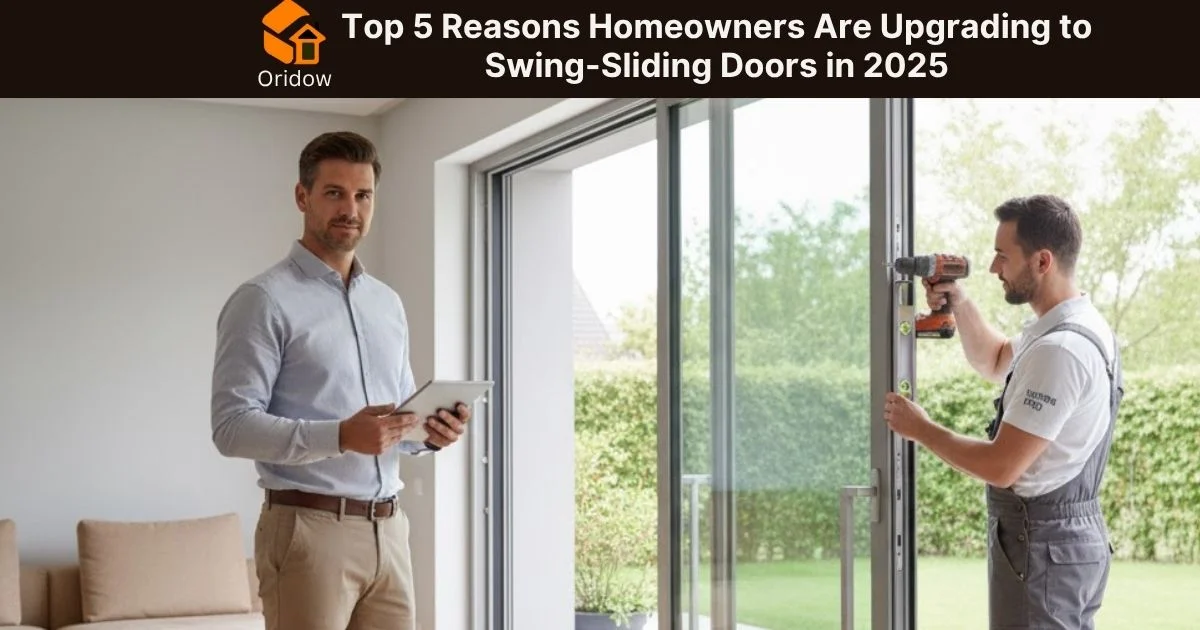
Homeowners are increasingly choosing swing-sliding doors in 2025 for their perfect balance of style, functionality, and energy efficiency. These doors combine the elegance of traditional hinged systems with the smooth operation of sliding mechanisms, making them an ideal upgrade for both contemporary and classic homes. The design not only enhances aesthetic appeal but also improves natural light flow and space utilization two major priorities in modern architecture.
With the rise of smart home technology and sustainable living, more homeowners are focusing on energy-efficient, space-saving, and customizable upgrades. Swing-sliding doors fit these evolving needs perfectly. They deliver advanced insulation, innovative automation options, and a minimalist look that aligns with 2025 home improvement trends. Let’s explore the top five reasons these doors have become the go-to choice for homeowners this year.
What Are Swing-Sliding Doors and Why Are They Trending in 2025?
Swing-sliding doors are innovative systems that blend the mechanisms of hinged and sliding doors. Each panel moves smoothly along a track and can also pivot open, giving you both flexibility and full access when needed.
Why They’re Part of 2025 Home Improvement Trends
- Homeowners want modern minimalist door designs that save space.
- Builders and designers highlight them as the best door system of 2025 for energy efficiency and flexibility.
- Their sleek aesthetic fits perfectly into open-concept and sustainable home renovations.
Homeowners looking to compare door design options can find multiple frame and material choices that complement modern layouts.

1. Space-Saving Elegance for Modern Homes
Question: How do swing-sliding doors save space compared to traditional doors?
Swing-sliding systems help you maximize your floor area by removing the need for a wide door swing radius. They slide and pivot along the same track, creating a smooth transition between indoor and outdoor areas.
Benefits:
- Perfect for compact homes, patios, and balconies.
- Provides uninterrupted views and a seamless flow between spaces.
- Complements open-plan layouts that dominate 2025 interior design trends.
Pro Tip: For efficient installation, check the detailed door fitting guide to ensure proper alignment and track placement.
2. Energy-Efficient and Weather-Smart Design
Question: Are swing-sliding doors energy-efficient?
Yes. Modern models use insulated aluminum or composite frames, low-emissivity glass, and tight weather seals to reduce heat loss.
Key Takeaways:
- Provide up to 30% better insulation than standard sliding doors.
- Support energy-efficient home upgrades aligned with 2025 building standards.
- Many systems are certified by ENERGY STAR® for verified thermal performance.
Verified Data:
According to the U.S. Department of Energy’s 2025 Energy Efficiency Outlook, door and window upgrades can reduce annual energy bills by 10–15%, especially when paired with low-E glazing and proper installation.
When evaluating energy-efficient models, focus on glazing ratings and material certifications to ensure long-term performance.
3. Modern Minimalist Aesthetic Appeal
Question: Why do designers prefer swing-sliding doors for modern homes?
They deliver both function and style. With slim frames, expansive glass panels, and concealed hardware, swing-sliding doors enhance natural light and give spaces a clean, architectural look.
Design Highlights:
- Fit seamlessly into modern minimalist door designs.
- Popular in industrial, Scandinavian, and contemporary homes.
- Available in custom finishes such as matte black, brushed steel, and soft white.
Pro Tip: Coordinate your door finish with interior elements for harmony. Homeowners seeking flexible customization can review tailored swing-sliding systems that balance function and design.
4. Seamless Smart-Home Integration
Question: Can swing-sliding doors connect to smart home systems?
Yes. In 2025, leading manufacturers have introduced models compatible with home automation platforms like Google Home, Amazon Alexa, and Apple HomeKit.
Smart Features Include:
- App-based locking and unlocking for enhanced security.
- Weather-sensor automation that adjusts airflow.
- Voice-activated controls for convenience and accessibility.
To explore real-world integrations, review this overview on smart home compatibility and how it enhances convenience and energy control.
5. Long-Term Value and ROI for Homeowners
Question: Is upgrading to swing-sliding doors worth the investment?
Yes. They add long-term comfort, improve home value, and contribute to energy savings.
Return on Investment Highlights:
- Average ROI: 70–80% based on the recent Remodeling Magazine Cost vs. Value Report 2025.
- Improves curb appeal and interior brightness, key selling points for buyers.
- Qualifies for energy-efficiency tax credits under current federal incentive programs.
Verified Market Insight:
According to the National Association of Realtors® 2024 Remodeling Impact Report, modern door replacements and upgrades are among the top five projects that enhance resale value and buyer appeal.
Homeowners who value precision craftsmanship and certified materials can confidently consider Oridow’s swing-sliding doors globally recognized for durability, customization, and CE-certified performance.
Swing-Sliding Door vs Sliding Door vs Bifold Door
If you are planning a door upgrade, it helps to compare how each system works in everyday use. Swing-sliding, sliding, and bifold doors can all create a strong indoor-outdoor connection, but they differ in access, space requirements, operation, and maintenance.
| Feature | Swing-Sliding Door | Sliding Door | Bifold Door |
|---|---|---|---|
| Operation | Combines swing and sliding movement | Panels slide horizontally along tracks | Hinged panels fold and stack together |
| Everyday Access | Excellent; a swing panel can provide quick entry without opening the full system | Simple and convenient | May require moving several panels |
| Opening Flexibility | High; choose partial or wider access depending on the configuration | Moderate; overlapping or fixed panels can limit the clear opening | Very high; most of the opening can be exposed |
| Space Efficiency | Good; requires some clearance for the swing panel | Excellent; no inward or outward swing area needed | Good, but stacked panels require space at one or both sides |
| Indoor-Outdoor Connection | Excellent | Good to excellent | Excellent |
| Large Openings | Well suited to flexible multi-panel configurations | Well suited to wide glazed openings | Particularly effective for creating wide openings |
| Weather Sealing | Strong when designed with quality compression seals and drainage | Strong with properly engineered interlocking seals | Depends heavily on seals across multiple panel joints |
| Security | Can use multi-point locks and secure panel hardware | Can use reinforced locks and security glazing | Can use multi-point locking across folding panels |
| Maintenance | Tracks, hinges, rollers and seals require periodic attention | Generally straightforward track and roller maintenance | More hinges, rollers and moving joints to maintain |
| Best Suited For | Homeowners wanting flexible daily access plus a wider opening when needed | Spaces where simplicity and floor-space efficiency matter | Projects where maximizing the clear opening is the priority |
Which One Is Right for Your Home?
Choose a swing-sliding door if you want the convenience of a conventional swing door for everyday access while retaining the ability to open a much larger section when entertaining or connecting indoor and outdoor areas.
A sliding door is often the better choice when floor space is limited and straightforward operation is the priority.
A bifold door makes sense when the primary goal is to open as much of a wide wall opening as possible and you have sufficient room for the panels to stack.
The best system ultimately depends on your opening dimensions, available space, climate, frequency of use, desired clear opening, and architectural style.
Before You Upgrade: Swing-Sliding Door Checklist
A door upgrade should be based on more than appearance. Before ordering a swing-sliding system, confirm that its dimensions, components, glazing, security, and performance are appropriate for your property.
Use this checklist before making your decision:
- Measure the opening accurately. Confirm width, height, wall thickness, floor level, and available clearance.
- Choose the panel configuration. Decide how many panels you need and which panel should provide everyday swing access.
- Confirm the opening direction. Consider furniture, walls, walkways, and outdoor areas before choosing inward or outward operation.
- Inspect the track and rollers. Quality hardware should support the panel weight while providing smooth, controlled movement.
- Evaluate the frame. Consider structural strength, corrosion resistance, thermal performance, and suitability for your climate.
- Choose suitable glazing. Options may include double glazing, Low-E glass, tempered safety glass, or laminated glass depending on your requirements.
- Check weather sealing. Ask about gaskets, compression seals, drainage channels, and resistance to air and water infiltration.
- Review the locking system. Multi-point locking and robust hardware can improve both security and sealing.
- Assess the threshold. Consider accessibility, drainage, weather exposure, and potential trip hazards.
- Consider climate exposure. Coastal, high-wind, humid, or very hot environments may require specific finishes and hardware.
- Check maintenance requirements. Make sure tracks, rollers, drainage channels, seals, and locking hardware remain accessible for servicing.
- Review warranty coverage. Ask what is covered for frames, glazing, locks, rollers, hinges, and other moving components.
- Confirm replacement-part availability. Reliable access to rollers, handles, locks, seals, and other hardware can simplify future repairs.
- Use qualified installation. Correct alignment, sealing, drainage, and panel adjustment are essential for long-term performance.
A reliable manufacturer or supplier should be able to explain these factors clearly and recommend a system based on your project’s dimensions, location, usage, and performance requirements.
Safety Features to Look for in Swing-Sliding Doors
Large moving glass panels need more than attractive frames and smooth operation. Safety features should protect users during everyday operation while also improving security and structural reliability.
Anti-Pinch Design
Moving panels, hinges, and closing points can create areas where fingers may become trapped. A well-designed system should minimize exposed pinch points and use hardware or protective design features that reduce this risk.
This is particularly important in homes with children or in busy commercial environments.
Controlled Panel Movement
Heavy panels should move smoothly rather than accelerate or close suddenly. Quality tracks and rollers help maintain controlled movement, while soft-close or damping mechanisms can reduce harsh impacts and slamming.
Tempered or Laminated Safety Glass
Large glazed doors should use suitable safety glass.
Tempered glass is designed to break into smaller fragments rather than large sharp pieces if damaged.
Laminated glass contains an interlayer that helps hold broken glass together and can also provide additional security.
The appropriate glazing should be selected according to the project’s location, size, safety requirements, and local building regulations.
Multi-Point Locking
Instead of securing the door at only one position, a multi-point lock engages the frame at several points.
This can provide stronger resistance to forced entry while also helping the panel compress evenly against its weather seals.
Secure Tracks and Rollers
The panels should remain securely engaged with their tracks throughout operation. Quality guides, rollers, and retention components help minimize excessive movement and reduce the risk of a panel becoming unstable.
Anti-Collision Protection
Controlled stops, buffers, or anti-collision features can help prevent moving panels from striking adjacent panels, frames, or walls too forcefully.
These features can also help protect hardware and finishes from repeated impact.
Safe Threshold Design
A poorly designed threshold can become a trip hazard. Consider a low-profile solution where accessibility is important, while ensuring that adequate drainage and weather protection are maintained.
Child-Safe Hardware
For family homes, consider handle placement, locking controls, closing speeds, and whether children can operate the system unsupervised.
Where appropriate, additional locking or access-control features can provide extra protection.
Professional Installation and Safety Testing
Even high-quality safety components depend on correct installation. Once installed, the door should be tested for:
- Smooth and controlled panel movement
- Secure track engagement
- Correct lock operation
- Proper panel alignment
- Safe clearances between moving components
- Secure glazing
- Effective stops and closing mechanisms
For oversized panels, exposed locations, or high-traffic applications, discuss safety and structural requirements with the manufacturer or installer before finalizing the system.
Where to Buy the Best Swing-Sliding Doors for Homes

When choosing a supplier, prioritize quality, customization, and certified performance. Your door system should reflect precision engineering, reliable materials, and long-term durability.
Why Homeowners Trust Oridow
For homeowners seeking a trusted global manufacturer, Oridow stands out as a leading choice in custom aluminum and uPVC swing-sliding doors. Unlike generic suppliers, Oridow specializes in tailor-made designs that fit both residential and commercial projects, ideal for modern architecture where every millimeter matters.
What Sets Oridow Apart:
- Precision Customization: Every door is built to order, ensuring exact fit, smooth operation, and design harmony.
- Global Standards: Certified under CE and ISO quality benchmarks for structural integrity and performance.
- Energy Efficiency: Advanced thermal insulation and airtight sealing help reduce energy costs while improving comfort.
- Durability and Longevity: Premium-grade materials resist corrosion, weathering, and fading even in demanding climates.
- End-to-End Support: From consultation to export logistics, Oridow delivers professional service and transparent communication worldwide.
Whether you’re an architect, builder, or homeowner, Oridow’s swing-sliding door systems are engineered for modern comfort, sustainability, and design excellence, making them the ideal choice for anyone upgrading in 2025.
Final Thoughts
Upgrading to swing-sliding doors in 2025 is a practical, stylish, and future-focused choice. These doors combine the best of innovation, sustainability, and design flexibility perfectly aligned with the modern homeowner’s priorities.
Frequently Asked Questions (FAQ)
Are swing-sliding doors more expensive than regular doors?
They typically cost 20–40% more than standard sliding doors, but offer better insulation, design flexibility, and energy savings that offset the cost over time.
Do swing-sliding doors require special maintenance?
Maintenance is minimal. Keep tracks clean, lubricate moving parts annually, and inspect weather seals to maintain airtight performance.
Can swing-sliding doors be customized?
Yes. Most suppliers offer custom sizing, colors, glazing options, and hardware finishes to match your home’s design.
Are they suitable for all climates?
Yes. Verified models are tested for thermal resistance, wind pressure, and moisture control, making them suitable for both warm and cold regions.
What’s the best swing-sliding door system in 2025?
Top-rated systems by Consumer Reports and Houzz 2025 Home Design Study include Reynaers MasterLine 8, Andersen E-Series, and LaCantina Aluminum Series, all recognized for efficiency and durability.


