

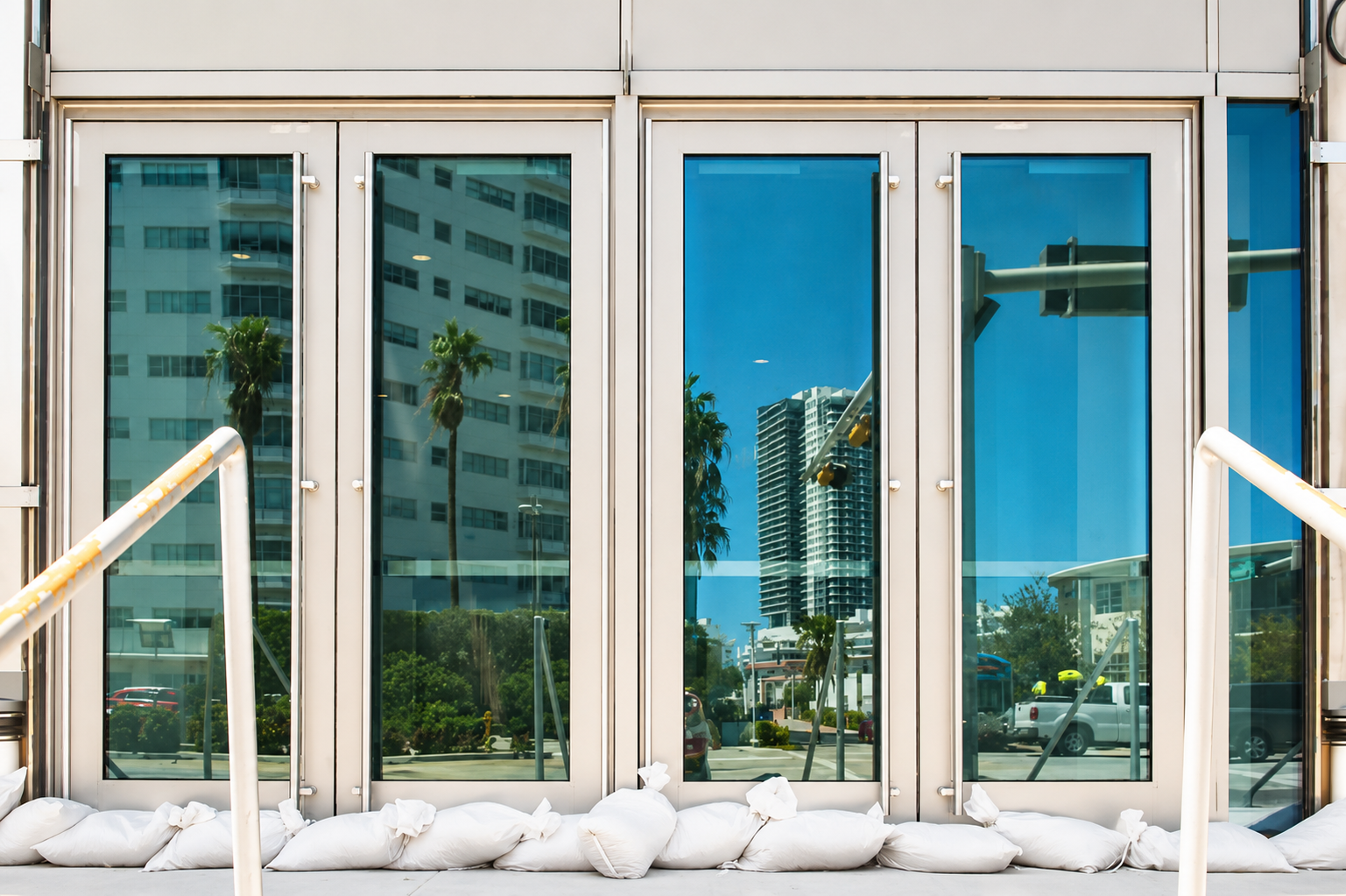
Commercial buildings throughout the Bahamas and the Caribbean face some of the world’s harshest coastal elements. Category 5 hurricanes, flying windborne debris, and corrosive salt air place tremendous structural stress on building envelopes.
Standard glazing cannot survive these coastal forces. For beachfront resorts, hotels, and high-rise developments, commercial impact windows and coastal impact windows are structural necessities. They protect building envelopes and reduce storm damage.
This guide explains how commercial impact windows are engineered, the ASTM standards they should meet, and the key factors builders, developers, and distributors should evaluate before specifying hurricane-resistant glazing for Caribbean projects.
What are Commercial Impact Windows?
Commercial impact windows are heavy-duty structural barrier systems. Unlike entry-level residential windows or standard commercial glass, they are specifically engineered to keep a building’s exterior fully intact under severe hurricane winds and violent physical hits.
These high-performance window systems rely on two core components working together:
- Architectural Aluminum Frames: We extrude these frames with extra-thick walls (up to 2.0mm) to resist intense air pressure without bowing or breaking.
- Heavy-Duty Laminated Glass: We permanently bond multiple layers of glass together using a thick, high-tensile PVB interlayer to create durable impact-rated glazing.
How they protect your property: When flying storm debris strikes the window, the outer glass layer may crack, but the resilient inner interlayer holds the shattered pieces firmly in place. This prevents a blowout, seals out driving rain, and keeps destructive hurricane-force winds from breaching the building envelope.
The ROI of Hurricane-Resistant Window Systems
Investing in engineered commercial impact windows and hurricane windows delivers long-term financial value for Caribbean developers and wholesale distributors a major financial advantage. Here is how our systems protect your bottom line:
- Stops Roof Lifting & Total Failure: When Category 5 winds hit a building, standard windows blow out. This creates sudden, massive indoor pressure that can lift the roof right off. Our impact systems secure the building envelope to prevent this catastrophic failure.
- Blocks Costly Water Damage: Driving rain during tropical storms causes massive financial losses for beachfront resorts. We integrate specialized commercial sealants and continuous EPDM gaskets to stop high-pressure water from leaking inside.
- Cuts Commercial Energy Bills: If you choose our thermal break aluminum frames, the built-in insulation barrier blocks intense tropical heat. This keeps interiors cooler and drastically lowers your commercial air conditioning costs.
- Provides 24/7 Property Security: Beyond hurricane defense, the thick laminated glass and multi-point stainless steel locks make forced entry nearly impossible. This keeps your wholesale inventory and commercial properties safe from burglary year-round.
Laminated Glass Options & Technical Configurations
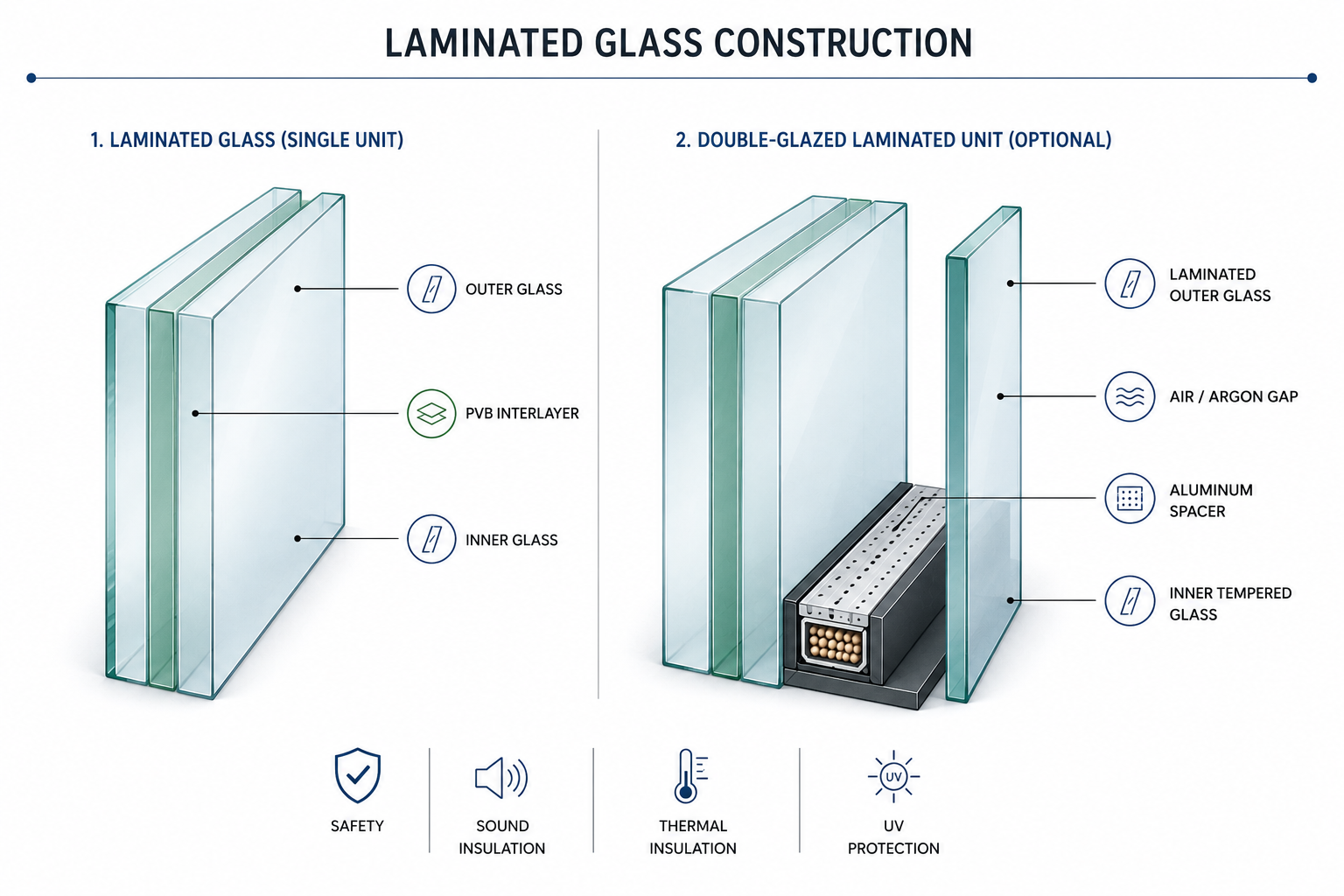
We offer two primary categories of hurricane-resistant glazing, specifically engineered to balance structural impact performance with thermal efficiency:
1. Single Laminated Glass (Monolithic Laminated)
Ideal for standard hurricane protection where high-velocity debris resistance is the primary requirement. This configuration features two layers of glass permanently bonded by a heavy-duty PVB (Polyvinyl Butyral) interlayer.
- Standard Glass Available
- 10.76 mm: 5mm Glass + 0.76mm PVB + 5mm Glass (Standard commercial applications)
- 12.76 mm: 6mm Glass + 0.76mm PVB + 6mm Glass (Enhanced wind-load areas)
- 17.14 mm: 8mm Glass + 1.14mm PVB + 8mm Glass (Heavy-duty / Large-missile impact zones)
2. Double Glazed Laminated Glass (Insulated Laminated Glass / IGU)
Designed for premium commercial projects, coastal resorts, and high-rise developments. This system combines the extreme debris defense of laminated glass with the superior thermal and acoustic insulation of double glazing. It features an outer laminated unit, an aluminum spacer air gap, and an inner tempered glass pane.
- Standard Profiles Available:
- 5mm + 0.76PVB + 5mm + 6A + 5mm: Total thickness approx. 21.76mm. Perfect balance of safety and standard insulation.
- 8mm + 1.14PVB + 8mm + 6A + 5mm: Total thickness approx. 28.14mm. Engineered for high-occupancy commercial structures requiring maximum structural integrity and heavy acoustic dampening.
- Wholesale Customization Options: Spacers can be upgraded to 9A or 12A gaps, and filled with Argon gas with Low-E coatings to strictly comply with local energy codes (like NFRC standards) in high-temperature Caribbean climates.
Reinforced Aluminum Frames: Profiling & Thermal Engineering
An impact window’s structural integrity depends entirely on the strength of its aluminum profiles. For heavy-duty commercial and coastal applications, standard residential-grade thin aluminum is insufficient. We engineer our systems using high-tensile architectural aluminum with calibrated wall thicknesses to resist extreme wind loads and structural deformation.
Standard Commercial Thickness Profiles
Depending on the structural calculations, window dimensions, and required design pressure (DP rating) of your project, we supply frames in four standardized commercial specifications:
- 1.4 mm / 1.6 mm: Optimized for standard-sized commercial windows, interior partitions, or projects with moderate wind-load requirements.
- 1.8 mm / 2.0 mm: Heavy-duty structural profiles engineered for oversized storefront panels, high-rise developments, and extreme Category 5 hurricane zones.
Choosing the Right System: Thermal Break vs. Non-Thermal Break
To meet varying energy codes and project budgets across the Caribbean and international markets, our reinforced frames are available in two engineering configurations:
| Feature | Thermal Break Aluminum Frames | Non-Thermal Break Aluminum Frames |
|---|---|---|
| Core Construction | Features a high-density polyamide insulating barrier split between the interior and exterior aluminum profiles. | A continuous, solid extruded aluminum profile without an internal insulation barrier. |
| Thermal Insulation | Excellent. Effectively blocks outside solar heat from transferring indoors, reducing commercial air conditioning loads. | Standard. Aluminum conducts heat quickly, allowing more solar heat to enter the building. |
| Condensation Control | Helps prevent interior frame sweating and moisture buildup in humid coastal environments. | More susceptible to surface condensation when indoor and outdoor temperatures differ significantly. |
| Structural Strength | Maintains excellent structural integrity and impact resistance with reinforced 1.8mm–2.0mm frame options. | Highly durable and rigid, offering strong structural performance with 1.6mm–2.0mm extrusions. |
| Best Application | Ideal for premium coastal resorts, beachfront hotels, and energy-efficient commercial buildings requiring NFRC compliance. | Best suited for budget-conscious commercial projects, warehouses, and open-air retail spaces where thermal performance is less critical. |
Hardware & Sealing Engineering for Severe Storm Resistance
Beyond high-tensile frames and impact glass, a commercial window system requires heavy-duty ancillary components to withstand continuous, violent cycling during a hurricane. Oridow integrates industrial-grade hardware and sealing technology to guarantee structural performance:
1. Multi-Point Stainless Steel Locking Systems
Standard latches will instantly fail under the massive negative pressure (suction) caused by Category 5 winds.
- Our Specification: We equip our commercial impact windows with heavy-duty, multi-point locking hardware made from high-grade Stainless Steel 304 or 316 for maximum tensile strength and rust prevention in high-salinity environments.
- The Advantage: This system distributes wind-load pressure evenly across the entire perimeter of the frame, ensuring consistent gasket compression and preventing the window sash from blowing out or bowing.
2. Commercial-Grade EPDM Gaskets & High-Performance Sealants
Water damage often causes more financial loss during a storm than wind itself.
- Our Specification: We utilize continuous EPDM (Ethylene Propylene Diene Monomer) gaskets combined with premium, structural-grade silicone sealants at all joint connections.
- The Advantage: This commercial sealing matrix prevents air leakage, eliminates water penetration under severe pressure changes, and resists long-term UV degradation and chalking in Caribbean coastal climates.
Engineering Design Standards for the Caribbean Market
Commercial developments in the Bahamas and across the Caribbean require strict structural performance to pass local building inspections.
While individual projects may require localized third-party testing, Oridow engineers its commercial window systems based on the technical design principles of international hurricane standards to ensure they are built to handle the harshest Category 5 conditions.
Our systems follow internationally recognized ASTM impact testing principles for dependable structural performance.
1. Debris & Impact Resistance Principles (Referencing ASTM E1886 / E1996)
Our heavy-duty impact-rated glazing configurations are designed to align with the core requirements of Large Missile Impact Testing.
- The Design: We specify a thick, high-tensile PVB interlayer sandwiched between tempered glass. Even if severe windborne debris cracks the outer glass layer during a storm, the inner structural interlayer is designed to remain intact.
- The Protection: This prevents sudden cabin depressurization, preserving the building envelope and protecting occupants from catastrophic structural failure.
2. Structural Wind Load Resistance (Referencing ASTM E330)
Our reinforced frame profiles and hardware configurations are engineered by referencing the structural testing criteria for static air pressure.
- The Design: By utilizing heavy-duty architectural aluminum wall thicknesses (from 1.6mm up to 2.0mm) and multi-point stainless steel locking systems, the window assembly is built to resist violent positive and negative wind pressures.
- The Protection: This continuous structural rigidity minimizes profile deflection, ensuring the windows stay securely anchored to the concrete buck under relentless hurricane-force winds.
3. Custom Project Certification & Engineering Support
We understand that large-scale commercial, resort, or government bids in the Caribbean often require specific localized certifications or active project testing reports.
- Our Support: While we focus on supplying high-performance, factory-direct window systems built to these international benchmarks, we offer dedicated B2B technical support to help you achieve compliance. We can supply detailed shop drawings, exact profile material specifications, and structural data to assist your engineering team with local third-party testing and smooth project sign-offs.
How to Choose an Impact Window Manufacturer (Factory-Direct Wholesale Solutions)
Sourcing hurricane-resistent, commercial impact windows, commercial windows for large-scale Caribbean developments requires more than just finding a supplier; it requires partnering with an experienced impact window manufacturer that offers scalable production, verified structural engineering, and international logistics experience.
When evaluating an impact window manufacturer, smart B2B buyers focus on four critical production capabilities—all of which form the core of Oridow’s factory-direct operations:
1. Structural Engineering & Project Compliance Support
- The Industry Risk: Many suppliers promise hurricane readiness but fail to provide the exact material data or engineering records required when local building inspectors demand structural proof.
- The Oridow Capability: We design all systems strictly to international architectural specifications, referencing the principles of ASTM E1886/E1996 and ASTM E330. To ensure smooth project sign-offs, we provide comprehensive technical data, glass configurations, and detailed shop drawings to support your local compliance and engineering approvals.
2. Scalable Container-Load Capacity & Competitive Pricing
- The Industry Risk: Delayed manufacturing schedules can stall an entire commercial construction site, leading to massive financial penalties. Meanwhile, intermediaries and brokers inflate your sourcing costs.
- The Oridow Capability: Our manufacturing facilities are optimized for scalable, heavy-volume production. By purchasing directly from our factory, Caribbean distributors and importers eliminate middleman markups to protect their profit margins, while ensuring consistent container-load outputs that keep project schedules on time.
3. Advanced Coastal Engineering & Customization
- The Industry Risk: Standard residential configurations cannot handle oversized commercial storefronts, specific design pressures (DP requirements), or custom architectural shapes.
- The Oridow Capability: We provide dedicated B2B technical support during the specification phase. From large structural panels to custom configurations, our engineers tailor profile wall thicknesses (up to 2.0mm) to match your exact blueprints and structural needs.
4. Export-Grade Packaging & Anti-Corrosion Surface Treatments
- The Industry Risk: Ocean freight often results in glass breakage, and the harsh marine air can cause rapid frame chalking and pitting within months of installation.
- The Oridow Capability: Every shipment is secured in heavy-duty, reinforced wooden crates engineered for sea transit and port handling. Furthermore, our profiles undergo premium coastal-grade surface treatments designed to resist high-salinity corrosion, severe UV exposure, and tropical humidity
Commercial Impact Windows vs Standard Aluminum Windows
Although standard aluminum windows are suitable for many commercial buildings, they are not specifically engineered to withstand hurricane conditions or severe wind events.
For coastal developments, upgrading to specialized commercial impact windows is not a design preference—it is a structural necessity. Below is a direct technical comparison:
| Technical Feature | Commercial Impact Windows (Oridow Engineered) | Standard Aluminum Windows |
|---|---|---|
| Glazing Security | Heavy-duty laminated glass (e.g., 5mm + 0.76 PVB + 5mm). The interlayer remains intact even if the outer glass breaks under debris impact. | Standard monolithic glass (single-pane tempered or annealed) that shatters upon impact, increasing the risk of building depressurization. |
| Profile Thickness | 1.4 mm to 2.0 mm architectural-grade extruded aluminum engineered to withstand high wind loads with minimal deflection. | 1.0 mm to 1.2 mm thin-walled aluminum that is more susceptible to bowing, twisting, and frame failure under severe wind pressure. |
| Locking & Hardware | Industrial multi-point stainless steel (304/316) locking systems securely anchor the sash to resist strong negative wind pressure. | Single-point latches or basic crescent locks that can fail or open during Category 3–5 hurricane conditions. |
| Sealing & Water Defense | Continuous EPDM gaskets with structural silicone sealants provide superior resistance against water infiltration during storms. | Standard PVC or wool pile weather stripping that deteriorates faster under UV exposure and is more prone to water leakage. |
| Coastal Lifespan | Premium coastal-grade surface treatments resist corrosion, chalking, pitting, and long-term salt spray exposure. | Basic powder-coated finishes that may blister, corrode, and peel after prolonged exposure to coastal environments. |
For commercial buildings in hurricane-prone regions, coastal impact windows provide an additional level of protection against strong winds, moisture, and salt exposure. For additional insights into commercial glazing solutions, read our blogs to aluminum window systems and their common applications.
Applications for Commercial Impact Windows: Region-Based Specifying
Commercial properties require different architectural solutions depending on their precise geographic location and exposure to severe weather. Our coastal impact windows are engineered for projects exposed to hurricane-force winds, corrosive marine environments, and long-term coastal weathering.
Oridow engineers its commercial window systems to serve two distinct B2B application environments:
1. High-Exposure Coastal & Oceanfront Zones
For properties directly facing the ocean—such as beachfront resorts, high-rise hotels, and coastal office complexes—protecting the building envelope against continuous Category 5 wind loads and large missile impacts is the absolute priority.
- Recommended Configurations: Heavy-duty Fixed Windows and Casement Systems extruded at 1.8mm to 2.0mm thickness, utilizing double-glazed laminated impact glass (e.g., 8mm+1.14PVB+8mm+6A+5mm).
- Key Target Projects:
- Beachfront Hotels & Luxury Resorts (Nassau, Out Islands, etc.)
- Oceanfront Condominiums & High-Rise Offices
- Coastal Healthcare Facilities & Emergency Centers
2. Inland Commercial, Retail & Entertainment Hubs
For commercial projects located further inland, inside sheltered bays, or within urban commercial districts, the priority shifts toward maximizing indoor-outdoor flow, foot traffic, and modern architectural aesthetics, while maintaining premium structural quality.
- Recommended Configurations: This is where Oridow’s signature heavy-duty systems shine. For these non-impact-rated premium zones, we offer architectural Fold-Up Windows and Floating Bifold Systems extruded at 1.4mm to 2.0mm using standard thermal break profiles.
- Key Target Projects:
- Open-Air Restaurants & Beachfront Bars (Ideal for walk-up bar counters using Fold-Up windows)
- Retail Storefronts & Automobile Showrooms (Using Floating Bifold doors to open up the entire facade)
- Boutique Cafes & Indoor-Outdoor Hospitality Spaces
Maintenance and Long-Term Performance: Lowering Total Cost of Ownership
In the harsh marine environments of the Bahamas and the Caribbean, post-installation maintenance can quickly become a massive financial burden for commercial property managers. Constant salt spray, high humidity, and intense UV radiation cause standard hardware to rust and inferior seals to fail.
Oridow designs its commercial impact systems with premium, weather-resistant components to ensure optimal structural performance and minimize long-term operational costs:
1. Marine-Grade Anti-Corrosion Hardware
- The Threat: Salt air causes standard steel or low-grade iron hardware to oxidize, lead to stiff operation, lock failure, and unsightly rust streaks on the building facade.
- Oridow’s Solution: We utilize heavy-duty Stainless Steel 304 or 316 for all multi-point locks, hinges, and fasteners. This marine-grade specification resists pitting and galvanic corrosion, ensuring smooth mechanical operation year after year without frequent replacements.
2. UV-Stabilized EPDM Sealing Matrix
- The Threat: Standard PVC weather stripping or cheap rubber seals rapidly dry out, crack, and chalk under intense tropical sunlight, leading to air leaks and water infiltration.
- Oridow’s Solution: Our systems are equipped with continuous EPDM (Ethylene Propylene Diene Monomer) gaskets. EPDM maintains its elasticity and tight seal under extreme temperature fluctuations and relentless UV exposure, preventing driving rain from penetrating the building envelope.
3. Coastal-Grade Powder Coating & Surface Finishes
- The Threat: High salinity causes standard architectural paint to blister, peel, and corrode within a few years of coastal exposure.
- Oridow’s Solution: Our aluminum profiles undergo advanced coastal-grade surface treatments (such as specialized powder coatings or PVDF finishes). This protective layer resists salt spray corrosion and fading, eliminating the need for frequent repainting or frame conditioning.
Simple Routine Maintenance for B2B Operations
To protect your investment and maintain the long-term performance of your coastal impact windows, we recommend a simple, low-cost maintenance schedule for building maintenance teams.
- Rinse Regularly: Wash frames and glass with clean water and mild soap every 3 to 6 months to remove accumulated salt crusts.
- Clear Weep Holes: Ensure frame drainage tracks (weep holes) remain free of debris or sand to allow heavy rain to drain efficiently.
- Inspect Seals: Conduct a quick annual visual check on gaskets and multi-point locking points to ensure tight compression before the hurricane season begins.
Conclusion: Partner with a Specialized Commercial Manufacturer
Protecting commercial properties in the Bahamas and across the Caribbean requires more than standard architectural glazing. It demands heavy-duty commercial impact windows, marine-grade corrosion defense, and scalable factory-direct support from an experienced impact window manufacturer.
While individual projects may require localized third-party testing, Oridow builds its premium commercial systems based on the strict design principles of international hurricane standards (referencing ASTM E1886/E1996 and E330). From oversized storefront layouts to custom coastal finishes and high-salinity hardware upgrades, we deliver the structural integrity your blueprints demand without the middleman markups.
Share your project drawings, opening schedules, or architectural plans with our export team, and we’ll provide a customized window recommendation, technical drawing review, and a factory-direct quotation tailored to your project requirements. We’ll also help you select the most suitable glazing, structural configuration, and aluminum profile for your application.
Partner with ORIDOW today and source factory-direct commercial impact windows engineered for long-term performance in demanding Caribbean environments.
Frequently Asked Questions
Can Oridow custom-engineer window profiles to meet specific project design pressures (DP)?
Yes. We provide dedicated B2B technical support. Our engineering team can tailor profile wall thicknesses (from 1.4mm up to 2.0mm) and customize single or double-glazed laminated glass configurations to match the structural blueprints and wind-load requirements of your specific commercial site.
Do your commercial systems come with ready-made ASTM testing certificates?
We focus on supplying factory-direct, high-performance window systems engineered strictly to international benchmarks (referencing the design principles of ASTM E1886/E1996 and ASTM E330). Because large-scale Caribbean or government bids often require localized third-party reports, we offer comprehensive technical data, glass configurations, and detailed shop drawings to fully assist your engineering team in securing local compliance and project sign-offs.
Is a Thermal Break aluminum system necessary for Caribbean coastal developments?
While non-thermal break profiles provide excellent structural rigidity for budget-conscious projects, upgrading to a Thermal Break system is highly recommended for premium coastal resorts and beachfront hotels. It integrates a high-density polyamide barrier that cuts solar heat transfer, drastically lowering long-term commercial air conditioning costs and preventing interior frame condensation.
How does Oridow protect window shipments during ocean freight to the Caribbean?
To eliminate the risk of transit damage and glass breakage during international sea shipping and port handling, every wholesale order is secured in heavy-duty, reinforced export-grade wooden crates. Additionally, all aluminum profiles undergo premium coastal-grade surface treatments to resist high-salinity corrosion and pitting from the moment they arrive at the port.


