

Choosing the right window material is one of the most important decisions in home construction or renovation. Windows directly affect energy efficiency, indoor comfort, security, appearance, and long-term maintenance costs. Among the many options available today, uPVC windows have become one of the most popular choices for residential and commercial buildings alike.
uPVC, or unplasticized polyvinyl chloride, is widely used because of its durability, affordability, and low maintenance requirements. Over the last two decades, advancements in manufacturing technology have significantly improved the performance, design, and insulation capabilities of uPVC windows. As a result, they are now commonly used in apartments, villas, offices, and even energy-efficient homes.
However, like any building material, uPVC windows come with both benefits and limitations. While they excel in insulation and ease of use, they may not always suit ultra-luxury aesthetics or highly customized architectural designs. Understanding both the advantages and disadvantages of uPVC windows helps homeowners make informed decisions rather than choosing based on trends alone.
This comprehensive guide explores the top 10 advantages and disadvantages of uPVC windows, compares them with other window types, discusses future trends, and answers frequently asked questions—giving you a complete picture before you invest.
What are uPVC Windows?
uPVC windows are window systems made from unplasticized polyvinyl chloride, a rigid and durable form of plastic. Unlike standard PVC, uPVC does not contain plasticizers, making it stronger, more weather-resistant, and longer lasting.
uPVC windows typically feature:
- Multi-chambered frames for insulation
- Double or triple-glazed glass
- Rubber seals for airtight closure
- Reinforced internal structures for strength
They are widely used because they balance performance, cost, and longevity, especially in varying climate conditions.
10 Advantages of uPVC Windows
1. Excellent Energy Efficiency
One of the most significant advantages of uPVC windows is their excellent energy efficiency, which directly impacts indoor comfort and long-term energy costs. uPVC window frames are engineered with multi-chambered profiles that trap air inside the frame. This trapped air acts as a natural insulating barrier, slowing down heat transfer between the interior and exterior environment.
When paired with double or triple-glazed glass units, uPVC windows significantly reduce heat loss during the winter months and prevent excessive heat gain during summer. This thermal performance helps maintain a stable indoor temperature regardless of outside weather conditions.
Why this matters
-
Multi-chamber uPVC frames reduce thermal bridging
-
Double or triple glazing improves insulation performance
-
Minimizes dependence on heating and air-conditioning systems
Key benefits
-
Lower electricity and fuel bills
-
Consistent indoor comfort throughout the year
-
Reduced carbon footprint due to lower energy usage
From an energy-efficiency perspective, uPVC windows align well with modern building standards and future-focused sustainable housing.
2. Low Maintenance Requirements
Unlike traditional wooden frames that require regular polishing, painting, and termite treatment—or metal frames that may corrode over time—uPVC windows are designed to be almost maintenance-free. The material does not absorb moisture, peel, or rust, even in challenging climates.
Routine care involves nothing more than occasional cleaning using mild soap and water. There is no need for repainting, sealing, or surface treatment, making uPVC windows particularly attractive for homeowners seeking hassle-free solutions.
Maintenance benefits
-
No repainting, sanding, or varnishing required
-
Resistant to rust, rot, fungus, and termites
-
Easy to clean with basic household products
As a result, uPVC windows are especially suitable for busy households, rental properties, and commercial spaces, where long-term upkeep needs to be minimal.
3. Long Lifespan and Durability
High-quality uPVC windows are built to last. With proper installation and standard care, they can easily deliver a service life of 20 to 30 years or more without significant performance degradation. The material is inherently resistant to environmental factors that commonly damage other window materials.
uPVC does not warp, swell, crack, or peel when exposed to moisture or heat. In addition, UV-stabilized formulations protect the frames from sun damage, preventing brittleness and discoloration over time.
Durability features
-
Resistant to humidity, rain, and moisture
-
Maintains structural stability over decades
-
UV protection reduces sun-related aging
This long lifespan translates into excellent return on investment, as replacement and repair costs are significantly reduced over time.
4. Cost-Effective Solution
From a cost perspective, uPVC windows strike an ideal balance between performance and affordability. Compared to wooden or aluminum window systems, uPVC windows typically offer a lower initial purchase price while still meeting modern standards of insulation, durability, and security.
Beyond upfront costs, uPVC windows deliver long-term financial benefits by minimizing maintenance expenses and reducing energy bills due to better thermal efficiency.
Cost advantages
-
Lower installation cost than wood or aluminum
-
Minimal maintenance expenditure over time
-
Energy savings reduce overall household expenses
For homeowners, builders, and developers working within a budget, uPVC windows represent a practical and financially sound choice without compromising functionality.
5. Strong Weather Resistance
uPVC windows are specifically engineered to perform reliably in extreme and unpredictable weather conditions. Whether exposed to heavy rainfall, intense sunlight, coastal humidity, or temperature fluctuations, uPVC frames maintain their shape and performance.
Unlike wood, uPVC does not swell in humid environments, and unlike metal, it does not corrode in salty coastal air. The material remains dimensionally stable, ensuring proper sealing and long-term performance.
Weather-resistance benefits
-
No swelling, rusting, or corrosion
-
Suitable for coastal and high-humidity regions
-
Maintains performance across temperature changes
This makes uPVC windows an excellent option for homes in diverse climatic zones.
6. Good Sound Insulation
Noise pollution is a growing concern in urban environments, and uPVC windows offer effective sound insulation when properly designed. Combined with double or triple glazing and airtight sealing, uPVC windows reduce external noise penetration dramatically.
This feature improves indoor comfort, especially for homes located near busy roads, railways, schools, or commercial areas.
Noise-control features
-
Multi-layer glazing dampens sound waves
-
Tight seals prevent sound leakage
-
Enhanced indoor privacy and calm environment
For city apartments and noise-sensitive areas, uPVC windows provide a meaningful improvement in living quality.
7. Enhanced Security Features
Modern uPVC windows are designed with safety and security as a priority. The frames are reinforced internally, and most systems are equipped with multi-point locking mechanisms that secure the window at multiple locations simultaneously.
Optional toughened or laminated safety glass further enhances protection against forced entry and accidental breakage.
Security advantages
-
Multi-point locking systems
-
Reinforced internal structures
-
Strong compatibility with safety glass
These features provide homeowners with confidence and peace of mind, making uPVC windows suitable for residential and commercial applications alike.
8. Environmentally Friendly (During Use Phase)
Although uPVC is plastic-based, it contributes positively to environmental sustainability during its use phase. Its excellent insulation properties reduce energy consumption, while its long lifespan reduces the need for frequent replacements.
Many modern uPVC systems are also recyclable, supporting circular material use.
Eco-friendly aspects
-
Recyclable uPVC material
-
Lower energy use due to insulation
-
Reduced waste through long service life
As green building standards evolve, uPVC continues to improve in environmental performance.
9. Wide Range of Design Options
Modern uPVC windows are far more versatile than many people expect. They are available in multiple opening styles, colors, and finishes, allowing homeowners to match them with different architectural styles.
Design flexibility includes
-
Sliding, casement, tilt-and-turn, bay styles
-
White, grey, black, and wood-grain finishes
-
Custom sizing for modern layouts
This design adaptability enables uPVC windows to suit both traditional and contemporary homes.
10. Easy and Fast Installation
uPVC windows are lightweight yet strong, which makes installation quicker and less disruptive compared to heavier materials. Faster installation reduces labor costs and limits inconvenience for occupants.
Installation benefits
-
Lightweight frames for easier handling
-
Faster fitting and alignment
-
Minimal structural stress on buildings
Quick installation also reduces exposure to construction errors, ensuring consistent performance from day one.
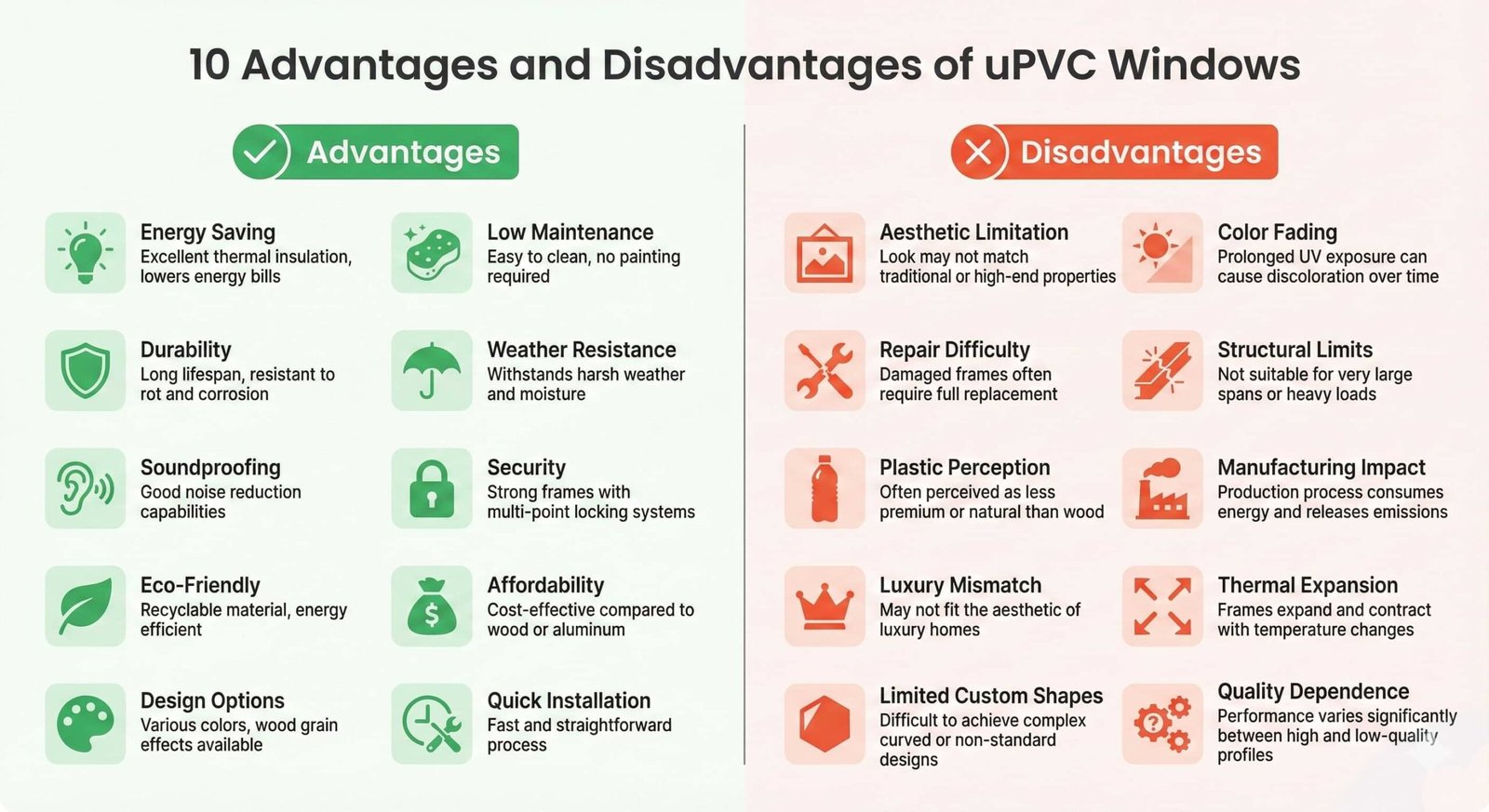
10 Disadvantages of uPVC Windows
1. Less Premium Appearance Than Natural Wood
While modern uPVC windows have improved significantly in appearance, they still cannot fully replicate the natural grain, warmth, and character of real wood. For homeowners who prioritize traditional or luxury aesthetics, this difference can be noticeable, particularly in heritage homes or high-end architectural designs.
Although wood-grain finishes are available, they often provide a visual imitation rather than the authentic texture and feel of natural timber.
Why this matters:
-
Wood offers unique natural variation
-
uPVC has a uniform, manufactured appearance
-
Aesthetics play a key role in luxury properties
2. Color Fading Over Time
uPVC windows are designed to resist UV exposure, but long-term exposure to intense sunlight can still result in gradual color fading—especially in older or lower-quality products. White frames may develop a yellow tint, while colored frames may lose their original vibrancy.
Higher-grade uPVC windows perform better, but fading remains a potential long-term consideration in hot or sun-intensive regions.
Key concerns:
-
Prolonged UV exposure
-
Lower-grade materials discolor faster
-
Affects exterior appearance over time
3. Repairs Can Be Difficult
Unlike wooden frames that can often be sanded, filled, or refinished, uPVC frames are harder to repair once damaged. Cracks, frame warping, or structural damage usually require panel or full-frame replacement rather than localized repair.
This can increase repair costs if damage occurs due to impact, improper installation, or extreme weather events.
Limitations include:
-
Limited repair flexibility
-
Replacement often required
-
Fewer cosmetic repair options
4. Structural Limitations for Large Openings
uPVC is strong but less rigid than aluminum, making it less suitable for very large window spans or floor-to-ceiling glass designs. For oversized openings, additional steel reinforcement is required, which increases cost and complexity.
This makes aluminum frames more practical for modern designs involving expansive glass areas.
Structural considerations:
-
Limited rigidity for wide spans
-
Reinforcement adds cost
-
Aluminum performs better for large openings
5. Plastic Perception Among Homeowners
Despite its performance benefits, uPVC is still fundamentally a plastic-based material. For some homeowners, particularly those investing in premium homes, the idea of plastic windows may be less appealing from a perception standpoint.
This perception is subjective, but it can influence purchasing decisions in upscale residential projects.
User concerns include:
-
Preference for natural or metal materials
-
Perceived lower prestige
-
Psychological value of material choice
6. Environmental Impact During Manufacturing
Although uPVC windows are energy-efficient during use, their manufacturing process involves chemicals and high energy consumption. This raises environmental concerns, particularly regarding raw material sourcing and emissions during production.
While recycling initiatives are improving, manufacturing impact remains an important consideration for sustainably focused buyers.
Environmental limitations:
-
Energy-intensive production
-
Chemical processing involved
-
Sustainability improves mainly during use phase
7. Not Ideal for Ultra-Luxury Architecture
In ultra-luxury or architecturally expressive homes, materials like solid wood, aluminum, or steel are often preferred for their premium finish and design flexibility. uPVC windows may not meet the visual or branding expectations of high-end residences or designer-led projects.
Why architects may avoid uPVC:
-
Limited bespoke finishes
-
Less architectural presence
-
Material perception in luxury markets
8. Thermal Expansion in Extreme Heat
uPVC naturally expands and contracts with temperature changes. In regions with extremely high temperatures, this thermal movement can cause minor alignment issues if installation tolerances are not properly managed.
Professional installation minimizes this risk, but it remains a technical factor to consider in hot climates.
Potential issues include:
-
Frame expansion in high heat
-
Seal stress if poorly installed
-
Importance of skilled installation
9. Limited Custom Shapes and Designs
uPVC windows are best suited for standard shapes and sizes. Highly customized, curved, or architecturally complex window designs are harder to achieve with uPVC compared to aluminum or steel frames.
This limitation affects projects that require artistic or unconventional window layouts.
Design limitations:
-
Restricted curved or angled designs
-
Less flexibility for custom architecture
-
Better suited to standard layouts
10. Quality Depends Heavily on the Manufacturer
One of the most critical disadvantages of uPVC windows is that performance varies significantly by manufacturer. Poor-quality uPVC products may fail to deliver promised benefits and can develop issues early in their lifespan.
Low-quality systems may:
-
Discolor more quickly
-
Lose insulation effectiveness
-
Use weak locking hardware
-
Deform over time
Professional advice:
Always choose reputable brands and certified installers to ensure long-term performance and safety.
uPVC Windows vs Other Window Materials
When selecting windows for a home or building project, uPVC is often compared with wooden and aluminum windows, as these are the most common alternatives. Each material has distinct strengths and limitations, and the right choice depends on factors such as budget, climate, maintenance expectations, and design goals.
Understanding how uPVC windows perform relative to other materials helps homeowners make a confident, informed decision rather than relying on trends alone.
uPVC Windows vs Wooden Windows
Wooden windows are traditionally admired for their natural beauty and timeless appeal, but they require significantly more care and investment over time. uPVC windows, in contrast, focus on practicality and long-term performance.
Key differences compared to wooden windows:
-
More affordable: uPVC windows generally cost less upfront than high-quality wooden frames.
-
Much lower maintenance: Wood requires regular painting, polishing, and protection from termites and moisture, while uPVC needs only occasional cleaning.
-
Better moisture resistance: uPVC does not swell, rot, or crack in humid or rainy conditions.
-
More consistent performance: uPVC maintains its shape and sealing over time, whereas wood can warp with climate changes.
Where wooden windows still excel:
-
Rich, natural appearance
-
Prestige value for luxury or heritage homes
-
Easier cosmetic repair and refinishing
Expert view:
uPVC windows are a better fit for homeowners who prioritize durability, affordability, and minimal upkeep, while wooden windows suit those who value aesthetic authenticity and traditional craftsmanship.
uPVC Windows vs Aluminum Windows
Aluminum windows are known for their slim frames and structural strength, particularly in modern architecture. uPVC windows offer a different set of advantages focused on comfort and efficiency.
Key differences compared to aluminum windows:
-
Better insulation: uPVC has natural thermal resistance, while aluminum requires thermal breaks to prevent heat transfer.
-
Lower overall cost: uPVC windows are usually more budget-friendly than aluminum systems.
-
Improved indoor comfort: uPVC reduces heat loss and external noise more effectively in standard residential use.
-
Less condensation: uPVC frames remain warmer to the touch, reducing condensation risk.
Where aluminum windows perform better:
-
Very large window openings
-
Floor-to-ceiling glass panels
-
Ultra-modern and minimalist architectural designs
-
Higher structural rigidity
Expert view:
uPVC windows are ideal for energy-efficient homes and apartments, while aluminum windows suit large-span, design-heavy projects where slim profiles are essential.
Are uPVC Windows Worth It?
Whether uPVC windows are “worth it” depends on what you value most in a window system. From a performance-to-cost ratio, uPVC windows are among the most practical options available today.
They are especially worthwhile if your priorities include energy savings, low maintenance, and long-term durability, rather than purely high-end aesthetics.
uPVC windows are worth considering if you value:
-
Energy efficiency that lowers heating and cooling costs
-
Low maintenance without repainting or surface treatments
-
Durability in varied climates and environmental conditions
-
Cost-effectiveness over the full life cycle of the product
Best suited for:
-
Residential homes and apartments
-
Offices and commercial buildings
-
Rental properties
-
Energy-conscious renovations
-
Urban and high-noise areas
They may not be the best choice for:
-
Ultra-luxury homes
-
Architecturally complex or bespoke designs
-
Projects requiring very large glass spans
Future Trends in uPVC Window Technology
The evolution of uPVC window technology reflects broader changes in how buildings are designed, constructed, and used. No longer viewed as simple frames for glass, modern uPVC windows are becoming high-performance building components that support energy efficiency, sustainability, and smart living. Advances in materials, manufacturing, and digital integration are transforming uPVC windows into future-ready solutions aligned with next-generation housing needs.
As environmental standards tighten and homeowners demand long-term value, uPVC window systems are adapting to meet both current expectations and future performance benchmarks.
1. Slim-Profile and High-Strength uPVC Designs
One of the most notable future trends is the development of slimmer yet stronger uPVC window profiles. Advanced internal reinforcements and composite materials allow manufacturers to reduce frame bulk without sacrificing strength or security.
Key developments include:
-
Slimmer frames to maximize glass area and daylight
-
Improved structural reinforcements for stability
-
Enhanced load-bearing capacity for larger openings
-
Cleaner, modern aesthetics comparable to aluminum
2. Smart-Integrated uPVC Window Systems
uPVC windows are increasingly designed to integrate with smart home ecosystems. These systems move beyond manual operation and contribute actively to indoor comfort and energy management.
Emerging smart features include:
-
Sensor-ready frames for temperature and humidity monitoring
-
Integration with smart ventilation systems
-
Auto-alerts when windows are left open
-
Compatibility with home automation platforms
3. Sustainable and Eco-Friendly uPVC Innovations
Sustainability is shaping the next generation of uPVC window materials. Manufacturers are prioritizing environmentally responsible production while maintaining performance standards.
Sustainability advancements include:
-
Higher recycled content in uPVC profiles
-
Low-emission manufacturing processes
-
Full recyclability at end of product life
-
Compliance with green building certifications
4. Advanced Thermal and Acoustic Performance
Future uPVC window systems continue to push the limits of thermal insulation and sound control, supporting energy-efficient and quiet indoor environments.
Performance enhancements include:
-
Triple-glazing compatibility
-
Improved air-tight sealing technology
-
Better condensation resistance
-
Enhanced sound insulation for urban homes
Frequently Asked Questions (FAQs)
Are uPVC windows good for homes?
Yes. They offer durability, insulation, security, and affordability, making them suitable for most residential applications.
How long do uPVC windows last?
Typically 20–30 years with proper installation and basic care.
Are uPVC windows safe?
Modern uPVC windows include multi-point locks and tempered glass, making them highly secure.
Do uPVC windows increase home value?
Yes. Their energy efficiency and low maintenance appeal to buyers, improving resale value.
Are uPVC windows better than aluminum?
uPVC is better for insulation and cost, while aluminum is better for large or modern architectural designs.
Can uPVC windows be recycled?
Yes. uPVC is recyclable, and many manufacturers now focus on sustainable production.


