

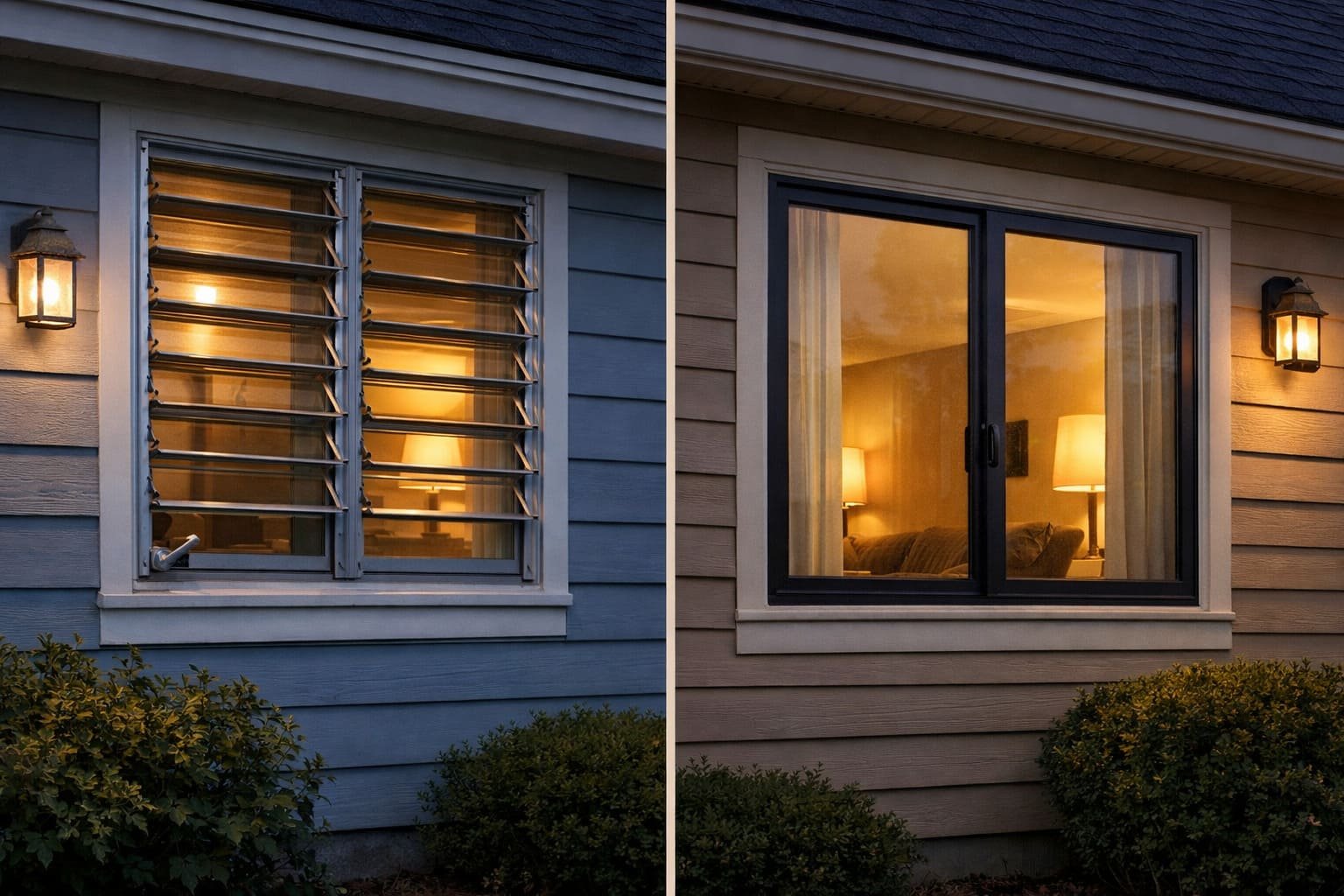
Security is no longer judged by appearance or window style alone. Modern residential protection is evaluated through structural integrity, glazing resistance, hardware strength, and installation quality.
Whether you are considering louvered ventilation systems or horizontal sliders, true safety depends on configuration and performance standards such as EN 1627 and ASTM F588.
Both jalousie and sliding windows can be secure when properly specified. The difference lies in how each system handles forced entry attempts, glass impact, locking mechanisms, and long-term durability.
Quick Verdict
In basic configurations, sliding windows typically provide stronger resistance due to a more rigid sash structure and simplified locking geometry. However, upgraded jalousie systems with reinforced operators and laminated glass can significantly narrow the security gap.
Choose jalousie windows when:
- Ventilation is a priority in humid or tropical regions.
- Laminated louvers are installed.
- A secondary barrier like security mesh is included.
Choose sliding windows when:
- Anti-lift protection is present.
- Multi-point or keyed locking is specified.
- Laminated glazing upgrades are used.
Security outcomes depend more on glass type and hardware grade than operating style.
Safety vs Security – What Are We Measuring?
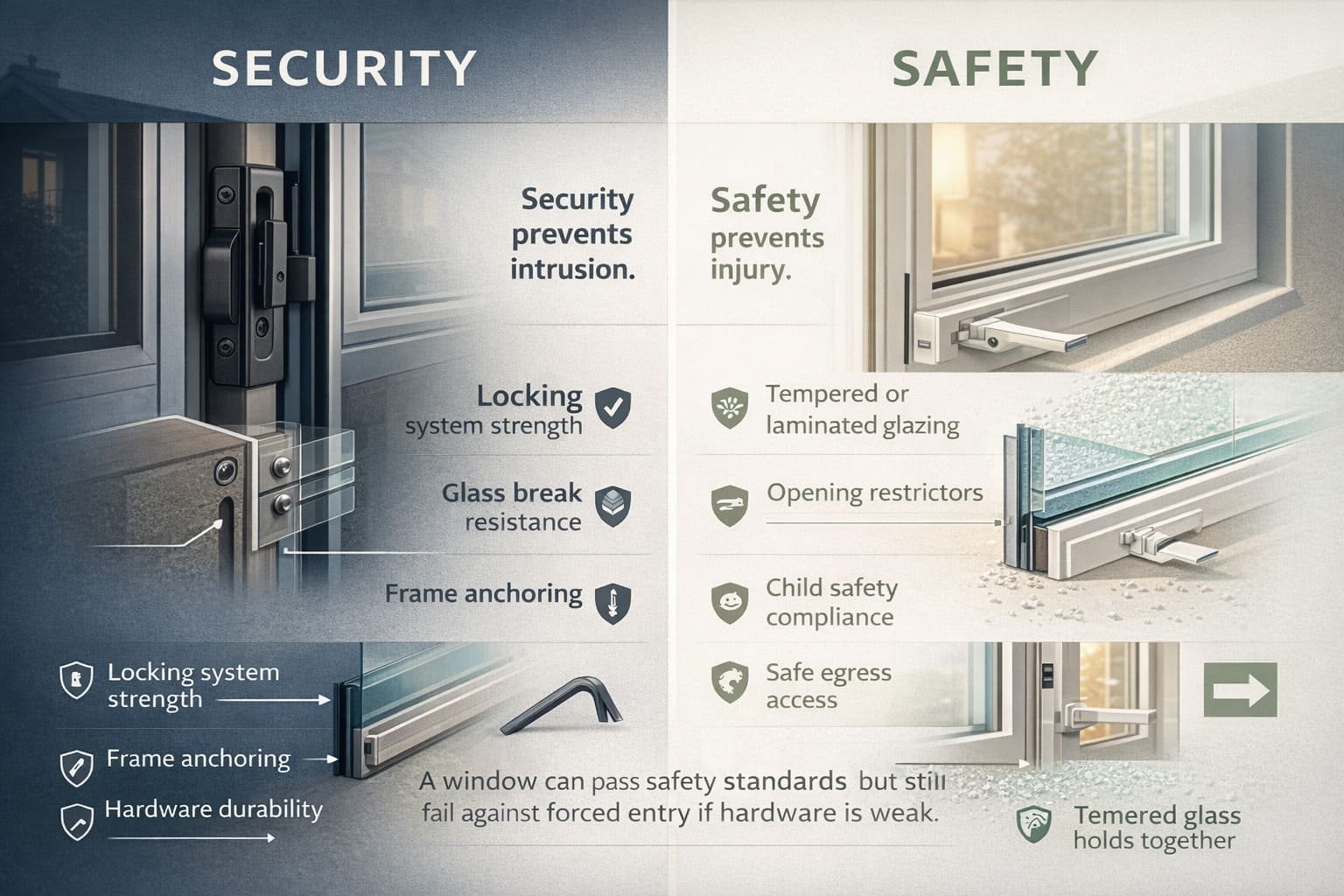
Security refers to resistance against forced entry. Safety addresses injury prevention, fall control, and emergency exit performance.
Security factors include:
- Locking system strength
- Glass break resistance
- Frame anchoring
- Hardware durability
Safety factors include:
- Tempered or laminated glazing
- Opening restrictors
- Child safety compliance
- Safe egress access
A window may perform well in safety tests but fail under intrusion attempts if hardware is weak.
How Intruders Exploit Windows
Intruders typically look for the fastest and quietest point of failure. Most window break-ins rely on leverage, weak locks, or exposed glass rather than full structural destruction. The goal is speed, not noise.
Common Break-In Methods
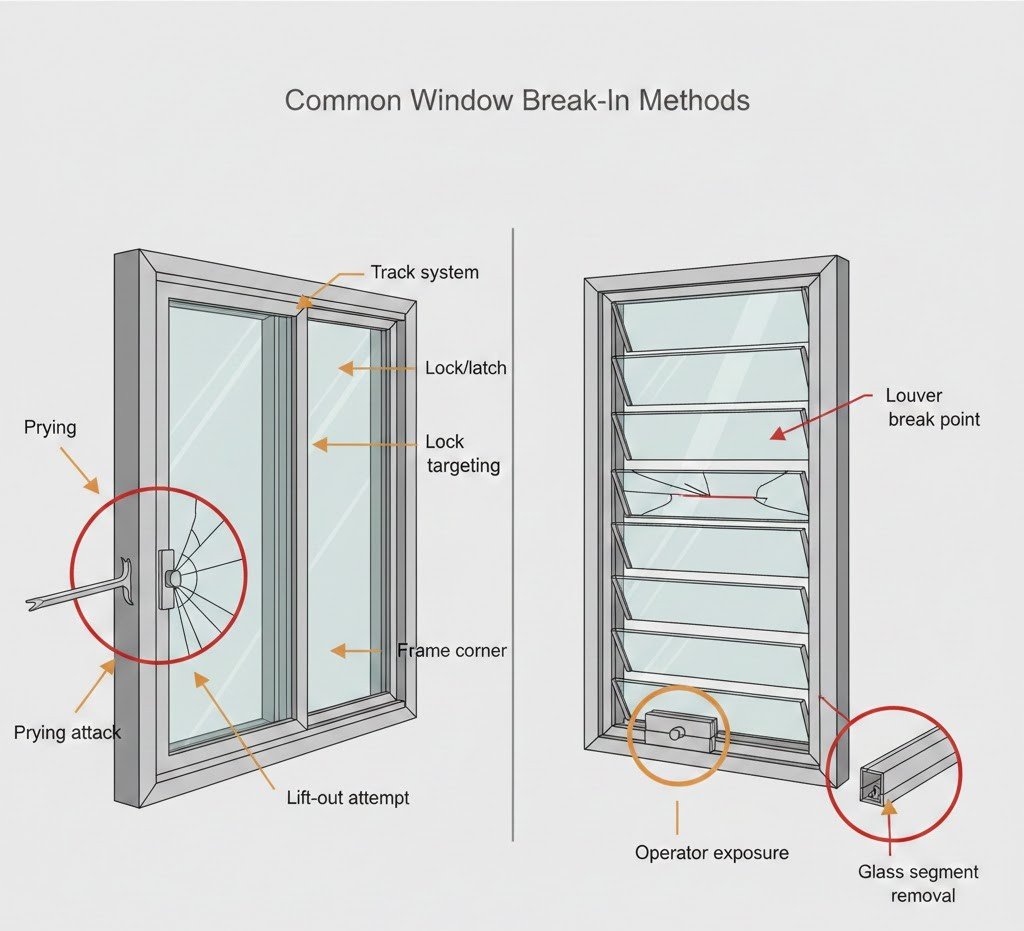
- Prying frame corners to create sash separation
- Lift-out removal of sliding panels without anti-lift blocks
- Breaking glass near locks to reach inside
- Manipulating exposed operators on louvered systems
- Repeated blunt-force impact to weaken glazing
Sliding windows are usually attacked at the track and latch area. Without anti-lift devices, the sash can be forced upward and removed.
Jalousie windows are rarely removed entirely, but individual louvers may be broken or dislodged if glazing is not reinforced.
Security testing such as ASTM F588 evaluates how long a window can resist these tool-based attacks. In practice, intrusion delay time is what deters most opportunistic break-ins.
Attack Focus Comparison
| Attack Method | Sliding Window | Jalousie Window | Primary Weak Point |
| Prying | Common | Moderate | Lock & frame joint |
| Lift-Out | High risk (no anti-lift) | Low | Upper track |
| Glass Break | Target near latch | Multiple louvers | Glazing strength |
| Hardware Tampering | Latch access | Operator exposure | Lock mechanism |
Jalousie Window Security Assessment
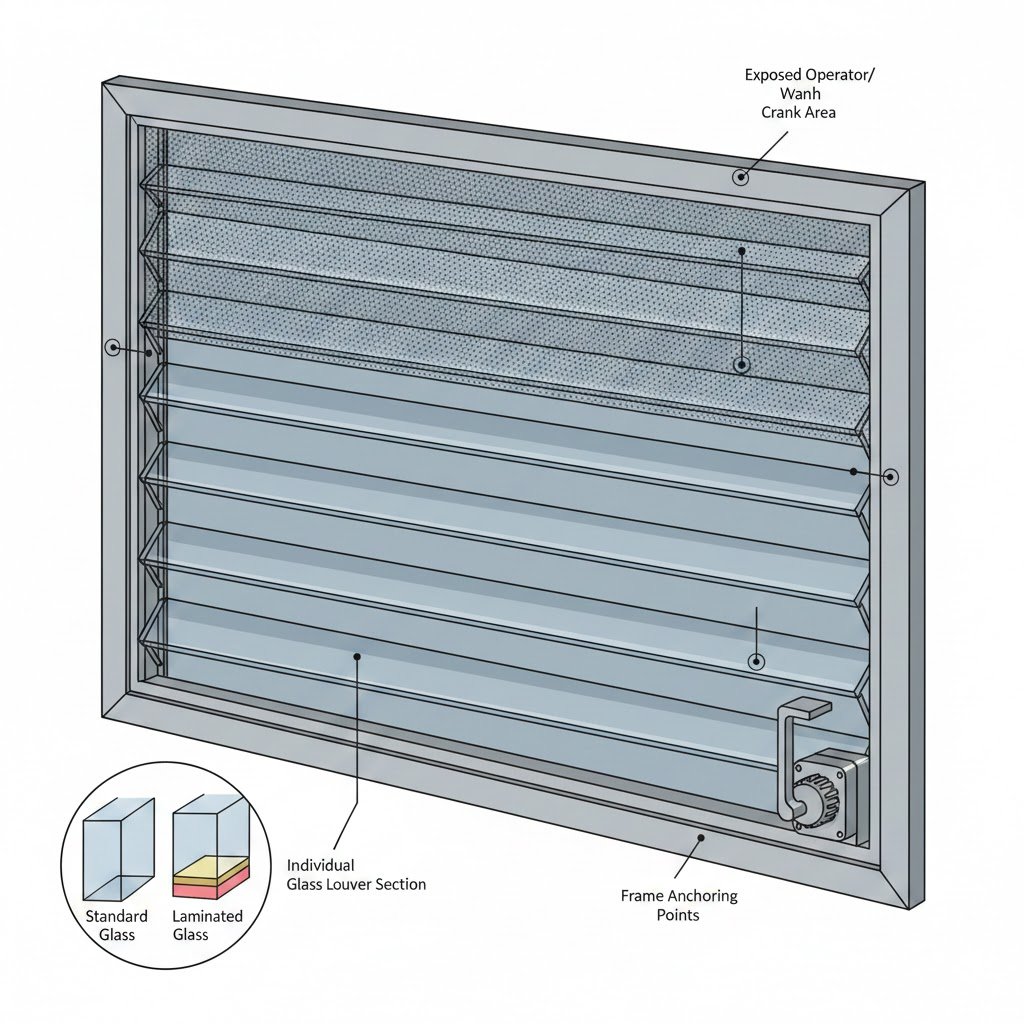
Jalousie windows operate through horizontal glass blades controlled by a mechanical crank. Their airflow advantage makes them common in humid and coastal environments, particularly in regions where tropical housing markets favor ventilation-focused designs integrated into residential architecture.
Strengths:
- Smaller glass segments reduce single-point structural failure.
- Adjustable airflow without full opening.
- Compatible with integrated security mesh.
Weaknesses:
- Multiple glass edges increase potential break points.
- Operator housing may be externally exposed.
- Structural rigidity depends on frame reinforcement.
Security improvements include:
- Laminated glass louvers instead of standard tempered glass.
- Reinforced operator enclosures.
- Internal locking crank mechanisms.
- Stainless-steel security mesh.
Long-term durability also depends on maintenance, and regular care aligned with louver maintenance practices helps preserve alignment and hardware performance in high-humidity environments.
Sliding Window Security Assessment
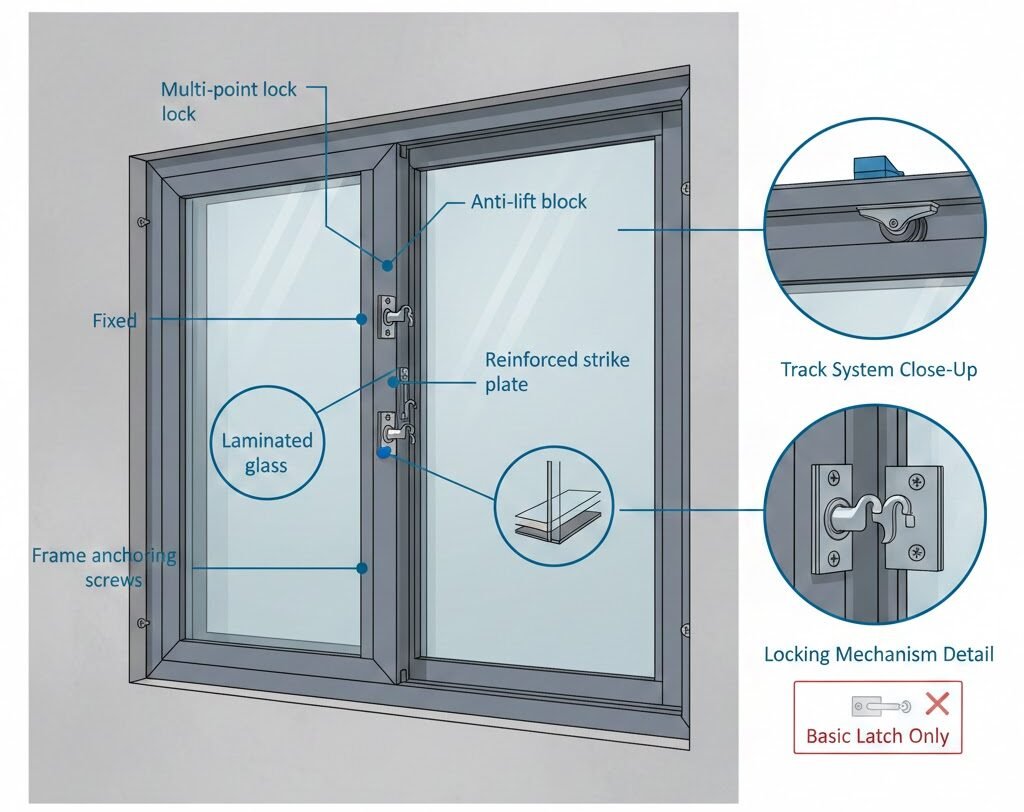
Sliding windows use a horizontal track system with one fixed and one movable sash. Their continuous glass surface and reinforced frame geometry provide inherent structural stability, particularly in projects incorporating aluminum frame systems designed for customization and reinforcement flexibility.
Strengths:
- Stronger overall frame geometry.
- Fewer exposed mechanical components.
- Easier integration of advanced locking systems.
Weaknesses:
- Lift-out risk without anti-lift blocks.
- Basic latch systems offer limited resistance.
- Track wear may reduce lock alignment over time.
Security upgrades include:
- Anti-lift devices installed in the head track.
- Multi-point locking systems.
- Reinforced strike plates.
- Laminated double glazing.
Structural anchoring during aluminum window installation directly influences forced-entry resistance, since misalignment or weak fastening reduces overall system integrity.
Head-to-Head Security Comparison
| Feature | Jalousie Window | Sliding Window |
Security Impact |
| Structural Rigidity | Moderate | High | Sliding advantage |
| Glass Vulnerability | Multiple small panes | Large continuous pane | Depends on glazing type |
| Locking Options | Operator-based | Latch or multi-point | Sliding more upgradeable |
| Lift-Out Risk | Low | Moderate (without anti-lift) | Requires reinforcement |
| Ventilation While Secured | Strong | Limited | Jalousie advantage |
| Upgrade Potential | Moderate | High | Sliding easier to certify |
Sliding systems generally offer stronger baseline protection, but properly reinforced jalousie units narrow the difference significantly.
Glass Choice: The Critical Security Variable
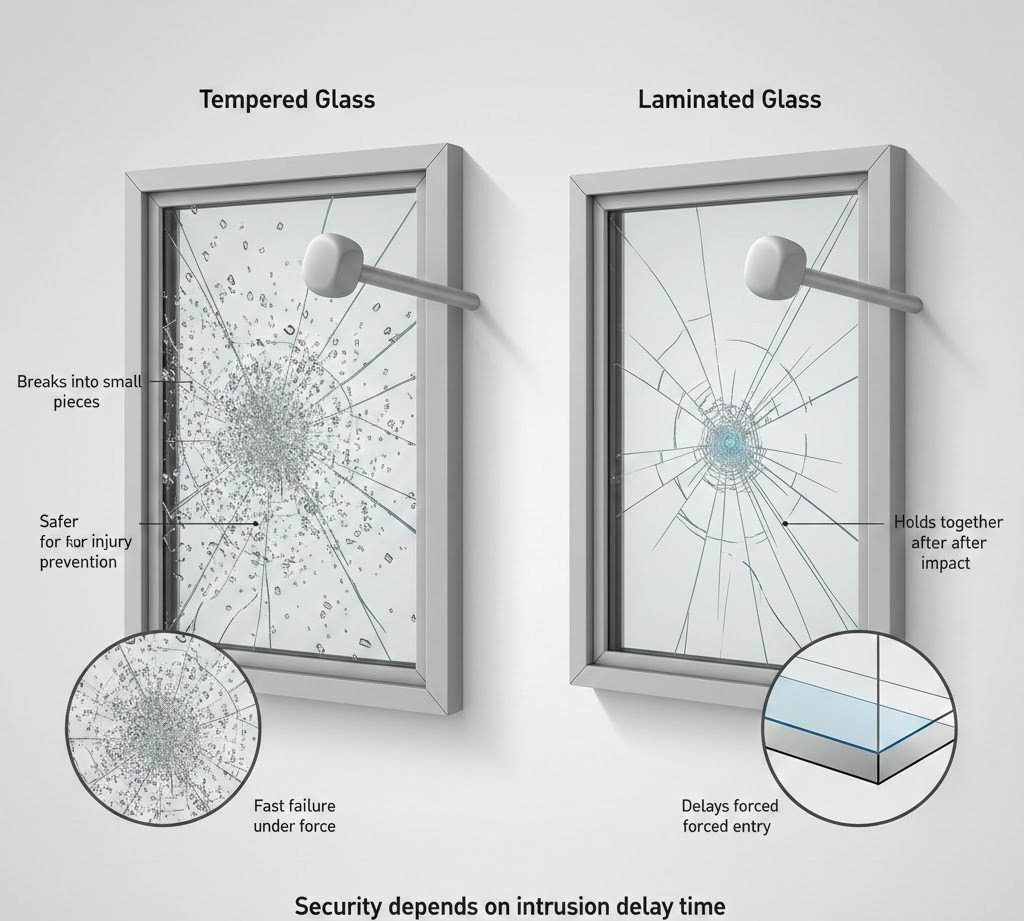
Glazing determines how long a window resists impact. Many intrusion attempts focus on breaking glass near the lock.
Tempered glass:
- Shatters safely into small fragments.
- Protects occupants from sharp shards.
- Breaks relatively quickly under concentrated force.
Laminated glass:
- Holds together after impact.
- Requires sustained force to penetrate.
- Delays entry attempts significantly.
In forced-entry evaluations under ASTM F588, laminated assemblies outperform standard tempered configurations in intrusion delay time.
Hardware and Installation – The Deciding Factor
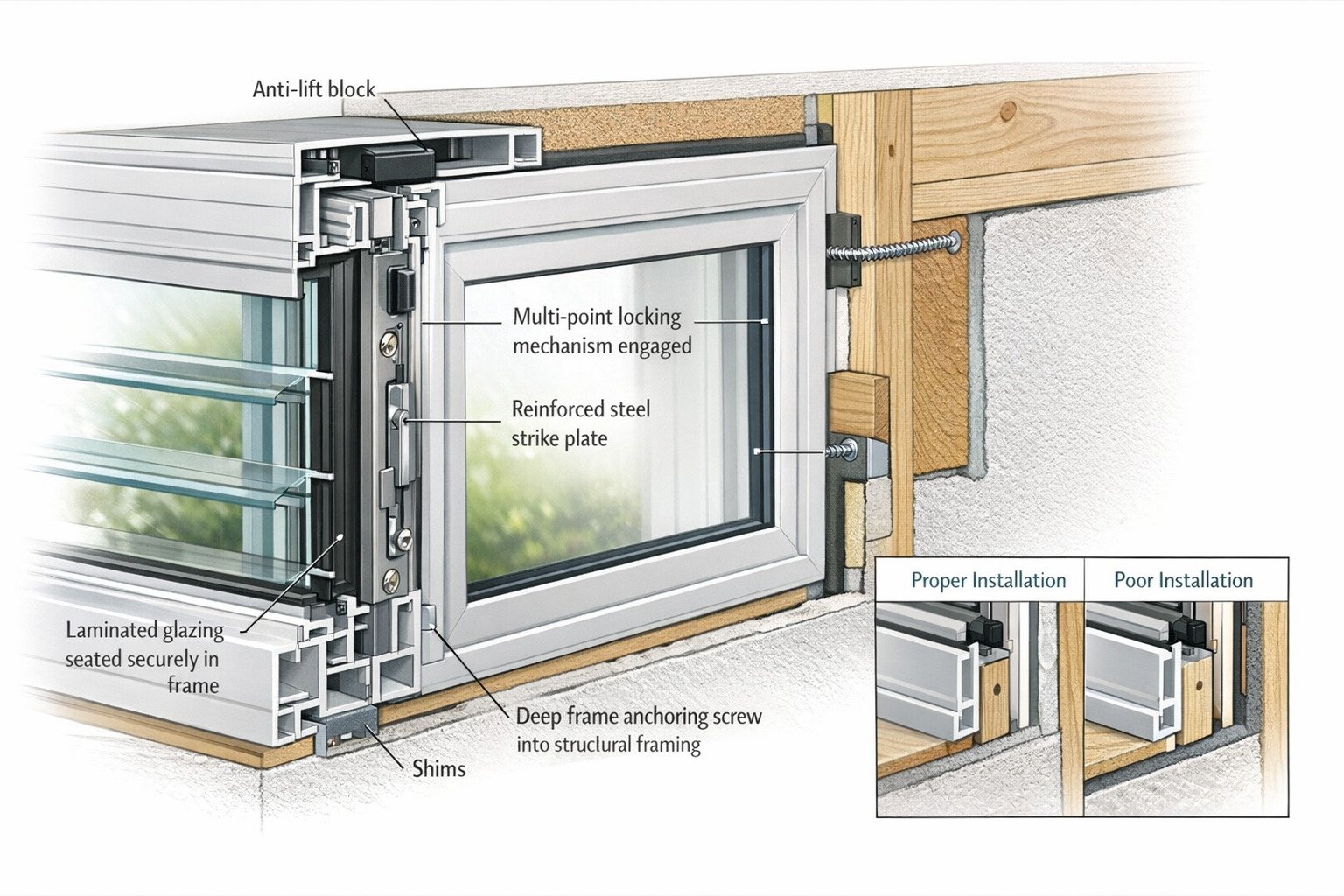
Window security depends on the complete assembly. Strong frames cannot compensate for weak locks or poor anchoring. Standards like EN 1627 and PAS 24 assess full-system performance rather than isolated parts.
Critical Hardware Components
- Multi-point locks distribute force better than single latches
- Anti-lift devices prevent sliding sash removal
- Reinforced strike plates resist prying pressure
- Laminated glazing increases intrusion delay
- Corrosion-resistant fasteners maintain long-term strength
Installation errors reduce security even in high-grade systems. Poor anchoring, shallow screw penetration, and misalignment can create leverage points for prying.
Installation Impact Overview
| Factor | Risk if Poorly Installed | Security Impact |
| Frame anchoring | Frame movement | Easier prying |
| Lock alignment | Partial engagement | Lock failure under force |
| Fastener depth | Weak attachment | Reduced resistance |
| Seal integrity | Structural gaps | Compromised rigidity |
A properly installed mid-range window often performs better than a premium system with weak anchoring. Security is the result of hardware, glazing, and installation working together.
Scenario-Based Recommendations
Ground-floor bedroom projects using reinforced aluminum sliding units typically benefit from laminated double glazing and multi-point locking systems for improved resistance.
Coastal tropical residences often integrate louvered window systems with laminated louvers and security mesh to balance airflow with intrusion delay.
Rental properties perform best with keyed locking sliders, opening restrictors, and reinforced keepers to prevent tampering.
High-crime environments require laminated glazing, certified locking hardware, and secondary barrier protection regardless of operating style.
Frequently Asked Questions
1.Are jalousie windows easy to break into?
Standard jalousie windows can be vulnerable if they use thin glass and exposed operators. However, upgraded configurations significantly improve security performance.
-
Laminated louvers resist penetration better than tempered glass.
-
Reinforced crank mechanisms reduce manipulation risk.
-
Security mesh adds a secondary protective barrier.
-
Proper frame anchoring improves overall resistance.
2.Can sliding windows be lifted from the outside?
Yes, sliding windows can be lifted out if anti-lift protection is not installed. Properly configured systems eliminate this weakness.
-
Install anti-lift blocks in the upper track.
-
Use reinforced keepers and strike plates.
-
Upgrade from basic latches to multi-point locks.
-
Ensure tight frame alignment during installation.
3.Is laminated glass better than tempered glass for security?
Yes. Laminated glass offers superior intrusion resistance because it holds together after impact and requires sustained force to penetrate.
-
Tempered glass improves occupant safety but shatters quickly.
-
Laminated glass delays forced entry attempts.
-
Laminated units improve acoustic insulation as well.
-
Multi-layer interlayers increase resistance time.
4.Which window type is safer overall?
There is no universally safest type. Security depends on hardware grade, glazing specification, and installation quality rather than operating style alone.
-
Sliding windows offer stronger baseline rigidity.
-
Jalousie windows provide controlled ventilation advantages.
-
Laminated glazing improves both systems.
-
Certified hardware dramatically increases performance.


