

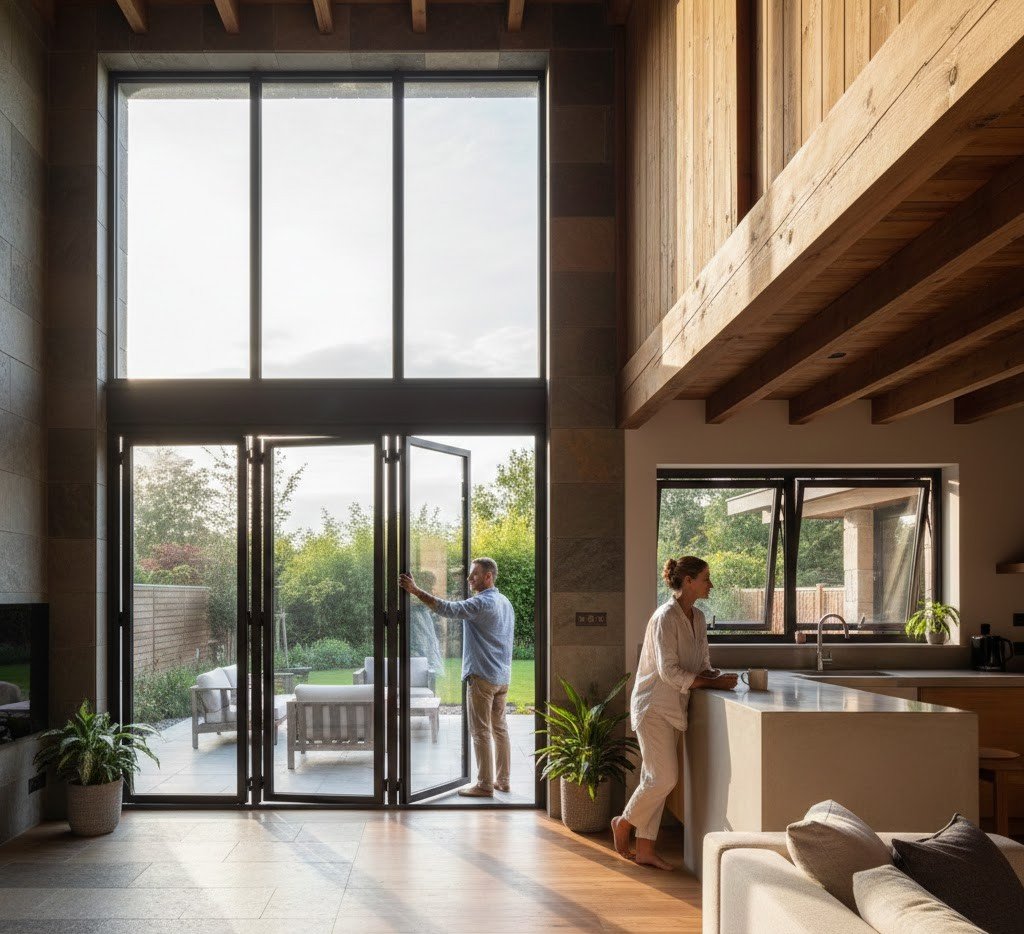
Folding windows are multi-panel window systems that open by folding and stacking panels to one or both sides, creating a wide, unobstructed opening between indoor and outdoor spaces. They are designed to adapt to different opening sizes, layouts, and lifestyle needs, making them one of the most flexible window solutions for modern homes and commercial spaces.
Whether you are working with a compact kitchen pass-through or a full-width opening in a café or luxury home, the right folding window configuration can completely change how you use the space.
For small openings (common choice: 2–3 panels)
Fewer panels are easier to open, seal, and maintain.
For large openings (common choice: 4–8 panels)
More panels spread the weight and make wide spans easier to move.
Let’s look at the most effective configurations for both small and large openings, and how to choose the one that works best for you.
How do folding window configurations work?
Folding window configurations refer to how individual panels are arranged, hinged, and stacked when opened. The configuration affects airflow, ease of use, structural performance, and how much of the opening remains clear.
In markets like Australia, the UK, and the USA, homeowners and architects increasingly favor folding systems because they offer flexibility across climates, property sizes, and architectural styles. Industry data shows that large-opening window systems are now one of the fastest-growing categories in residential renovation and hospitality design.
Key factors that influence configuration choice include:
- Opening width and height
- Traffic flow and usage frequency
- Wind exposure and climate
- Whether the opening needs partial or full access
Planning Tips for Homeowners and Builders
-
Choose the stack side early: It affects furniture layout, screens, and where people walk.
-
Check the opening width: More panels can mean narrower panels, which may feel easier to handle.
-
Think about water management: Sills and drainage details matter, especially in rainy climates.
-
Confirm structure and header needs: Large openings may require engineered support.
-
Ask about insulation and seals: Good weatherstripping and quality frames reduce drafts.
Quick Glossary
-
Panel/Sash: One folding section.
-
Stack: Where panels “park” when open.
-
Pivot panel: Panel that rotates at a fixed point.
-
Active panel: The panel you operate first.
Best folding window configurations for small openings
Small openings benefit most from configurations that maximize usability without overwhelming the space. These setups are common in kitchens, bars, pool houses, and compact commercial counters.
2-panel folding windows
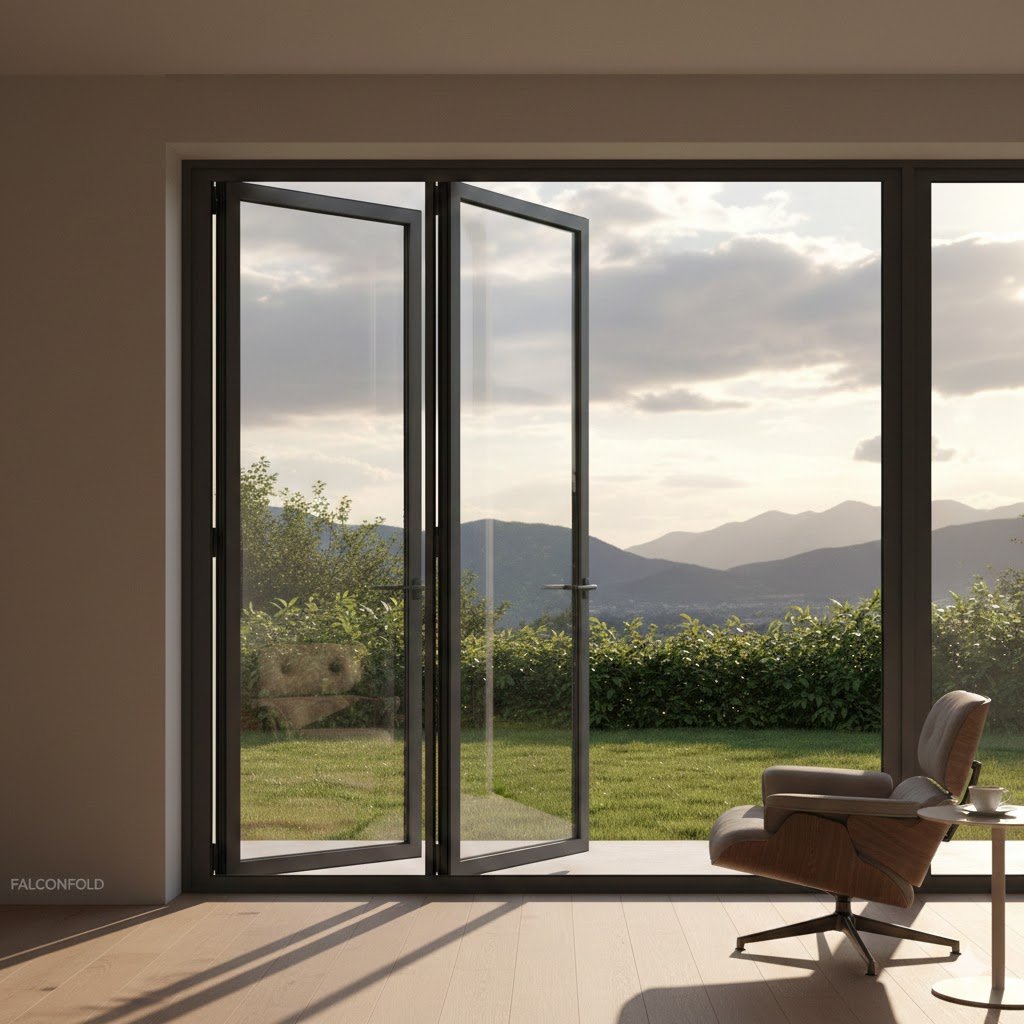
This is the simplest and most space-efficient option.
- One active panel folds over the second
- Ideal for openings under 1.5 meters
- Minimal hardware and clean sightlines
This configuration is popular for serving counters and internal-external pass-throughs where simplicity matters.
3-panel asymmetric configurations
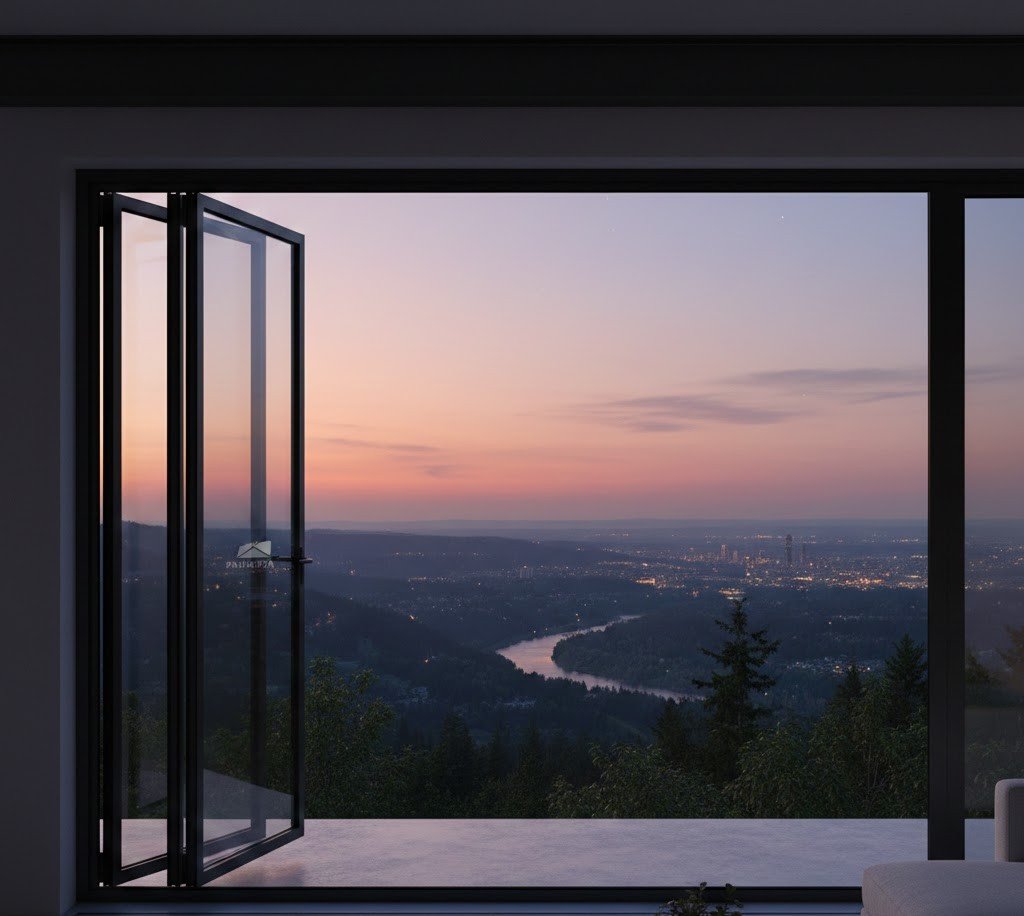
A three-panel system allows more flexibility.
- Panels can stack to one side
- Allows partial or full opening
- Better airflow control than 2-panel systems
This option works well when you want controlled ventilation without fully opening the wall.
Top-hung vs bottom-rolling systems
For small openings, top-hung systems reduce floor hardware and simplify cleaning. Bottom-rolling systems may be preferable if the wall cannot support overhead loads.
For design inspiration and technical options, many homeowners review specialist product ranges before finalizing dimensions.
Small opening configuration comparison
| Configuration | Best Use Case | Key Advantage | Consideration |
| 2-panel | Tight spaces | Simple, cost-effective | Limited opening width |
| 3-panel | Kitchens, bars | Flexible opening | Slightly more hardware |
| Top-hung | Internal counters | No bottom track | Requires structural support |
Best folding window configurations for large openings
Large openings require more planning but offer the biggest visual and functional payoff. These systems are common in luxury homes, restaurants, and entertainment spaces.
4 to 6-panel folding windows
This is the most versatile configuration for wide spans.
- Panels fold neatly to one or both sides
- Can open up to 90% of the total width
- Excellent for indoor-outdoor living
Splitting panels evenly reduces weight per panel and improves long-term performance.
Bi-directional folding configurations
Panels fold away from the center, stacking on both sides.
- Creates a symmetrical opening
- Ideal for very wide façades
- Improves traffic flow during events or peak usage
This setup is often chosen for hospitality venues where movement efficiency matters.
Integrated corner openings
Corner folding window systems eliminate the need for a fixed corner post.
- Seamless visual connection
- Strong architectural statement
- Requires advanced engineering and precision
For large openings in exposed locations, performance considerations like wind load are critical. Many designers assess wind resistance early in the planning phase to ensure durability.
Large opening configuration comparison
| Configuration | Opening Size | Visual Impact | Ideal For |
| 4–6 panels | Wide spans | High | Homes, cafés |
| Bi-directional | Extra-wide | Very high | Restaurants, events |
| Corner system | Feature openings | Maximum | Luxury architecture |
Horizontal vs vertical folding window layouts
While most folding windows operate horizontally, layout orientation still plays a role in usability and aesthetics.
Horizontal folding windows:
- Align with benchtops and serving counters
- Enhance visual width
- Support smooth indoor-outdoor transitions
They are especially popular in kitchens and bars due to their ergonomic height and flow. Design trends show growing interest in horizontal designs for contemporary homes.
Vertical folding systems are less common for windows but may be used where wall height exceeds width, typically in commercial or architectural feature spaces.
How do folding windows perform for security and durability?
Modern folding windows are engineered to meet strict safety and performance standards. Multi-point locking systems, reinforced aluminium frames, and precision hardware all contribute to long-term reliability.
Key security features include:
- Internal locking mechanisms
- Laminated or toughened glass
- Tamper-resistant tracks
Many property owners evaluate system security alongside aesthetic considerations, especially in urban or mixed-use environments.
Aluminium folding systems also perform well in coastal and high-humidity regions, making them suitable for Australian and UK seaside properties when specified correctly.
Why Oridow is the right supplier for folding windows
Oridow delivers Aluminium folding window systems engineered for both residential and commercial use. Their designs focus on structural integrity, smooth operation, and flexibility across small and large openings.
Key strengths include:
- Precision-engineered Aluminium profiles
- Configurations designed for wide spans and high wind zones
- Seamless integration with folding doors and modern façades
Their systems align with architectural expectations across Australia, the UK, and the USA, offering reliability without sacrificing design intent. Contact with oridow support team to know more about this window
FAQs about folding window configurations
What is the best folding window configuration for a kitchen?
A 2- or 3-panel folding window is usually best for kitchens. It provides easy pass-through access while maintaining control over ventilation and space usage.
How wide can a folding window system be?
Depending on the system and engineering, folding windows can span several meters. Large openings typically use 4 to 6 panels to distribute weight and ensure smooth operation.
Are folding windows suitable for coastal or windy areas?
Yes. When correctly specified, folding windows perform well in exposed locations.
- Reinforced aluminium frames resist corrosion and salt air
- Heavy-duty rollers and tracks improve stability in high winds
- Multi-point locking systems increase structural rigidity when closed
- Performance-tested systems are commonly used in coastal regions with strong wind exposure
Do folding windows improve home value?
In many cases, yes. Folding windows are viewed as a premium architectural feature.
- Enhance indoor–outdoor living, a top buyer preference
- Increase natural light and perceived space
- Support modern, open-plan design trends
- Improve functionality in kitchens, living areas, and entertainment spaces
Are folding windows easy to maintain?
Yes. Modern folding window systems are designed for long-term, low-effort maintenance.
- Aluminium frames do not warp, rot, or swell
- Smooth-glide hardware reduces wear over time
- Tracks are easy to clean and access
- Occasional lubrication and routine cleaning are usually sufficient


