


Aluminum bifold windows and aluminum sliding windows are both popular in modern homes, offices, and commercial spaces but they behave quite differently in day-to-day use. Choosing between them isn’t just about looks; it affects how you use the space, how much light and air you get, maintenance, and even how your furniture fits.
Here’s a clear breakdown to help you decide which is better for your project.
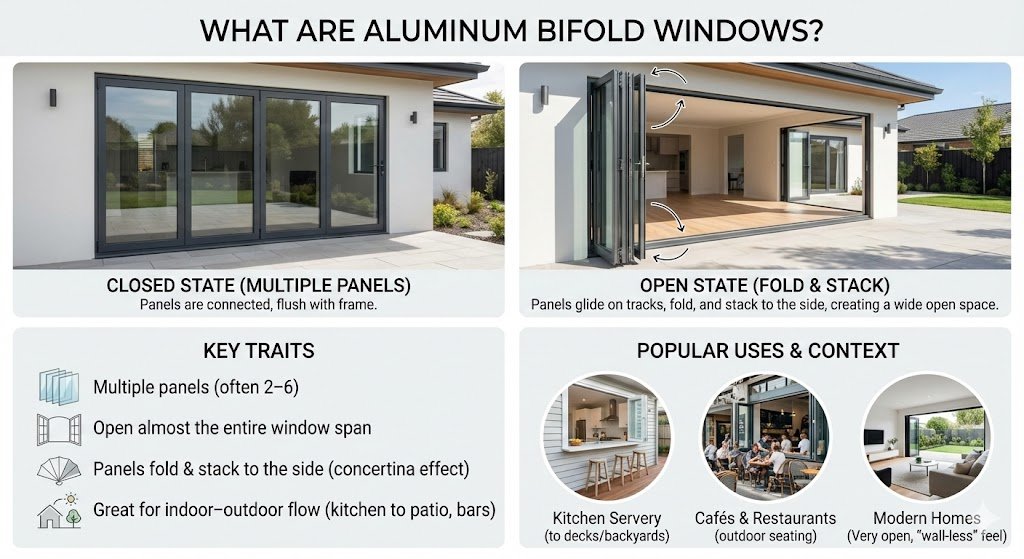
What Are Aluminum Bifold Windows?
Aluminum bifold windows are made of multiple glass panels connected by hinges that fold and stack to one or both sides when opened. Think of them like a concertina or accordion: they glide along a top and/or bottom track and fold neatly away, creating a very wide and open space.
Key traits:
- Multiple panels (often 2–6)
- Open almost the entire window span
- Panels fold and stack to the side
- Great for indoor–outdoor flow (kitchen to patio, bars, serving hatches)
They’re especially popular in:
- Kitchen servery windows to decks or backyards
- Cafés and restaurants opening to outdoor seating
- Modern homes wanting a very open, “wall-less” feel
What Are Aluminum Sliding Windows?
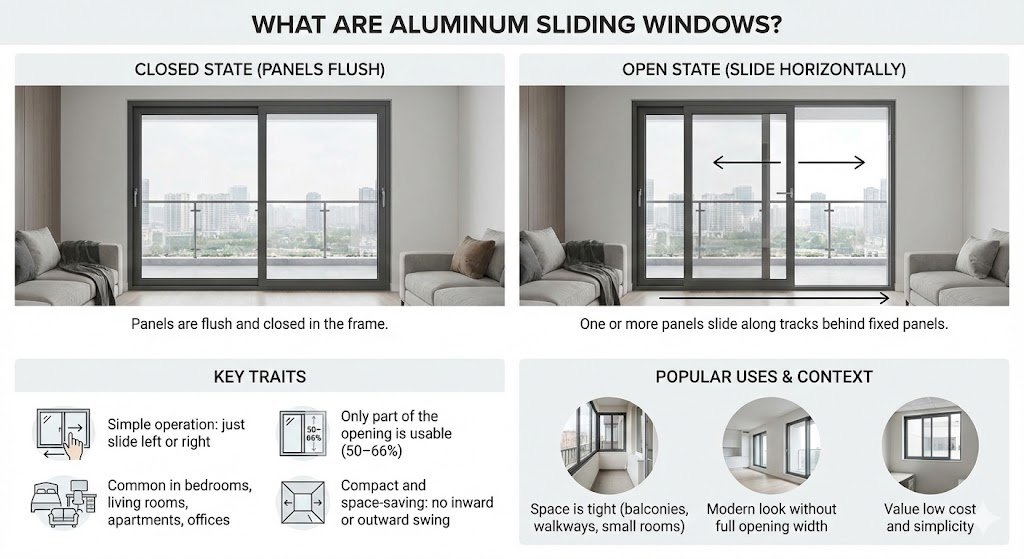
Aluminum sliding windows have one or more movable panels that slide horizontally along tracks past fixed panels. You don’t fold them; you simply slide one panel behind another.
Key traits:
- Simple operation: just slide left or right
- Only part of the opening is usable at once (usually 50–66%)
- Very common in bedrooms, living rooms, apartments, and offices
- Compact and space-saving: no inward or outward swing
They’re especially popular where:
- Space is tight (balconies, walkways, small rooms)
- You want a modern look but don’t need full opening width
- You value low cost and simplicity
1. Opening Size & Ventilation
Bifold Windows
- Big advantage: They can open almost the entire width of the frame.
- This creates a very open feel, almost like there’s no wall.
- Excellent for cross-ventilation: hot air escapes easily, fresh air enters from outside.
- Ideal if your goal is to “connect” two spaces like a kitchen to a terrace.
Sliding Windows
- Only a portion of the frame opens; one panel usually slides over another.
- In a typical 2-panel slider, you get about 50% opening area.
- Still good for ventilation, but you’ll never get that completely open wall effect.
Winner for maximum opening and airflow: Aluminum bifold windows
2. Space & Layout Considerations
Bifold Windows
- Folded panels stack to one or both sides, taking up space in that zone.
- You need to keep that area clear: no tall plants, cabinets, or furniture where the panels stack.
- Outside areas like decks or walkways need enough space so folded panels don’t feel in the way.
Sliding Windows
- Panels move within the frame; nothing swings or folds out into the room or outside.
- Perfect for tight balconies, walkways, or where you have furniture close to the window.
- Great choice above kitchen sinks or counters where you don’t want anything projecting inward.
Winner for compact spaces: Aluminum sliding windows
3. Aesthetics & Design Style
Bifold Windows
- Very “architectural” and dramatic.
- When open, they create a seamless transition and a resort-style look.
- Thin aluminum frames and large glass panels can look sleek and luxurious.
- Often used as a statement feature.
Sliding Windows
- Clean, minimal lines great for modern and minimalist designs.
- Because they’re common, they can feel more “standard,” but this is not necessarily bad.
- Work well when you want the window to blend in rather than become the main feature.
Winner for dramatic, feature-window design: Aluminum bifold windows
Winner for understated, minimal look: Aluminum sliding windows
4. Ease of Use & Everyday Operation
Bifold Windows
- Modern aluminum bifold systems are smooth, but:
- They use more moving parts: multiple hinges, rollers, locks.
- Larger units can feel heavier to operate, especially for children or older adults.
- You have to follow the opening/closing sequence (e.g., unlock, release bolts, then fold).
- Not difficult, but more involved than a simple slide.
Sliding Windows
- Extremely simple: unlock, slide open.
- Quick to open partially for a little fresh air or wider for more ventilation.
- Fewer moving components than a bifold system, so typically fewer operational quirks.
Winner for simplicity and everyday convenience: Aluminum sliding windows
5. Maintenance & Durability
Both are made of aluminum, which is:
- Strong for its weight
- Resistant to rust
- Low maintenance compared to timber
But there are differences:
Bifold Windows
- More moving parts (rollers, hinges, multiple seals, complex locking mechanisms).
- Tracks must be kept clean (dust, leaves, grit) for smooth folding.
- More seals and joints can mean more potential points of wear over time.
Sliding Windows
- Fewer moving components: mostly rollers and tracks.
- Easier to clean and maintain overall.
- Usually more forgiving over the long term if not perfectly cleaned or serviced.
Winner for long-term low maintenance: Aluminum sliding windows
6. Thermal & Acoustic Performance
In terms of raw material, aluminum is not as naturally insulating as timber or uPVC but modern aluminum systems often include:
- Thermal breaks in the frame
- Double or triple glazing
- Quality seals and gaskets
In both bifold and sliding systems, performance depends more on:
- Glass type (double glazing, low-E, gas fill)
- Frame quality and thermal break
- Installation quality and sealing
However:
Bifold Windows
- More panel joints and seals = more potential for tiny air leaks if poorly made or installed.
- When closed, a good system will still be quite efficient, but there’s more engineering involved.
Sliding Windows
- Fewer Leafs and seals.
- Often easier to achieve a consistently tight seal, especially in basic residential setups.
Slight edge for typical installations: Aluminum sliding windows
(But premium bifold systems can perform equally well if specified correctly.)
7. Cost Considerations
Costs vary heavily depending on brand, size, and glass, but as a general rule:
Bifold Windows
- More expensive than standard sliding windows.
- Custom sizes, high-quality hardware, and more panels drive up the price.
- Installation can be more complex, especially for wide openings.
Sliding Windows
- Generally more budget-friendly.
- Easier to manufacture and install in standard sizes.
- A good choice when you need multiple windows on a tight budget.
Winner for budget-conscious projects: Aluminum sliding windows
8. Best Use Cases: When to Choose Which
Choose Aluminum Bifold Windows if:
- You want a wow factor and a seamless indoor–outdoor connection.
- You’re designing a kitchen servery window, bar window, or large entertaining opening.
- Your priority is maximizing the clear opening and airflow.
- You have enough space for panels to fold and stack without getting in the way.
- You’re okay with a higher upfront cost and a bit more maintenance.
Choose Aluminum Sliding Windows if:
- You’re working with limited space (balconies, walkways, tight rooms).
- You want something simple, practical, and easy to use every day.
- Budget is a key factor and you need good performance at a lower cost.
- You prefer a clean, minimal look that blends into the façade.
- You don’t need the full width of the opening to be clear at once.
So… Which Is Better for Your Project?
There’s no universal “winner” the better choice depends on your priorities:
- If your goal is maximum opening, entertaining, and visual impact →
Go with aluminum bifold windows. - If your goal is affordability, simplicity, and everyday practicality →
Go with aluminum sliding windows.
If you’re considering bifold systems, this guide on how to choose the right aluminum bifold window supplier can help you understand what to look for in terms of quality, design, and long-term performance.
Why Oridow Is the Best for Aluminum Bifold Windows and Aluminum Sliding Windows
Oridow’s premium collection of aluminum bifold windows and aluminum sliding windows is designed for projects that demand performance, durability, and modern aesthetics. Oridows every system is crafted using high-quality materials and advanced engineering to deliver smooth operation, long-lasting strength, and refined architectural appeal. Whether for residential or commercial spaces, Oridow focuses on precision, reliability, and design flexibility—making its window solutions a trusted choice for both functionality and style.
-
Precision-engineered aluminum systems designed for smooth operation, strength, and long-term durability
-
Premium-grade aluminum profiles that resist rust, warping, and weather damage in all climates
-
Custom-made solutions for aluminum bifold windows and aluminum sliding windows to fit exact opening sizes
-
Advanced hardware and track systems ensuring effortless sliding and folding, even for large window spans
-
Excellent thermal and acoustic performance with options for double glazing and thermal break technology
FAQs
1. Are aluminum bifold windows or aluminum sliding windows better for ventilation?
Aluminum bifold windows provide superior ventilation because they can open almost the entire window width, while sliding windows usually open only part of the frame.
2. Which is more suitable for small or tight spaces?
Aluminum sliding windows are ideal for compact areas since the panels slide within the frame without folding inward or outward.
3. Are Oridow aluminum windows suitable for commercial projects?
Yes, Oridow aluminum bifold and sliding windows are designed for both residential and commercial use, including cafés, offices, and retail spaces.
4. Do aluminum bifold windows require more maintenance than sliding windows?
Bifold windows have more moving parts and may need slightly more maintenance, but Oridow systems are engineered for durability and smooth long-term performance.
5. Can Oridow customize aluminum windows to my project requirements?
Absolutely. Oridow offers custom sizing, configurations, and finishes to match your design, space, and


