

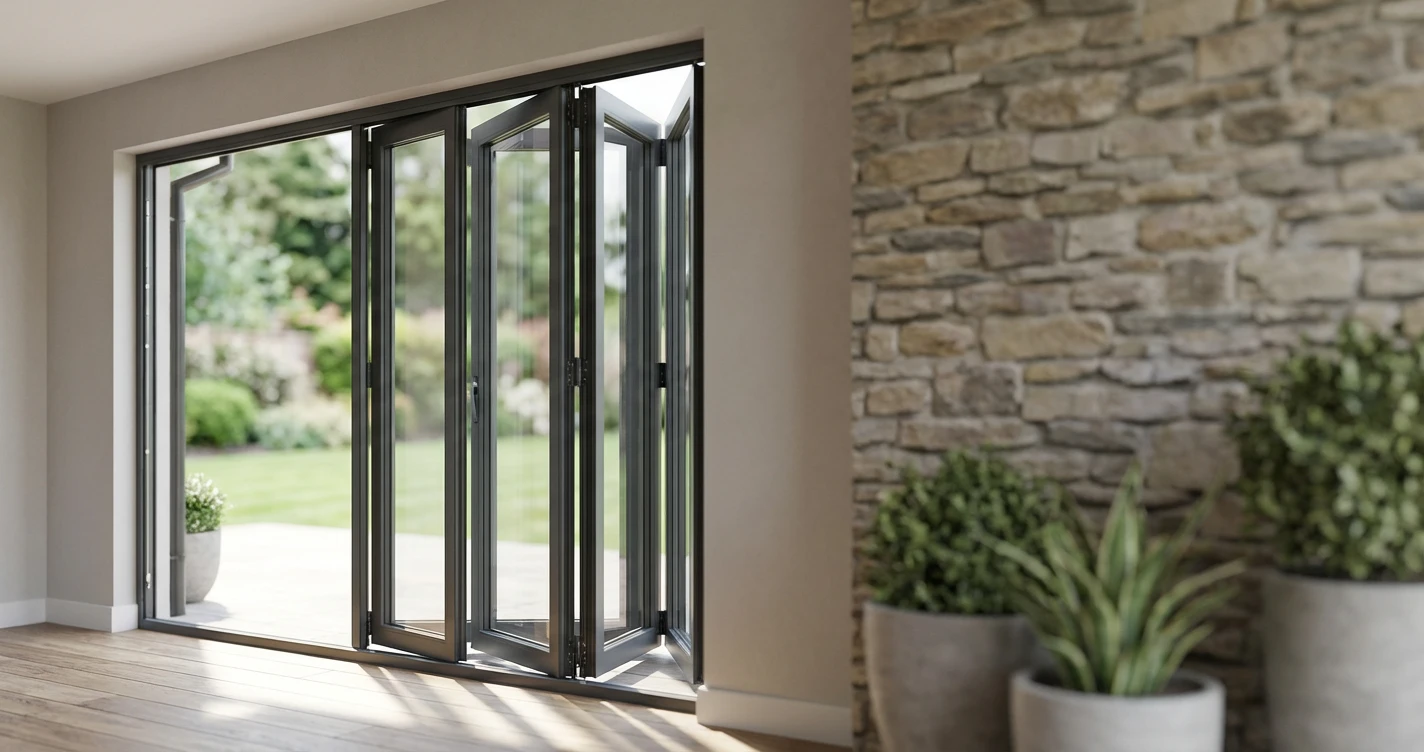
Aluminium folding doors are made up of panels that fold and stack to open a wide gap. They are used in homes and businesses all over the world. They are not just good-looking. They are a smart, practical choice.
We make and supply aluminium folding doors to homeowners, builders, and architects in the UK, Australia, and the USA. We have been doing this for over 15 years. In that time, we have learned which door setups work best and what buyers worry about most.
This guide explains how aluminium folding doors work, how they compare to other doors, what they cost, and what to check before you buy.
What Are Aluminium Folding Doors?
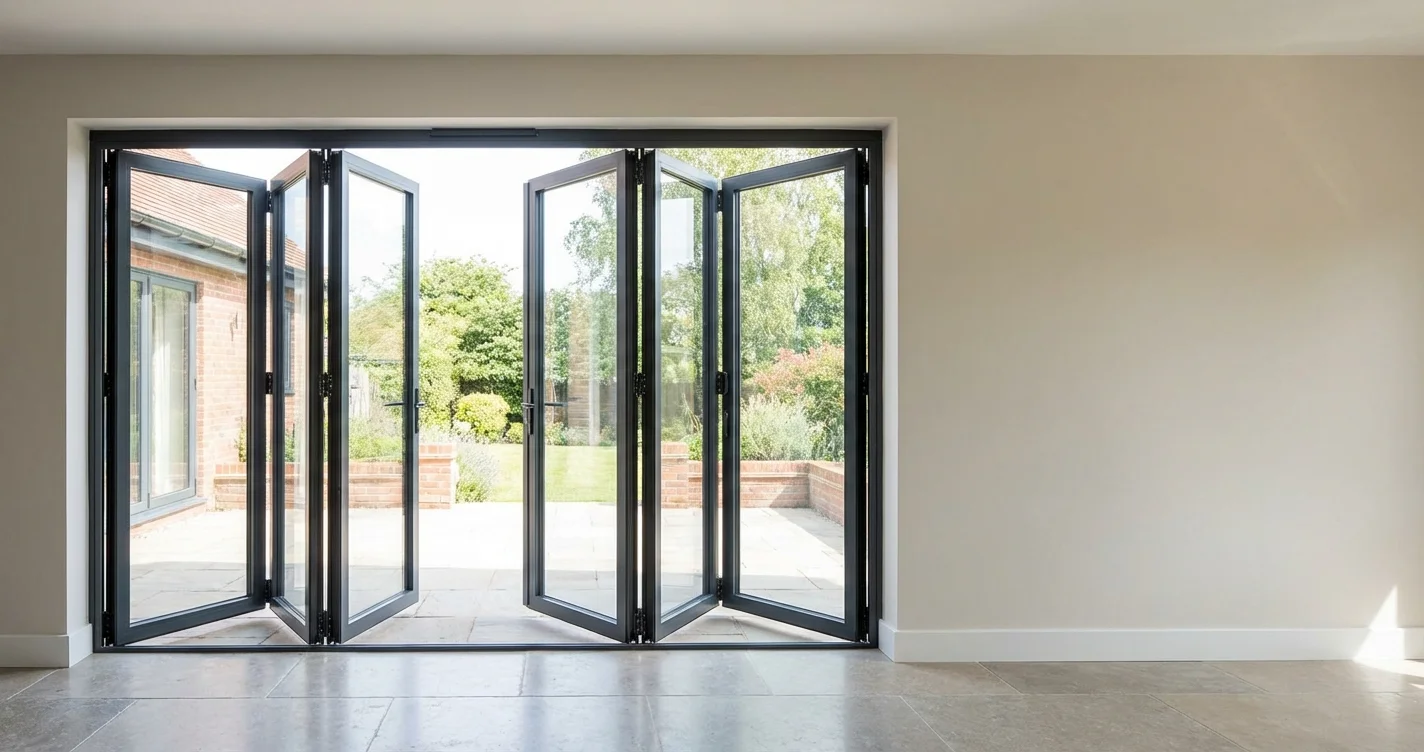
Aluminium folding doors have several panels joined by hinges. The panels hang from a track at the top. When you open the doors, the panels fold like a concertina and stack at one or both sides of the opening. The aluminium frame holds the glass in each panel.
From our experience making and supplying these doors, a well-made aluminium folding door can open up to 90% of the wall space. A normal sliding or hinged patio door only opens about 50%. That extra space makes a big difference when you want to connect your home to the garden or outdoor area.
How Do Aluminium Folding Doors Work?
Each panel hangs from a top track using small wheels called rollers. A guide rail at the bottom keeps the panels in line when they move. When you open the doors, the panels fold at the hinges between them and stack neatly at one or both ends.
Most systems have one panel called a traffic door. This panel opens on its own, like a normal door. You can use it every day without moving the whole system.
Main parts of an aluminium folding door system:
- Overhead track – carries the weight of panels via top-hung rollers
- Bottom guide rail – keeps panels aligned during operation
- Inter-panel hinges – pivot points connecting each panel in the concertina sequence
- Traffic door panel – single panel that opens independently for everyday access
- Threshold seal – weatherproofing at the base; low-threshold options are available for level access
What Makes a Good Aluminium Folding Door? Key Performance Factors
Not all aluminium folding doors are made the same. A good manufacturer knows the rules for each country. In the UK, doors must have a U-value of 1.6 W/m²K or lower. In Australia, the limit is 2.0 W/m²K, depending on the area. In the USA, Energy Star rules set limits between 1.3 and 1.7 W/m²K.² A shop that just sells doors may not know these rules. We build every door to meet them.
Thermal Performance and the Thermal Break
A thermal break is a plastic barrier inside the aluminium frame. It sits between the inside and outside parts of the frame. It stops heat from passing through the metal. This helps keep your home warm in winter and cool in summer.
Some people think aluminium gets too cold and will make their home draughty. This is not true if the door is made well. The frame design matters more than the material. From our production experience, doors with a thermal break and special Low-E glass can reach U-values of 1.4 to 1.6 W/m²K. That meets UK Part L rules and is as good as a well-made uPVC door. Read more in our guide on thermal break technology and low maintenance in aluminium folding doors.
U-Value Performance Bands
| Performance Band | U-Value (W/m2K) | Regulatory Threshold | Climate / Market |
| Basic | 2.5 to 3.0 | Below code | Mild regions, unregulated |
| Improved | 1.8 to 2.2 | AU 2.0 W/m2K (zone-dependent) | Australia |
| High-performance | 1.4 to 1.6 | UK Part L 1.6 W/m2K | UK residential |
| Premium | 1.0 to 1.3 | US Energy Star 1.3 to 1.7 W/m2K | US cold climate zones |
Performance band data based on Oridow product documentation. Regulatory thresholds: UK Building Regulations Part L; NCC (Australia); US Energy Star.
Weather Resistance
There are three things that show how well a door handles bad weather. First, water tightness above 700Pa means rain cannot get in under pressure. Second, air tightness below 1.5 m³/m²h means no draughts come through. Third, wind resistance above 3,500Pa means the door stays strong in heavy wind. These are real test results, not just claims. The glass in our doors is also AS/NZS certified, which means it meets safety and strength standards.
Security
Wide folding doors use multi-point locks. These locks clip into the frame at several spots at once. This is much stronger than a single lock on one side. Good systems also have tracks that stop the panels from being lifted out, and toughened or laminated glass.
Some people worry that lots of glass makes folding doors easier to break into. This is not the case. What matters most is the quality of the locks and how strong the frame is. See our guide on multi-point locking in aluminium folding doors to learn more.
Aluminium Folding Door Configurations: Panel Counts, Opening Directions, and Use Cases
Panel Configuration Reference
| Configuration | Panel Count | Typical Span | Opening Direction | Best For |
| 2-panel | 2 | 1.2 to 2.0m | One-direction fold | Narrow secondary openings, utility access |
| 3-panel | 3 | 2.0 to 3.0m | One-direction fold | Compact residential patios |
| 4-panel (most common) | 4 | 3.0 to 4.8m | One-dir. or bi-part (2+2) | Standard residential rear extensions, kitchen-diners |
| 5-panel | 5 | 4.5 to 6.0m | Bi-parting (3+2) | Wider residential openings |
| 6-panel | 6 | 5.5 to 7.5m | Bi-parting (3+3) | Large residential or light commercial |
| 7 to 8 panel | 7 to 8 | Up to 10m+ | Bi-parting | Commercial, hospitality, open-plan frontages |
Minimum recommended panel width: 900 to 1000mm per panel for smooth operation. Maximum panel weight capacity: up to 180kg (Oridow spec).
Based on our supply data from home projects in the UK and Australia, 4-panel doors are the most popular choice for standard rear extensions. If you need something bigger, see our guide on aluminium folding doors in commercial settings.
Opening Direction: Inward vs. Outward Fold
The direction your doors fold depends on your space. Here are four things to think about:
- Internal floor space available – inward-folding panels require clearance inside the room
- External patio or deck projection – outward fold requires unobstructed exterior space
- Prevailing weather direction – outward-folding panels in exposed sites may catch wind when open
- Accessibility threshold requirements – low or flush threshold options vary by fold direction and frame design
Finish and Colour Options
Choosing a finish is more than just picking a colour. Our powder coat paint does not fade or need repainting. It stays looking good for 20 to 30 years under normal conditions. You can choose from hundreds of RAL colours, a metal-look anodised finish, or a wood-effect finish. We supply a wide range of aluminium door types to buyers in the UK, Australia, and the USA.
To see how the right finish can change the look of a room, read our post on how aluminium folding doors maximise natural light and indoor-outdoor living.
Choosing Aluminium Folding Doors: What to Look For in a Quality System
Now that you know how these doors work, the next step is knowing how to pick a good one. Not all doors are built to the same standard.
From our experience supplying doors across the UK, Australia, and the USA, the problems we see most often with cheap systems are: the top track bends under the weight of the panels; the seal at the bottom wears out after 3 to 5 years; and the hinges and rollers are not strong enough for the panel size. Use the checklist below to avoid these issues.
What to check when buying aluminium folding doors:
- Panel weight capacity rating – confirm hardware and track are rated to match (our systems support up to 180kg per panel)
- Thermal break specification – confirm a polyamide barrier is present and rated for the climate zone
- Water and air tightness ratings – benchmark: above 700Pa water tightness, below 1.5 m³/m²h air tightness
- Glazing unit specification – look for Low-E coating, argon fill, and toughened or AS/NZS-certified glass
- Multi-point locking at each panel junction – not only at the master traffic door
- Warranty coverage split by component: frame vs. hardware vs. glass unit (Oridow: 20-year frame, 10-year hardware, 2-year glass)
- Lead time and custom sizing capability – confirm the system can be made to your opening dimensions; standard orders ship in 30 to 40 days
A supplier that gives a separate warranty for the frame, the hardware, and the glass is showing you they trust every part of the door. A single broad figure tells you much less.
To see these points applied to a real product range, browse Oridow’s aluminium folding doors range for sizes, options, and specs.
| Ready to Get a Quote?
Tell us your door size, number of panels, and finish. We will send you a detailed quote within 24 hours. |
FAQ: Aluminium Folding Doors
What is the difference between folding and bi-folding doors?
Folding doors and bi-folding doors are the same thing. Both names are used in the UK market. Bi-fold just describes the way the panels fold in a zigzag pattern. Some makers use the two words to mean slightly different sizes, but there is no standard rule about this. See how aluminium folding doors compare to sliding alternatives for a side-by-side look.
Are aluminium folding doors energy efficient?
Yes, when the door has a thermal break and good glass. From our production experience, doors with a thermal break and Low-E argon glass reach U-values of 1.4 to 1.6 W/m²K. This meets the UK Part L limit of 1.6 W/m²K.¹ It is also as good as a well-made uPVC door. The three things that matter most are the thermal break, the glass type, and the seal at the bottom of the door. See the table above for full detail.
Read more about thermal break technology and low maintenance in aluminium folding doors.
How much do aluminium folding doors cost?
The price depends on how many panels you need, the size of the opening, the glass type, the finish, and the type of bottom seal. We cannot give you a firm price without knowing your measurements and what you need. The best way to find out is to get a quote for your aluminium folding doors based on your project.
How long do aluminium folding doors last?
Our aluminium folding door systems are built to last 30 to 40 years or more under normal home conditions. Aluminium does not rot or bend out of shape. It also holds up well against rust in most settings. If you live near the sea or in a salty environment, ask us about extra protective coatings. Our powder coat paint does not need repainting. The parts that need the most attention over time are the hinges, rollers, locks, and glass seals. These wear out faster than the frame, which is why they have shorter warranties. Our 20-year frame warranty shows the standard we build to.
Do aluminium folding doors add value to a property?
Estate agents often list aluminium folding doors as a plus when selling homes with garden access, especially in kitchen and dining room extensions. Buyers like the extra light, the connection to the outdoor space, and the clean look of aluminium. How much value they add varies by area and cannot be given as a fixed number. Read our post on how aluminium folding doors maximise natural light and indoor-outdoor living for more on this.
References
- US Environmental Protection Agency. ENERGY STAR Residential Windows, Doors & Skylights. energystar.gov/products/res_windows_doors_skylights


